Sunday, 22 January 2017

The Longest Road (2016): A Journey To Help Yazidi Refugees

The Longest Road

In a world completely desensitised to images of violence and suffering, I suddenly realise that despite knowing about it, I haven’t seen much of what is actually going on in ISIS controlled territories. I’m watching The Longest Road, a documentary by Matthew Charles Hall and Jennifer Salcido, and a painter is showing his artwork to the camera. He has created incredibly detailed scenes of unimaginable horror and violence and somehow, perhaps because it has come from his memory and not a camera lens, it is all the more horrifying with the removal of that artificial barrier.

The Longest Road details the project that Matthew Charles Hall and Jennifer Salcido embarked on with a group of American veterans living on the other side of the world. Iraq War veteran Richard Campos had served in Iraq, trusting that he was working for the greater good without actually being able to see the fruits of his work. Now retired, he has committed himself to returning to Iraq and actually making a visible difference.

Gold Star father Kevin Graves joined him on his mission. Head of Some Gave All: The Joey Graves Foundation, he lost his son on a mission just outside of Baghdad. Desperate to see the land where his son paid the ultimate sacrifice, Kevin agreed to join Richard on his project.

What started as a basic mission to fund a hospital in Iraq turned into so much more when the team travelled to the frontlines and were able to witness the atrocities committed by ISIS. There they meet a Catholic nun and Dr Nemam Ghafouri, a Muslim heart surgeon, as well as scores of Kurdish and Yazidi refugees.

DSC_9486

Filmed over a period of three years, on two continents and in four languages, The Longest Road documents encounters and conversations with individuals who have stared evil in the face and the efforts of the team to make the smallest difference in their lives. We witness the transformation that the team went through and the manner in which their project grew into a major humanitarian effort.

The Longest Road is incredibly powerful. For so long, politicians have hijacked the refugee crisis for their own means and the continuing atrocities in Syria and ISIS-controlled territories somewhat distract us from the fact that human beings, men, women and children, are suffering under appalling conditions in Kurdistan, Iraq and Syria. This documentary breaks through the disaster-fatigue to remind us that why we need to continue fighting. It couldn’t have come at a better time.

SJR_9835 (2)


The Longest Road posterScreening

The Longest Road will have its UK and Europe premiere at the Dalston Rio in London on Saturday 18th February at noon. There will also be a Q&A afterwards with the directors and Dr Nemam Ghafouri, a medic who helped the American veterans in their mission to aid the two million refugees trapped in camps in Kurdistan and who is featured heavily in the film.

Facebook eventEventbriteWebsite


Trailer

SHARE:

Sunday, 1 January 2017

Book Review: Islam and Democracy After the Arab Spring by John Esposito, Tamara Sonn & John Voll

Islam and Democracy - John Esposito

In the aftermath of the Arab Spring and the descent into war in Syria, one question that arises time and again is this: is Islam compatible with democracy? It is a question that John Esposito, Tamara Sonn and John Voll promise to answer in their book Islam and Democracy After the Arab Spring

It is difficult to review a book and to rate it when it clearly doesn't do what it promises to do on the cover and while this book has a lot to do with Islam and democracy, it has little to do with the Arab Spring (with the exception of the final two chapters). One of the questions that most interests me is the events leading up to the Arab Spring, some of which I attempted to explore in the series Before the Spring

Events such as the Iraq war and the Second Intifada were pivotal in the development of a shared Arab consciousness that transcended national borders as was the rise of Al Jazeera and social media. 

In focusing on countries such as Pakistan, Turkey, Iran and Senegal, I was hoping that Islam and Democracy After the Arab Spring would continue in a similar vein - picking up those similarities and exploring whether those countries were also ripe for a Spring-like uprising. Or at least exploring similar factors in the various countries that so emboldened the Arab Spring protestors to take action and topple governments. 

Islam and Democracy After the Arab SpringIt doesn't quite manage that but what this book does do is take an in-depth look at the rise of Islamic governments in seven countries and how issues such as equality, democratic participation and the economy were shaped by world events and the relationship of each country to outside forces. 

The book includes a fascinating profile of Iran and the lasting impacts of US interference, such as in the 1953 coup. Likewise, the chapter on Turkey provides an insight into current political events and gives some background to Erdogan's political motives. 

As a series of essays on the rise of Islamic governments, it would have been more accurate had the book been titled A Political History of Islam in the 20th Century. Judging it on that basis, it's quite interesting and the difference in writing styles between the various authors keeps it so. 

As a resource further exploring the roots and enduring consequences of the Arab Spring, there are better volumes, such as Lin Noueihed and Alex Warren's The Battle for the Arab Spring.

SHARE:

Sunday, 18 December 2016

Book Review: Voices from Chernobyl by Svetlana Alexievitch

Voices from Chernobyl by Svetlana Alexievitch

I was 12 years old when the Chernobyl disaster happened and I remember being quite aware of the dangers of nuclear events - I'd learned about Hiroshima and Nagasaki and the enduring impact of the atomic bomb. Chernobyl was something else. It was a catastrophic and unprecedented disaster; we didn’t immediately know what the lasting effect would be but we knew that they were in trouble.

It was little surprise then when the years passed and we learned that Pripyat and surrounding areas had become ghost towns, areas that would be unfit for human habitation for another 10,000 years (or so estimates go).

But people do live there. They cut through fences and snuck past military patrols to resettle in their homes or to make new homes, surrounded only by the ghosts of the tens of thousands of people that once lived in those towns and the ever-present spectre of radiation.

Svetlana Alexievitch, Belarusian investigative journalist and winner of the Nobel Prize in Literature in 2015, spoke to those people and indeed, to people from all walks of life who were effected by Chernobyl. She spoke to widows and survivors, liquidators, contractors and military reservists who were called to Chernobyl in the days after the disaster. She spoke to families who had been evacuated from Pripyat and surrounding areas, to those who returned and to those who fled the war in Tajikistan to settle there because they had nowhere else to go.

Voices from Chernobyl: The Oral History of a Nuclear Disaster reads like a dystopian novel, or perhaps a post-apocalyptic survival story. First published in Russian in 1997 and expertly translated by Keith Gessen, Voices from Chernobyl is the fruit of hundreds of interviews that Alexievitch obtained over a three year period. It is an incredible and page-turning volume with accounts as fascinating as they are obscene.

It’s difficult to put into words how much of an impact this book has on the reader and any attempt will be nowhere near as eloquent as the accounts themselves. The lack of understanding of the dangers that people faced, coupled with a massive campaign of disinformation is perhaps most notable. In the aftermath of Chernobyl, they sent cranes from East Germany and robots intended for the Russian Mars exploration. Even robots from Japan made it to the site but the radiation interfered with all their workings and so they resorted to sending human beings in rubber suits instead.

There were 340,000 personnel despatched to Chernobyl but those working on the roof of the reactor got it the worst. They were wearing lead vests but the radiation came through their boots.

Voices from Chernobyl - Svetlana AlexievitchDespite the massive loss of life and how many disaster personnel succumbed to radiation poisoning or ‘Chernobyl cancer’ that took years to emerge and yet more years to eventually kill them, many of the interviewees displayed a nostalgia for the Soviet era and for the heroism of a bygone era. Time after time, interviewees would explain that they did not know the danger but they would have responded in the same way even if they had. It was their duty and they would have fulfilled it.

And then, throughout the book is the ever-present reminder that the Chernobyl disaster happened to a population less than 50 years after the Second World War.

Gulag, Auschwitz, Chernobyl. One generation saw it all.

What impressed me the most is that many of these people survived the Leningrad blockade only to suffer devastation again in Chernobyl. They spoke of the terrible winters during the blockade where people froze to death on the streets and one man mentioned, perhaps in jest, burning his belt so that the smell could stay his hunger.

Voices of Chernobyl is a study in the various shades of trauma. Some interviewees expressed that they couldn’t talk about the blockade, it was too traumatic, but Chernobyl they could talk about. Despite the catastrophic loss of life and livelihood, the events of Chernobyl still felt less traumatic to many of them than the blockade.

I cannot recommend Voices from Chernobyl enough and was so impressed that I have ordered Alexievitch’s latest book Secondhand Time: The Last of the Soviets which was shortlisted for the 2016 Bailie Gifford prize for non-fiction.

SHARE:

Sunday, 11 December 2016

Book Review: The Chibok Girls by Helon Habila

Helon Habila author of Chibok Girls

On the evening of 14-15 April 2014, Boko Haram militants kidnapped 276 female students from the Government Secondary School in Chibok, Borno State, Nigeria. The girls became known the world over as the 'Chibok Girls' yet surprisingly little is known about who they are, what their families are going through or the context in which this crime occurred. To date, in December 2016, almost 200 of the original abductees remains missing and the little that we do know is that their lives with Boko Haram are ones of untold horror, violence and sexual slavery.

Helon Habila is a Nigerian born author and professor of creative writing at George Mason University, Washington, D.C. In early 2016, he returned to Nigeria to take a road trip to Maiduguri and Chibok to speak to people not only about the events on that fateful evening in 2014, but about the long wait for the girls to return home and the present climate of war and strife in the region.

The Chibok Girls by Helon Habila - coverHabila has produced a chronicle of his time in Nigeria in the short but incredibly insightful The Chibok Girls: The Boko Haram Kidnappings and Islamist Militancy in Nigeria.

The book begins with accounts of the events of 14 April 2014 from parents and relatives of the girls who were taken and those that escaped. The residents of Chibok had received warnings that the town would be targeted that day and they had every reason to believe it. Massacres, assassinations and terrorist attacks have become ever more prevalent in what locals have begun to call the war with Boko Haram.

Just 9 months before the abduction of the girls from Chibok, Boko Haram militants entered a secondary school in Mamudo, Yobe State and killed 42 people, most of them students.

After spending time in Chibok, Habila moves on to Maiduguri and the heart of Boko Haram territory. He speaks of the effects of the civil war and how a divide was created between Christians and Muslims as successive governments misused state resources, culminating in the declaration of Sharia law in the area in 1999. Perhaps most chilling is the description of the rise of Boko Haram from a modest force to one to be reckoned with following the Boko Haram uprising in June / July 2009.

Moving back to Chibok, Habila collects yet more first-hand accounts of the fears and devastation of a community who have lost their daughters, sisters and friends.

Woven throughout the book is the story of the girls and the accounts of those who have escaped. Perhaps to be expected with the youth of the girls and the horrors that they experienced, there is very little in the book about their time with Boko Haram. Indeed, with so few escapees (and being that the book was in production at the time 21 girls were released in October 2016), we are but depending on the narratives of a handful of very traumatised girls.

Confronted with their reticence in the face on ongoing questions about their experiences, Habila notes the following:

Hauwa, Ladi, and Juliana were ordinary girls, young enough to be my daughter, who had been raised to almost mythic status by their extraordinary experience – Helon Habila, The Chibok Girls

Insightful, powerful and intimate, The Chibok Girls: The Boko Haram Kidnappings and Islamist Militancy in Nigeria is highly recommended for those interested in gaining a more in-depth perspective of the lives and people effected by Boko Haram activities.

The book is out in the States and will be released in the UK on 15 December 2016.

SHARE:

Tuesday, 29 December 2015

Review: My War Gone By, I Miss It So by Anthony Loyd (2015 edition)

Sarajevo


During the war in Bosnia and Herzegovina in the 1990s, most press correspondents huddled in the safety of the distinctive yellow Holiday Inn in Sarajevo, sending out second-hand dispatches to news outlets back home. Anthony Loyd was never going to do that. In his memoir My War Gone By, I Miss It So Loyd travelled across Bosnia and Herzegovnia during the war of 1992-1995 and spent time in Grozny at the height of the First Chechen War. Now, to mark the 20th anniversary of the signing of the Dayton Agreement, a new edition of Loyd’s memoir has been released with an updated foreword.

The prologue of My War Gone By, I Miss It So begins at the end of the Bosnian war, in the hills near Srebrenica. Withdrawing from drugs and newly clean, Loyd stumbles through a landscape peppered with corpses, witness to the aftermath of the Srebrenica genocide. It is an interesting place to begin, at the very end of the war, but by the end of the memoir we will see that this was not the most disturbing thing that Loyd saw in his time there. Moreover, by the end of the war, we will see that Loyd has come full circle in his life.

Armed with just a camera and pen, Loyd travelled over to Bosnia during the war after a stint in the military. Landing first in Sarajevo, he befriended a local family and spent his days dodging sniper bullets and trying to overcome the relentless boredom of war. Eager to see the frontlines, Loyd later travelled to various towns and villages in central and northern Bosnia where he met up with other members of the press corps and began to eke out a living as a war correspondent.

Loyd’s writing is brutally honest and in many passages he describes scenes and photographs that many of us would look away from or avoid. That is not to say that I don’t want to know, I really do, but at times his descriptions were so intimate and graphic that I felt somehow wrong reading the passages, as if I had somehow violated someone’s privacy. Such is the power of Loyd’s writing.

At many times in the memoir, Loyd mentions his eagerness to support the Bosniak cause on a moral level, to view them as the underdogs, but even this explicit bias is tested from time to time by the atrocities he sees. The saying goes that all is fair in love and war but that is utter rubbish, and what Loyd witnesses proves that all is twisted and futile in war instead.

It was the scenes in Grozny that were perhaps the most shocking. I’ve read a fair amount about the wars in the former Yugoslavia and felt somehow familiar with the subject matter when Loyd described his time in Bosnia and Herzegovnia. The chapter on the conflict on the ground in Grozny was disturbing to say the least. Loyd travels to the Chechen capital days before the fall of Grozny in February 1995 and what he witnesses is the utter meaningless and futility of war. It is especially moving in light of the way that history ultimately played out for the Chechens.

Again, my view of events in Bosnia might be influenced by all that I have read about the war and history of the region in the past but the only aspect of Loyd’s memoir that concerned me was his tendency to takes sides in the conflict. It is true that history and the subsequent trials have pretty much confirmed what he wrote almost 20 years ago but throughout the memoir I couldn’t shake the feeling that it would have been preferable if he had maintained a slightly more objective position.

In the foreword to the new edition, Loyd remarks how young and angry he was at the time of writing. It is interesting because while I might fault his objectivity, I never would have faulted his perspective which was infinitely more nuanced than anything I would have written back in the mid-90s when I was roughly the same age as him.

Nevertheless, I was riveted by the book from cover to cover and would highly recommend it to those interested in accounts of war or in the conflict in Bosnia and Herzegovina in particular. Like the timeless photographs to which Loyd refers in his memoir, his book provides a unique glimpse into one of the most disturbing conflicts of the 20th century.

SHARE:

Tuesday, 7 July 2015

Living the Lessons of Srebrenica (Event at Wiener Library)

Tonight we attended the "Living the Lessons of Srebrenica" event at the Wiener Library for the Study of the Holocaust & Genocide in London. It was one of hundreds of events taking place across the UK this week to commemorate the Srebrenica genocide in July 1995. 

Munira Subasic

We first heard from Munira Subasic, president of Mothers of Srebrenica. Ms Subasic spoke through a translator but I'd like to record some of what she said. 

On the continuing struggle to locate, identify and bury the remains of the victims of the Srebrenica genocide: 

If a human being doesn't have a place to show where they lived, it doesn't show that they existed. 

Ms Subasic talked about reaching out to other mothers' organisations but those who did it won't admit it, won't admit there was a genocide. Without admission, there can be no reconciliation. 

"Many women who were abused are not able to have their own children or have relationships with men. A whole generation is disappearing". 

Ms Subasic mentioned that the people who committed the crimes are still there, still abusing them. 

"People say things are moving forward but Mothers of Srebrenica wish they had two lives: one for waiting and one for enjoying our lives". 

When asked whether it would help if lower level perpetrators admitted their guilt, Ms Subasic explained that after the Holocaust, it was accepted that it happened. With Srebrenica, they are dealing with such total denial that no one is admitting it happened. 

"They found only two bones of my son. It is very difficult to move on not knowing how he died. They dragged him from my arms". 

"Those who committed genocide think they are national heroes. I am very happy with who I am today. I'd rather be a victim than a war criminal".  

The next speaker was Dr Gill Wigglesworth who spoke about the lessons from the International Criminal Tribunal for the former Yugoslavia. She gave a fascinating overview of the legal situation and the different levels of proof required by the ICTY and ICJ when hearing genocide cases. 

Dr Wigglesworth mentioned a different level of justice, restorative justice if you will, whereby Serbia or Croatia issues an apology for the crimes. Serbia has done so but that was only because they want EU membership whereas Republika Srpska have no such impetus and therefore there is very little chance of an acknowledgement or apology. 

Alex Buskie

Alex Buskie of the United Nations Association UK spoke next on the responsibility to protect.

She examined how the United Nations learned from their mistakes in the 90s and 00s and how the Responsibility to Protect doctrine came to be adopted in 2005. 

She mentioned that failures in the past stemmed from inattention, indifference and misjudgment or a perceived contradiction between the desire to protect a population vs the desire to protect a group of individuals. One concept that Ms Buskie reiterated several times was that the UN is a meeting of nation states, that they have no specific power as an organisation and they can only go so far as their members allow them. 

Ms Buskie then took us through the three pillars of responsibility to protect and what we are protecting against (ethnic cleaning, genocide, war crimes and crimes against humanity)

Finally, Ms Buskie admitted that the UN is struggling and that the R2P has only recently been adopted. Having watched the UN reaction to Syria and the continued yet fruitless motions, I found this especially frustrating. Ms Buskie dis highlight how the security council should have briefings earlier on in future and how the organisation needs to adopt a company-wide commitment to upholding human rights but they have a long way to go. 

Finally, Jasvir Singh of City Sikhs UK spoke about his own visit to Sarajevo and Srebrenica and how moving the experience was for him. 

He spoke of the parallels to be drawn with the Sikh genocide and how friends and neighbours turned on each other. Mr Singh had an important message about how easily a situation can deteriorate and he hinted that such a situation is not impossible even in the UK. He highlighted the role of interfaith organisations in establishing commonality and ensuring that communities can maintain their faith while living in peace with those of other faiths. 

The event was then wound up with a very interesting discussion. I was most impressed with how we tackled some controversial topics with respect and consideration.

This event was organised by Remembering Srebrenica, City Sikhs and the Wiener Library. We received a copy of the excellent “Remembering Srebrenica” publication which I was very pleased about.


Remembering Srebrenica

SHARE:

Saturday, 13 August 2011

Rwandan Genocide: The Hutu Ten Commandments

Tutsi Identity Card
Tutsi Identity Card [Source: Prevent Genocide International]

The Rwandan genocide began on 6 April 1994 when the plane carrying President Juvénal Habyarimana was shot down from the sky, killing all on board.  Over the course of the next 100 days, 800,000 Tutsis and moderate Hutus were murdered.  While the assassination of President Habyarimana was certainly a catalyst, it did not cause the genocide.

Owing to their systematic and intentional nature, genocides, by definition, are rarely caused by underlying factors, as such.  Rather, underlying factors are manipulated and exploited in the planning and preparation that goes into the act of genocide. (See: What is Genocide?).

In Rwanda, evidence shows that militia had been trained, machetes flown into the country and weapons had been stockpiled for several months before the genocide started.  Much has been made of the role of the media in inciting genocide in Rwanda, with singers, radio presenters and journalists all calling for the extermination of the Tutsi cockroaches. 

“The Hutu Ten Commandments” was a document that was published in the pro-Hutu, anti-Tutsi newspaper Kangura in December 1990, almost four years before the commencement of the genocide in Rwanda.  The document was published in Kinyarwandan, the official language of Rwanda, and has also been translated as “The Ten Commandments of the Bahutu”. 

Incitement to commit genocide is a crime punishable under article 3c of the Genocide Convention.  There were numerous convictions of genocide that related to media, propaganda and incitement to commit genocide.  The Hutu Ten Commandments were attributed to the editor of Kangura, Hassan Ngeze,  and in 2003, he was convicted of genocide and crimes against humanity by the ICTR.


The Hutu Ten Commandments

1. Every Hutu should know that a Tutsi woman, whoever she is, works for the interest of her Tutsi ethnic group. As a result, we shall consider a traitor any Hutu who

  • marries a Tutsi woman
  • befriends a Tutsi woman
  • employs a Tutsi woman as a secretary or a concubine.

2. Every Hutu should know that our Hutu daughters are more suitable and conscientious in their role as woman, wife and mother of the family. Are they not beautiful, good secretaries and more honest?

3. Hutu women, be vigilant and try to bring your husbands, brothers and sons back to reason.

4. Every Hutu should know that every Tutsi is dishonest in business. His only aim is the supremacy of his ethnic group. As a result, any Hutu who does the following is a traitor:

  • makes a partnership with Tutsi in business
  • invests his money or the government's money in a Tutsi enterprise
  • lends or borrows money from a Tutsi
  • gives favours to Tutsi in business (obtaining import licenses, bank loans, construction sites, public markets, etc.).

5. All strategic positions, political, administrative, economic, military and security should be entrusted only to Hutu.

6. The education sector (school pupils, students, teachers) must be majority Hutu.

7. The Rwandan Armed Forces should be exclusively Hutu. The experience of the October 1990 war has taught us a lesson. No member of the military shall marry a Tutsi.

8. The Hutu should stop having mercy on the Tutsi.

9. The Hutu, wherever they are, must have unity and solidarity and be concerned with the fate of their Hutu brothers.

  • The Hutu inside and outside Rwanda must constantly look for friends and allies for the Hutu cause, starting with their Hutu brothers.
  • They must constantly counteract Tutsi propaganda.
  • The Hutu must be firm and vigilant against their common Tutsi enemy.
10. The Social Revolution of 1959, the Referendum of 1961, and the Hutu Ideology, must be taught to every Hutu at every level. Every Hutu must spread this ideology widely. Any Hutu who persecutes his brother Hutu for having read, spread, and taught this ideology is a traitor.

Source: Wikipedia (reproduced under Creative Commons)

SHARE:

Sunday, 20 February 2011

Genocides from 1915 to 2006

Auschwitz I Camp - Arbeit Macht Frei - Detail of Main Gate - Oswiecim, Poland

With the possible exception of the Holocaust, the definition and application of the term ‘genocide’ has been fraught with controversy.  In fact, since the term was legally codified by the United Nations in 1948 as they approved the Convention on the Prevention and Punishment of the Crime of Genocide, only two cases have been determined to have constituted genocide.  These are the Rwandan genocide and the Srebrenica genocide in Bosnia in 1995.

Human Rights and Wrongs-Slavery, Terror, GenocideIn her book Human Rights and Wrongs: Slavery, Terror, Genocide, researcher Helen Fein has drawn on a range of historical documents to estimate the actual numbers of people killed in genocide in the last century.  As you can see from the table below, more people have died in genocides than are accounted for by the two existing cases confirmed by the international courts and tribunals.


Table of Genocides from 1915 - 2006
Table source: Centre on Law and Globalization

The defining factor in determining genocide is whether the offending party had the intention to destroy a group of people in whole or in part on the basis that they were simply part of that group. 

Cambodia

That is why, for example, despite the number of deaths in Cambodia, the ECCC have been unable to establish genocide as they cannot prove that there was an intention to destroy any specific group.  Where there were instances of the slaughter of ethnic Vietnamese and Cham Muslim minorities, charges of genocide were brought against Nuon Chea, Ieng Sary and Khieu Samphan and former first lady Ieng Thirith.

Rwanda and Democratic Republic of the Congo

You will note that the table above includes the Rwandan genocide which is considered to have taken place over one hundred days between April and July 1994.  It does not include the decade of systematic rape that is documented to have taken place in the Democratic Republic of the Congo between 1994 and 2003 (and in fact, still continues to this day).  The situation in the Congo is directly linked to the Rwandan situation but is considered separately.

Herero and Namaqua Genocide and the Gukurahundi

Bizarrely enough, the table leaves off the Gukurahundi which was the deliberate and systematic attempt by Robert Mugabe and his government to destroy the Ndebele people of Zimbabwe in the early 1980s.

Also not included (as the period it analyses begins in 1915) is the first genocide of the 20th Century, the Herero and Namaqua genocide which took place between 1904 and 1907.

Image credit: “Auschwitz I Camp - Arbeit Macht Frei - Detail of Main Gate - Oswiecim, Poland” – Adam Jones (source)

SHARE:

Wednesday, 16 June 2010

This Day in History: 16 June 1976

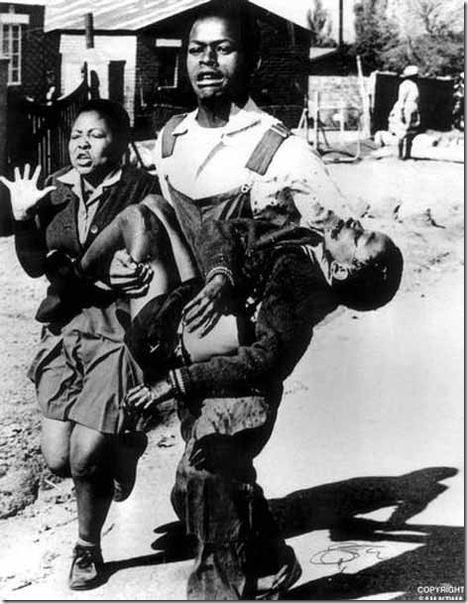
Hector Pieterson and Mbuyisa Makhubo

On 16 June 1976, thousands of black South African students staged a protest and walked from their schools to Orlando Stadium in Soweto.  They were protesting against the Afrikaans Medium Decree of 1974 which forced tuition to be given in a 50/50 split between English and Afrikaans in schools.  Not only was Afrikaans the language of their oppressors, it was also a language that many black South Africans did not understand as they primarily spoke one of the black African languages such as Zulu, Northern or Southern Sotho or Xhosa.  Part of the Apartheid policy was to allocate fewer resources to black schools as well and to make them purchase their own textbooks and exercise books whereas these were freely distributed in white schools.  The effects of teaching in Afrikaans in already disadvantaged and inferior schools was devastating.

On the morning of 16 June 1976, protesting children found that their route to the stadium was blocked by a police barricade.  There are conflicting reports as to how the first shot was fired and whether it was provoked.  Some say that the children began throwing stones, other simply say that the policemen got spooked.  Once that first shot had been fired though, children ran screaming in different directions, terrified and panicked.  More shots were fired and by the end of the day, 23 people were dead (two of them were white people).

Soweto uprising - Hector Pieterson Hector Pieterson is the little boy being carried in the photograph above.  He was one of the first children to be killed that day.  Perhaps even more heartbreaking is that the boy carrying him was 18-year-old Mbuyisa Makhubo.  He was harassed so much by the police that he went into hiding after the event and his mother has not heard from him since 1978.   I imagine he is but one of the thousands of victims that “disappeared” in the Apartheid years.

The resulting violence after the shootings that day became known as The Soweto Uprising or Soweto Riots.  Between 200 and 600 people died in the violence and thousands were injured.  June 16 is commemorated each year as Youth Day and services and events are held across South Africa to honour their youth and to remember all that was lost during the Apartheid struggle.

Images © Sam Nzima

SHARE:

Saturday, 28 November 2009

What Is Genocide?

Srebrenica Srebrenica Mass Grave [photo source]

The primary purpose of this post will be to explore the legal definition of the term “genocide”.  In a later post, I shall discuss problems, limitations and criticisms of the current definition of genocide and try to find out why it is so rarely applied to conflicts around the world.

The term “genocide” did not exist prior to 1944.  The term was coined by a Polish lawyer named Raphael Lemkin as he sought to describe the systematic nature of the Nazi policies and their intention to destroy the European Jews.  He formed the word by combining the Greek word geno- meaning race or tribe and the Latin word –cide meaning killing. 

The term was codified legally by the United Nations in 1948 as they approved the Convention on the Prevention and Punishment of the Crime of Genocide.  The act of genocide was thus criminalised in times of both war and peace.
The convention defines genocide as follows:

“In the present Convention, genocide means any of the following acts committed with intent to destroy, in whole or in part, a national, ethnical, racial or religious group, as such:
  1. Killing members of the group;
  2. Causing serious bodily or mental harm to members of the group;
  3. Deliberately inflicting on the group conditions of life calculated to bring about its physical destruction in whole or in part;
  4. Imposing measures intended to prevent births within the group;
  5. Forcibly transferring children of the group to another group”

- UN General Assembly Resolution 260

Breaches of the Genocide Convention

Did you know that since the creation of the Genocide Convention in 1948, international tribunals have determined only two cases to constitute genocide?

  • Rwandan Genocide: This refers to the genocide that took place in Rwanda in April 1994.  The International Criminal Tribunal for Rwanda (ICTR) is currently prosecuting cases in connection with crimes committed during the genocide.
  • Bosnian Genocide: This refers to the genocide committed in Srebrenica in 1995 by the Serb forces.  There have been attempts to broaden this definition to include crimes of ethnic cleansing committed during the 1992-1995 Bosnian War but this was rejected by the International Court of Justice in February 2007.  The International Criminal Tribunal for the former Yugoslavia (ICTY) is currently prosecuting cases in connection with the Srebrenica genocide.
Contentious Cases

This list may in fact be longer but my research has shown that there are two cases currently being discussed which might constitute genocide:

  • Darfur / Sudan: United States Secretary of State Colin Powell  declared the conflict in Darfur to constitute a genocide in September 2004.  However, the United Nations Security Council-sponsored International Commission of Inquiry on Darfur stated that "the Government of the Sudan has not pursued a policy of genocide.” This was met with dismay but it is important to note that the report further went on to state that despite not meeting the definition of genocide, war crimes and crimes against humanity were nevertheless taking place and were just as serious.  Despite this, the International Criminal Court has filed charges against Sudan's President Omar al-Bashir and three others. I’ll try to find out more about this in the near future.
  • Croatian Genocide Case: The Croatian government waited until the close of the Bosnian Genocide Case before bringing an application to the International Court of Justice to apply the Genocide Convention against the Serbian government.  The Serbian government announced their intention for a counter-suit and in January 2009, the ICJ gave them a deadline of 22 March 2010 to file their Counter-Memorial.

At a later stage I will discuss the problems, limitations and criticisms of the current definition of genocide and an analysis of the reasoning to not classing certain events as genocide (for example, Cambodia).

SHARE:

Monday, 15 September 2008

On Rwanda: my passion and the need to know

Never again Rwanda

In 1994, in 100 days between April and July, genocide was committed in Rwanda. 800,000 people of Tutsi and moderate Hutu origin were slaughtered in an organised and systematic attempt to wipe out the Tutsi race. The world stood by and nothing was done to halt this carnage, even though ample warning was given in the months leading up to the genocide. Four months before the outbreak of the genocide, Lieutenant General Roméo Dallaire of the UN warned of major stockpiling of weapons and the mobilisation of forces to exterminate the Tutsis. His hands were tied by political apathy and UN red tape. The genocide broke out on 6 April 1994 and the world refused to admit that a genocide was occurring. By the time the international media began to focus on Rwanda, they were calling the events ethnic warfare and they were focusing on fleeing Hutu refugees and calling them the victims.

Many times since World War II we have said "never again" and time and time again it happens again. What continues to haunt me is my own ignorance back in 1994. I cannot remember what happened on 6 April 1994, but I remember that on 27 April 1994 I stood for hours and hours to vote in South Africa's first democratic election. I remember casting my vote and then bursting out in tears as I digested the magnitude of the change we were bringing about. I turned 21 in May and I started my first part-time student job around that time. We had our June exams and then holidays in July. We got back to university in August to find that they had changed the Sociology curriculum. There had been a genocide in Rwanda and I had barely noticed.

I'm old enough now and wiser and I can promise that I will never suffer such ignorance again. I will do everything I can to open people's minds up to these atrocities and to put a human face on war and suffering.


I picked up my first book on the Rwandan genocide about a year ago and it has been a whirlwind year of book after book on the subject. I have often remarked how I sometimes feel like I cannot read anymore. The books have made me feel physically ill at times but then I find I am filled with such energy as I read about the amazing people who survived and overcame the cruellest and most evil treatment a person can encounter. The most recent book that I have read was Into The Quick of Life: The Rwandan Genocide - The Survivors Speak. Below are several quotes that I have taken from the book. I would both like to encourage people to read this brilliant and moving book and I'd like to express how it touched me too.

A genocide is not an especially murderous or cruel war. It's a planned extermination. At the end of a war, survivors feel a strong need to bear witness; after a genocide, on the contrary, the survivors strangely long for silence. - Jean Hatzfeld, author

I read that a lot throughout this book. I wonder what it must have been like after World War II. Did the survivors of the concentration camps also cover themselves in a shroud of silence? Maybe that is why the "Never Forget" movement began - maybe people had to make a concerted effort to break the silence, to escape the need to just blank out the events and keep quiet.

The day that the killing began in Nyamata, in the street of the big market, we ran to the parish church. A large crowd had already assembled there, because when massacres begin it is Rwandan custom to take refuge in houses of God - Cassius Niyonsaba age 12

"...because when massacres begin it is Rwandan custom...". This really made me put my own existence into perspective. I live in a world where I have not had to adopt a custom in case of massacres. In South Africa, we lived in a violent society where it was custom to have bars on our windows and six-foot high walls with electric fences and gates. This was normal to us but then behind all of that security we were protecting a superb standard of living. But to have to live to protect yourself against repeated massacres? That is a human rights violation in itself.

But we no longer celebrate birthday, because this pains us too much, and it costs too much money. We never row, not even once by chance, because we cannot find a how or a why. - Jeanette Ayinkamiye age 17

Imagine never arguing. Everyone rows! But I understand that - it is almost like a luxury that you simply cannot afford when you are living at the edge of survival.

[On the killing in the church in Ntarama] Very early on, I felt a blow. I collapsed between some benches, pandemonium all around. When I woke up, I checked to see that I was not dying. - Francine Niyitegeka age 25

Isn't that just the sheer epitome of Life? To be so surprised to be alive that it takes a process of self-examination to prove to yourself that you are, in fact, still alive. I can't explain it but it seems that there is so much more to the experience of life than we can ever conceive.

In the evening, we were four families to group together in my house in Cyugaro. There were no mats or mattresses to roll out on the floor because the interahamwe had stolen them. We would exchange a little conversation, above all about the details of that day, or some words of comfort. We did not argue. We teased no one; we did not mock the women who had been raped, because all the women expected to be raped. We were all fleeing from the same death, we suffered the same fate. - Jean-Baptiste Munyankore age 60

There is little I can say about this, but once again - what a gross human atrocity - "all women expected to be raped".

The killers worked in the swamps from nine to four, half past four, as the sun would have it. Sometimes, if it rained to much, they came later in the morning. They came in columns, announcing their arrival with songs and whistles. They beat drums, they sounded very cheerful to be going killing for an entire day. - Angelique Mukamanzi age 25

This goes to show just how systematic and organised the genocide was. These men worked from nine to four each day. They whistled on their way to work each morning, did their day's work and made sure they were safely home again by sundown. Absolutely chilling.

To listen to them, I deduce that in time people will not remember the genocide in the same way. For example, a neighbouring woman talks of how her maman died in the church; then, two years later, she explains that her maman died in the marsh. For me, there is no lie. The girl had an acceptable reason to wish for her mother's death to have taken place in the church. Perhaps because she abandoned her running full stretch through the marsh and was ashamed. Perhaps because it relieved her of an all too painful sorrow; to persuade herself that her maman in this way suffered less, one fatal blow on the first day. Then time offered the girl a little peace, so she could remember the truth, and she accepted it. - Angelique Mukamanzi age 25

I found this really touching and I can understand this process of the truth coming out. I have my own personal experience of trauma and not being able to remember the details of that trauma for quite some time (I was in a bank robbery in 1998 and could not remember the gun being pointed at me).

In the end, there were only us sprinters left. We had begun as five or six thousand; one month later when the inkotanyi arrived, there were twenty of us alive. That's the arithmetic. If the inkotanyi had lingered on the road one week more, our exact number would be zero. - Innocent Rwililiza age 38

The inkotanyi was the name that was given to the approaching RPF soldiers who defeated the interahamwe (the organised Hutu killers) and eventually took over government of the country. Chilling - I have read time and time again from Tutsis that they honestly believe the Hutus thought there would be no survivors, that they would kill each and every single Tutsi.

I have read that after each genocide historians explain that this will be the last. Because no one could again allow such an infamy. That is an amazing joke. Those responsible for the Rwandan genocide are not poor ignorant farmers, no more than they are ferocious and drunken interhamwe - they are educated people. They are the professors, the politicians and the journalists who expatriated themselves to Europe... Hardly any of them killed with their own hands, but they sent people to the hills to do the job. - Innocent Rwililiza age 38

Just imagine. Your highly educated, sophisticated neighbour decides overnight that you are the enemy and that you and your kin need to be wiped off the face of the Earth. It happened and it can happen again.

Married to a Tutsi woman, he tried to save her as well as several of his friends. Among Hutu villagers, he was the powerless witness to the killings in the church and the marshes. Since then, he has quit farming to dedicate himself entirely to the memory of the victims. Indifferent to the heat, he lives wrapped up in an anorak and nods his head, as he tirelessly repeats: "How was it possible, how was it possible?" You first think that this is a question addressed to the person he's talking to; then you realise it's addressed to himself. - Jean Hatzfeld, author

Some people's lives are so broken, so fractured and there is just nothing that can be done to relieve that. Is there a point at which a person is too old or they have seen too much or they are just too shattered to be healed? This is the face of human tragedy.

... there is no word in Kinyarwandan to describe the crimes of the killers of a genocide, a word whose meaning can outdo the wickedness, the ferocity and the category of actual feelings. - Claudine Kayitesi age 21

...and nor should there have needed to be such a word.

The criminals did not bury their victims, because the great numbers put them off. They preferred to get the job of killing done, without the additional fatigue of wiping away the traces. These people were so sure that they would get rid of all Tutsis that they concluded that no one would ever come and interfere with their business in Rwanda. - Claudine Kayitesi age 21

Genocide is the deliberate and systematic destruction, in whole or in part, of an ethnic, racial, religious, or national group.

Adolescents suffer more than others from not understanding. They cannot admit that the interahamwe wanted to put an end to them without any prior threat or argument. Without a care, adolescents arrived at the doors of life and machete blows stopped them from entering. They have been in the why of it ever since. - Sylvie Umubyeyi age 34

The task of healing children's minds and moving towards reconciliation must have seemed insurmountable at times.

[On international reporting of Huti refugees fleeing the RPF forces] On the television screens, the reporters said: "Those who have not been killed are the people now fleeing on the long roads to the camps," and in the end they completely forgot the survivors of the Tutsi massacres. - Sylvie Umubyeyi age 34

While the international media was focusing on Hutu refugees, Tutsi survivors were still hiding in the marshes and refusing to come out, refusing to believe that it was all finally over. The Hutu refugees were made up of killers escaping prosecution and Hutu families fleeing the country to escape possible reprisals.

Because if you dwell too long in fear of genocide, you lose hope. You lose what you have managed to salvage of life. You run the risk of being contaminated by another madness. When, in calm moments, I think about the genocide I think about it so as to know where to put it in my life, but I can find no place. I simply mean that it is beyond the human. - Sylvie Umubyeyi age 34

Where does one put such trauma and unimaginable evil? Human being were not made to bear such atrocities.


Below is a list of the books I have read so far on this topic. An excellent (although discontinued) blog to read on current life in Rwanda is Morgan in Africa.


Future books on my reading list include:

Image credit: “Never Again - With Display of Skulls of Victims - Courtyard of Genocide Memorial Church - Karongi (Kibuye) - Western Rwanda – 02” by Adam Jones. Licensed through Creative Commons (source)

SHARE:
© A Passion to Understand

This site uses cookies from Google to deliver its services - Click here for information.

Blogger Template Created by pipdig