Sunday, 6 April 2014

This Day in History: 6 April 1994

Skull and Belongings of Genocide Victims - Genocide Memorial Center - Kigali - Rwanda

On this day in history on 6 April 1994, the plane carrying presidents Juvénal Habyarimana of Rwanda and Cyprien Ntaryamira of Burundi was shot down just outside Kigali airport in the Rwandan capital.

It was the catalyst that started the Rwandan genocide and over the next 100 days between April and July 1994, between 800,000 and 1.2 million Rwandans of Tutsi and moderate Hutu origin were murdered.

The assassination of the president might have triggered the genocide but in truth, this was a carefully planned, organised and systematic attempt to wipe out the Tutsi race.

As early as December 1990, 3 years before the start of the genocide, a racist manifesto known as the The Hutu Ten Commandments appeared in the anti-Tutsi newspaper Kangura in which Hutus were reminded of their inherent superiority to Tutsis and their responsibility to maintain racial purity.

Over the years, hostilities escalated as Tutsi were scapegoated, targeted and increasingly dehumanised. It was a disturbingly familiar turn of events that Dr Gregory Stanton of Genocide Watch now refers to as the Ten Stages of Genocide.

In the months leading up to the genocide, it became ever more clear that something was amiss. In what has become notorious as the Genocide Fax, on 11 January 1994 Lieutenant General Roméo Dallaire of the UN sent a facsimile to his superiors explicitly warning of the major stockpiling of weapons and the mobilisation of forces to exterminate the Tutsis. His concerns and those of other key individuals were ignored.

Once it began, the genocide continued unabated until Paul Kagame's RPF forces gained control of the country in mid-July 1994.

The world did not respond during the genocide in Rwanda in 1994 and today, despite being discussed by the UN Security Council on more than one occasion, we've not responded in Syria. This is the reason why, on the 20th anniversary of the genocide in Rwanda, it is more important than ever to understand, educate and discuss genocide, crimes against humanity, war crimes and mass murder in order to prevent them from happening in the future.

Click to read more about Rwanda or Genocide on this blog.

Image credit: “Skull and Belongings of Genocide Victims - Genocide Memorial Center - Kigali – Rwanda” by Adam Jones (source)

SHARE:

Sunday, 10 June 2012

This Day In History: 10 June 1942

The Destruction of Lidice

On 10 June 1942, Nazi forces completely destroyed the Czechoslovakian town of Lidice which is located just north-west of Prague.  They surrounded the village and rounded all 173 of the men up, taking them to a local farm where they were all shot to death. The women and children were separated and unspeakable atrocities were then committed against them.  Four pregnant women had their unborn children forcibly aborted and they were then sent to concentration camps while the majority of the rest of the women were sent to work at Ravensbrück concentration camp where most of them perished. 

Lidice Children's MemorialLidice Children's Memorial. Photo credit: Moravice [Source]

Eighty-eight children were transported to the Polish city of Lodz, south-west of Warsaw.  Seven of them were selected for Germanisation but the rest were taken to nearby Chelmno on 2 July 1942 and were gassed to death. 

The village of Lidice was razed to the ground, buildings were destroyed and even graves in the cemetery were dug up and destroyed.  The absolute cleansing of Lidice was complete.

The Assassination of Reinhard Heydrich

Reinhard Heydrich was a Nazi official and one of the major architects of The Holocaust.  He spoke at the Wannsee conference in January 1942 where he called for Jews to gathered from across Europe to be worked to death in concentration camps or exterminated. 

He was assassinated on the morning of 27 May 1942 by British trained Czech and Slovak parachutists.  His death caused an intense stage of mourning amongst Nazi circles and Hitler called for the explicit destruction of any village found to be harbouring Heydrich’s killers.  He ordered that all males should be killed, women transported to a concentration camp, children Germanised or otherwise dealt with, and the village razed to the ground.

The Assassination of Reinhard HeydrichHeydrich’s car at scene of assassination. Photo credit: Bundesarchiv [Source]

Intelligence incorrectly linked the towns of the Lidice and Ležáky and Hitler’s orders were carried out to the letter in a terrible and brutal act of revenge carried out against innocent men, women and children.

Lidice Lives!

In the aftermath of Heydrich's assassination, Adolf Hitler is said to have proclaimed that “Lidice shall die forever!”  When he heard of Hitler’s plan to destroy Lidice and the terrible price that the people Lidice paid, a Labour MP in Stoke on Trent, England decided to start the Lidice Shall Live campaign.

Through his work, Lidice was rebuilt and a home created for the 153 women and 17 children who returned after the war.

You can read more about Barnett Stross’s work and the incredible generosity of the people of Stoke on Trent in helping to rebuild Lidice over at Dáithaí C’s blog: Lidice Lives.  You can also read about the anti-fascist art exhibition in Melbourne in 1942 (partly inspired by the events at Lidice) at the Art and Architecture, Mainly blog: Anti-Fascist Art Exhibition, Melbourne 1942

SHARE:

Monday, 30 January 2012

This Day in History: 30 January 1972

I doubt that there are many people unfamiliar with the massive U2 hit “Sunday Bloody Sunday” but few people know what the song is about and the tragedy that inspired it. 

It was forty years ago today that soldiers of the British First Parachute Regiment (1 Para) opened fire on unarmed protestors, killing thirteen immediately and wounding fourteen others, with one man dying several months later of his wounds.


Banner and Crosses carried by the families of the Bloody Sunday victims on he annual commemoration march.
Photo credit: Sean Mack [
source]

As a South African, I find the similarities between this event and those of the 16 June 1976 to be particularly chilling.  Both events featured young people marching against civil rights abuses, both involved armed forces opening fire on unarmed protestors and both resulted in the deaths of innocent people.

So what happened on the day that would forever be known as Bloody Sunday or the Bogside Massacre?

The Bogside Area, Derry, Northern Ireland, 30 January 1972

The Northern Ireland Civil Rights Association (NICRA) organised a march to protest against the practice of internment without trial which was introduced in August 1971.  Authorities decided to let the peaceful march go ahead but there was a heavy army presence.  The march was intended to culminate at the Guildhall but barricades were erected and the protestors were redirected to Free Derry Corner.


Bottom of William Street one minute before the British First Parachute Regiment opened fire, killing thirteen civilians – an event now known as Bloody Sunday, Derry, Ireland, 1972
Photo credit: Gilles Peress [
source]

Eye witness accounts at the Museum of Free Derry speak of some altercations at the barricade, with protestors throwing stones, but nothing unusual by Derry standards.  The mood was upbeat when the march began just before 3pm but it was shortly before 4pm that the first shot rang out.

Five more shots were reported at 3.55 pm but it was reported that at 4.10pm soldiers of the Support Company opened fire on the crowd and did not stop firing until 30 minutes later.

Seven of the fourteen victims were teenagers and many were shot from behind as they were fleeing the scene or attempting to assist others.


Fr Daly waving a bloody handkerchief as he and several others carry the fatally wounded Jackie Duddy, 17, past British soldiers on January 30, 1972, known as Bloody Sunday.
Photo credit: Stanley Matchett [
source]

The first victim was seventeen-year-old Jackie Duddy. 

Four witnesses, Edward Daly, then a Catholic priest, Mrs Bonner, Mrs Duffy and Mr Tucker, all stated that Duddy was unarmed at the time he was shot and that he was running away from soldiers when he was shot. Three of these witness stated that they saw a soldier take deliberate aim at Duddy as he fled across the courtyard of Rossville Flats – CAIN Web Service

The Roots of the Protest

It is not sufficient to only look back to 1971 to understand the situation in Derry on the day of the march.  The Museum of Free Derry gives a comprehensive background to the rise of the civil rights movement in Northern Ireland, dating back to when the country was formed in 1920.

Politics and location had worked in favour of the mainly Protestant Unionists (those in favour of remaining part of Britain) while the mainly Catholic Nationalists saw increasing infringements on their civil rights.

Significantly, NICRA was formed in 1967 to campaign against inequalities in the allocation of public housing, discrimination in jobs and workplaces, and an unfair voting system.  It seems bizarre that in the late 1960s in Northern Ireland, property plural voting still existed and citizens had to campaign for "one man, one vote". 

It is believed that the blossoming civil rights movement became a mass movement on the 5 October 1968 when police attacked protestors at a NICRA rally in full view of the world’s media.

In the two years that followed, conflict escalated between between Unionists and Nationalists and tensions increased when Terrence O'Neill’s November 1968 Reform Package angered and disappointed both parties.  Riots began to break out with increasing frequency throughout 1969 and 1970, with increasing activity by the once-dormant IRA. 

The government felt justified then in introducing internment without trial on 9 August 1971.  Known as Operation Demetrius, this involved dawn raids by the British Army over two days, involving the mass arrest and internment without trial of 342 people suspected of being involved Irish republican paramilitaries.

The operation resulted in the displacement of 7,000 people as families fed to Ireland and other locations.  Those arrested were housed in internment camps, scarily reminiscent of the Nazi-era concentration camps and perhaps a precursor for the detention facilities at Guantanamo Bay. 

The Denial

If the facts above make you deeply suspicious of Britain’s track record in human rights, wait until you hear about the aftermath of the events of Bloody Sunday.  On 19 April 1972, a report by Lord Chief Justice, Lord Widgery, largely exonerated the British Army of any blame for Bloody Sunday.

The report by the Lord Chief Justice, Lord Widgery, stated that if the illegal march - protesting against internment without trial - had not taken place there would not have been any deaths - BBC News

The most severe criticism that Widgery offered was that the shooting "bordered on the reckless" but his ridiculous account was accepted not only by the British government and Northern Irish Unionists, but much of the British and international media too.

It was not until 30 January 1998 that British Prime Minister Tony Blair announced a new enquiry into Bloody Sunday.  Known as the Bloody Sunday Inquiry, the inquiry lasted for 12 long years before the Saville Report was published on 15 June 2010.  The report was so damning of the actions of British soldiers and the aftermath that Prime Minister David Cameron immediately apologised on behalf of the United Kingdom for the “unjustified and unjustifiable” events of Bloody Sunday.

"The report leaves me in no doubt that serious mistakes and failings by officers and soldiers on that terrible day led to the deaths of 13 civilians who did nothing that could have justified their shooting," he said - BBC News

Such is the extent of the cover up and distortion of the events of Bloody Sunday that members of the public, jaded from years of IRA attacks, were incensed by Cameron’s words.  They have been so terrorised over the years, and lied to on so many occasions by the media and their own government, that they forget that fourteen innocent people were murdered that day.

SHARE:

Tuesday, 9 August 2011

This Day in History: 9 August 1956

1948: The National Party Victory

South Africa, 1948: the United Party (led by incumbent Prime Minister Jan Smuts) and the Herenigde Nasionale Party (Reunited National Party) (led by DF Malan), competed against each other in the national elections.  This was an election where only white South Africans could vote, and realising that many of the electorate felt threatened by black political and economic aspirations, Malan promised a system of grand Apartheid if he was victorious.

The HNP was victorious and when they came into power in 1948, they implemented Apartheid.  The HNP was eventually renamed the National Party and thus, the same party was in power from 1948 to 1994, when the African National Congress took power in the first democratic elections in South Africa that featured universal franchise.

Apartheid Whites Only
Source

1950: The Group Areas Act

One of the first acts to be enacted following the implementation of Apartheid was the 1950 Group Areas Act.  The Group Areas Act divided up urban areas and assigned different racial groups to different residential and business areas. This meant that the black, white, Indian and coloured populations could not live together or own businesses in the same areas.  The 1913 Native’s Land Act had already ruled that only white people could become landowners in South Africa.

1952: The Pass Laws

The 1923 Native Urban Areas Act had made it compulsory for black men in cities to carry passes on them.  Any man found without a pass would be arrested and sent to a rural areas.  In 1952, the Native Laws Amendment Act and the Natives (Abolition of Passes and Coordination of Documents) Act were enacted to assist in policing the 1950 Group Areas Act.  The Native Laws Amendment Act required that no black South African could remain in an urban areas for longer than 72 without the necessary documentation.  The Natives (Abolition of Passes and Coordination of Documents) Act required that all black South African men over the age of 16 had to carry a single reference book.  It also noted that women would be required to carry such reference books at some time in the future.

Dompas
Source

The Injustice of the Dompas

The reference book (enduringly referred to as the dompas in Afrikaans) would stipulate where and for how long a person could remain and it included photographs, fingerprints and employer details.  It was a horrifically limiting document because black South Africans were subject to persecution if they were found to be outside of their stipulated area.  That meant that a man could not visit his brother who was working in the next neighbourhood, for instance.  If he lost his job, his right to remain in an urban area could be rescinded by any government employee and he could be made to return to rural areas immediately. 

Blacks in urban areas were often forced to leave their families behind in rural areas.  The consequence of this is that they could be subject to arrest, punishment and persecution if they were discovered to be travelling to or from those rural areas too.  Basically, each time a black person wanted to move within the country, they had to seek permission and that permission was recorded in their pass book.

Life in the Homelands

In the decades leading up to the 1950s, the majority of black South Africans in urban areas had been men.  They were often migrant workers, employed on mines and in factories and women were often left behind to look after the family.  The problem with the rural areas (and Homelands) allocated to black people is that they were specifically chosen on the basis of their dry, arid and unsustainable nature.  The very worst pockets of land in South Africa were allocated to rural black populations. 

A combination of factors lead to more and more women moving to urban areas in the early days of Apartheid.  Some scenarios include the death of income earners in precarious conditions in mines and factories; neglect from partners who took up with mistresses in town; and severe poverty caused by the high cost of living in urban areas, the inability to send enough money home, and the inability to sustain families in the arid conditions of the Homelands and rural areas.  Women were also permitted to join their spouses in urban areas if he had been born in that area or had laboured continuously in an area for over ten years.

(Incidentally, many of these factors continue today and many children are brought up in rural areas by grandparents and the extended family as poverty and economic needs continues to drive families apart).

1955: Plan to Issue Pass Books to Women

In response to the growing number of black women in urban areas, the government announced in September 1955 that all black women would be issued reference books with effect from January 1956.

9 August 1956
15BAHA-Women's-March-4
©Baileys Archives [Source]

The protest on 9 August 1956 was not the first protest against the Pass Laws and it was one action among one of the most colourful and successful liberation struggles in history.

What was outstanding about this protest is that it surprised many parties, the government and liberation movement included and it showed that women were active, organised and militant.


On 9 August 1956, 20,000 women marched to the Union Buildings in Pretoria in protest of the pass laws and the roll out of reference books for women.  The march was organised by the Federation of South African Women in conjunction with the ANC Women’s League and was attended by such great women as Helen Joseph and Albertina Sisulu.

Women came from all over the country to attend the protest, from as far afield as Durban and Cape Town, and black, white, coloured and Indian women attended the march.

The crowd left bundles of petitions filled with 100,000 signatures at Prime Minister JG Strijdom’s doors as he was not at the Union Buildings that day. 

In a masterpiece of peaceful protest, the women stood for a full half an hours’ silence, many with children on their backs, as they protested the assault on their freedom and integrity that the pass laws represented.

9 August 1994

Apartheid ended in 1994 when the African National Congress came to power.  Since 9 August 1994, the day has been commemorated as National Women’s Day in South Africa.  It is a public holiday and that is why South Africans celebrate women’s day on a different day to the rest of the international community.

SHARE:

Monday, 11 October 2010

Reconsider Columbus Day

I don’t think it is ever ‘easy’ or ‘comfortable’ when people ask us to reconsider our national holidays.  More so, perhaps, when those people are not a citizen of our country.  But consider for a moment whether that national holiday honours all citizens of your country.

One of the major sources of contention when the Apartheid government of South Africa was replaced by the government of the African National Congress was that all of the national holidays were either changed or abolished and new ones were introduced.

The “Day of the Vow” on December 16th was no longer a day of thanksgiving to honour a promise made to God for helping the ‘pious’ Afrikaners defeat the ‘heathen’ Zulus at Blood River in 1838 (for this is how the events on that day were taught to us in school). Most of us ‘got’ why such a holiday might be offensive, most of us welcomed the change of name (and spirit) of the holiday to the “Day of Reconciliation” but there are still people who remember and honour the “Day of the Vow” each year.  They dress up in 19th-century clothing, make pilgrimage to the Voortrekker Monument in Pretoria and generally hark back to the glory days of Apartheid. 

Despite that minority, the majority of South Africans today observe a day of reconciliation, overcoming conflicts, forgiveness and nation building.  Or they at least take a day off and don’t rub the Battle of Blood River in the face of the majority of the population.

When the time comes for your government to recognise that perhaps history needs to be reflected more accurately, are you going to embrace the change and work together on reconciliation, forgiveness and nation building?  Or are you going to hold on to this holiday (and others) and all that it represents?  What does Columbus Day mean to you?

Reconsider Columbus Day

SHARE:

Monday, 9 August 2010

Sixty-five years ago: Hiroshima and Nagasaki

Hiroshima leveled by A-bomb
Photo credit © United Press International, Inc

Sixty-five years ago today, the second atomic bomb was dropped on Nagasaki, Japan.  80,000 people died that day and 140,000 were killed three days earlier when the first atomic bomb was dropped on Hiroshima.  You can read about the specific details and the human suffering in this post from last year: This Day in History: 6 – 9 August 1945.


Photo essay: Hiroshima, the pictures they didn't want us to see

This is an incredibly shocking photo essay on the victims and devastation of the atomic explosions in Japan.  The photos are quite graphic and may be disturbing to some people.

hiroshima-damage

“Beneath the center of the explosion, temperatures were hot enough to melt concrete and steel. Within seconds, 75,000 people had been killed or fatally injured with 65% of the casualties nine years of age and younger.”

“Hibakusha is the term widely used in Japan referring to victims of the atomic bombings of Hiroshima and Nagasaki. The Japanese word translates literally to "explosion-affected people".

bomb2

They and their children were (and still are) victims of severe discrimination due to lack of knowledge about the consequences of radiation sickness, which people believed to be hereditary or even contagious.”


This is why the Nuclear Non-Proliferation Treaty is so important.  No country can ever have the power to exact this kind of devastation on the civilians of another country, no matter what their grievance with the government or policies of that country. 

SHARE:

Wednesday, 16 June 2010

This Day in History: 16 June 1976

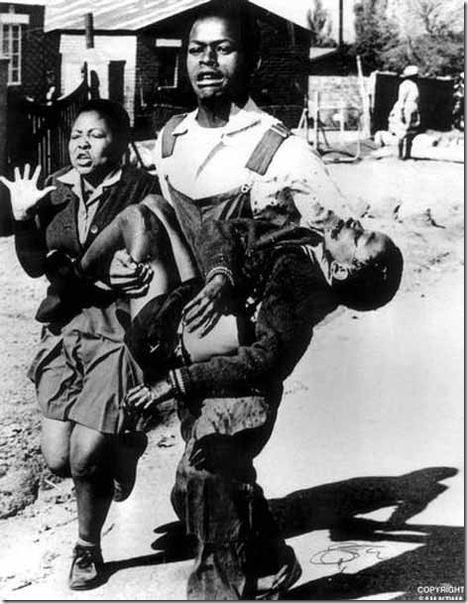
Hector Pieterson and Mbuyisa Makhubo

On 16 June 1976, thousands of black South African students staged a protest and walked from their schools to Orlando Stadium in Soweto.  They were protesting against the Afrikaans Medium Decree of 1974 which forced tuition to be given in a 50/50 split between English and Afrikaans in schools.  Not only was Afrikaans the language of their oppressors, it was also a language that many black South Africans did not understand as they primarily spoke one of the black African languages such as Zulu, Northern or Southern Sotho or Xhosa.  Part of the Apartheid policy was to allocate fewer resources to black schools as well and to make them purchase their own textbooks and exercise books whereas these were freely distributed in white schools.  The effects of teaching in Afrikaans in already disadvantaged and inferior schools was devastating.

On the morning of 16 June 1976, protesting children found that their route to the stadium was blocked by a police barricade.  There are conflicting reports as to how the first shot was fired and whether it was provoked.  Some say that the children began throwing stones, other simply say that the policemen got spooked.  Once that first shot had been fired though, children ran screaming in different directions, terrified and panicked.  More shots were fired and by the end of the day, 23 people were dead (two of them were white people).

Soweto uprising - Hector Pieterson Hector Pieterson is the little boy being carried in the photograph above.  He was one of the first children to be killed that day.  Perhaps even more heartbreaking is that the boy carrying him was 18-year-old Mbuyisa Makhubo.  He was harassed so much by the police that he went into hiding after the event and his mother has not heard from him since 1978.   I imagine he is but one of the thousands of victims that “disappeared” in the Apartheid years.

The resulting violence after the shootings that day became known as The Soweto Uprising or Soweto Riots.  Between 200 and 600 people died in the violence and thousands were injured.  June 16 is commemorated each year as Youth Day and services and events are held across South Africa to honour their youth and to remember all that was lost during the Apartheid struggle.

Images © Sam Nzima

SHARE:

Tuesday, 27 April 2010

This Day In History: 27 April 1994

This is the article I posted for Freedom Day last year. I was going to do a brand new one and then realised that this basically says it all. I am still so proud of South Africa.

27 April is Freedom Day in South Africa and it is a public holiday held to commemorate 27 April 1994 when the first democratic general election was held in the country. This election marked the end of Apartheid where the National Party government was replaced by the government of the African National Congress and Nelson Mandela became president.

It was the first ever election in South Africa in which there was universal suffrage which means that all adult South Africans, regardless of race or gender, were allowed to vote.

election
Photo: AP

Apartheid
Most people today have heard about Apartheid but I wonder if everyone knows what it was like? Apartheid officially began in 1948 but certain laws dated to before that time and were vital parts of Apartheid legislation. The 1913 Native's Land Act prevented non-white people from owning land. Not only could they never own the land they lived on, they could be forcibly removed from any land that was deemed attractive for white settlement (see District 6). This law was enhanced in 1950 by the Group Areas Act which assigned different racial groups to different residential and business areas in urban areas. Hence, blacks, whites, coloureds and Indians in South Africa could not live together, could not own businesses in the same areas and only whites could own land.

The second piece of important pre-Apartheid legislation was released under the Jan Smuts government. It was called the Native Urban Areas Act of 1923 and it deemed urban areas to be "white" areas and all black adult men had to carry passes at all times if they were in cities or urban areas. A statue of the lovely Jan Smuts now stands in parliament Square in London and he looks out over the square to where Nelson Mandela's statue now also stands. This law was also enhanced by the 1952 Pass Laws Act which made it compulsory for all blacks South Africans over the age of 16 to carry a pass book at all times. The book would stipulate where, when and for how long a person could remain in a specific urban area and it greatly restricted where black people could move or visit.

The final bit of despicable legislation I will talk about today was the 1949 Prohibition of Mixed Marriages Act which prohibited interracial marriage in South Africa and the 1950 Immorality Act which prohibited all sexual relations between whites and non-whites. These laws were repealed by PJ Botha in 1985 but up to that time, people could be arrested and prosecuted if they were caught having sexual relations with a person of another race and black people often got stronger sentences than white people.

The Beginning of the End
In the early 1980's, international economic sanctions had begun to take their toll on Apartheid and that was the beginning of the end. Little by little President PJ Botha began to repeal laws and offer greater freedoms to the Indian population and to blacks and coloureds too. The separate and completely unequal policies and privileges offered to the different population groups under PJ Botha are quite complex and the topic of another post, but in 1989 PJ Botha had a stroke and FW de Klerk became president. He began a process of reform which culminated in the unbanning of the South African Communist Party and the African National Congress on 2 February 1990 and the release of Mandela on 11 February 1990.

A national referendum was held on 17 March 1992 in which white people voted whether they wanted to continue the process of reform started by FW de Klerk two years earlier. We knew what the stakes were and the basic question was really, "will this be the last whites-only election before universal suffrage is awarded and national elections are held"? 2.8 million people voted and the result was 68.73% "Yes".

The Road to the Elections
The next two years were emotional and tumultuous for our emerging rainbow nation. There was so much intimidation and violence going on around the elections that people were advised never to divulge who they were voting for. It was our right to keep our vote private. Many of the young, black females that I worked with were too scared to vote, even though we offered to drive them to the election stations and hide them in our cars. This was worrying - we needed every single vote. I still won't divulge who I voted for or what my preference was, but the important thing was to vote!

The Day
As the photo above shows, South Africans stood for hours and hours in queues that day to vote. I myself stood for four hours in a queue that ran the whole way around the northern Johannesburg suburb of Craighall. I got to the front of the queue and stood for several minutes in the booth. My hand was shaking so much that I was scared to try to write in case I spoiled my ballot. I cast my "x" on the regional and national papers, posted my ballots in the box and burst out crying. I was so overwhelmed and so acutely aware of the importance of what had come to pass that day. I was one of the 19,533,498 people who changed the course of world history that day.

The rest, as they say, is history. The ANC won 62.65% of the vote and Nelson Mandela became the first president of the New South Africa. At some stage I hope to elaborate on what it was like to live in Apartheid South Africa.

SHARE:

Sunday, 21 March 2010

This Day in History: 21 March 1960: Sharpeville Massacre

Sharpeville Massacre
Photo: AFP

South Africa, 21 March 1960

On 21 March 1960, the Pan Africanist Congress organised a peaceful march in Sharpeville, Soweto.  During the protest, black South Africans burnt their pass books which restricted their movement to other areas in terms of the Pass Laws Act of 1952 which stipulated where, when, and for how long a person could remain.

The police opened fire on the peaceful march and killed 69 human beings and injured 178 others.

Sharpeville Day has since been commemorated each year in South Africa on 21 March and in 1994, the day was made into a national public holiday called Human Rights Day.  The idea is for South Africans to remember the great human rights sacrifices and transgressions that occurred against the black people of South Africa in the road to freedom.

The photo above showed people lying wounded in the streets of Sharpeville.  Today, Sharpeville remains an impoverished area where many people are living in shacks without running water or indoor sanitation.

In 1966 the United Nations proclaimed the 21 March the International Day for the Elimination of Racial Discrimination.  Rmembering the event of 21 March 1960, the United Nations General Assembly called on the international community to redouble its efforts to eliminate all forms of racial discrimination.

What have you done to eliminate racism today?

SHARE:

Tuesday, 2 February 2010

This day in history: Apartheid Dismantled

ANC unbanned
Photo: Independent Newspapers Archive

“There are moments in history that become icons of their era, symbols of a shift in the world order. The liberation of Auschwitz, the fall of the Berlin Wall, the assassination of John F Kennedy, the liberation of Saigon, FW de Klerk's address to parliament 20 years ago this coming week” - IOL

I can barely believe that it was twenty years ago today that the then-President of South Africa gave the speech which effectively dismantled Apartheid. I was sixteen and in my last year of school and I can remember that huge feeling inside as we witnessed the end of an era. On February 2, 1990 FW de Klerk unbanned the African National Congress and 9 days later Nelson Mandela was released from prison after being incarcerated for 27 years.

South Africa is just one small country amongst many that had right-wing totalitarian regimes in the past but the specific oppression of people of colour in favour of a white conservative government meant that South Africa's struggle became a global symbol for the fight against racism, oppression and domination.

Mr de Klerk, I cannot thank you enough for changing my world and for making me proud to say that I am South African. I cannot even begin to explain how your bravery and your actions, together with those of Nelson Mandela, shaped my mind and made me realise that we need to carry the struggle worldwide and fight against evil in this world.  Thank you.

You can find out more about this momentous day by clicking the links below:

IOL photo gallery on the events of February 1990

FW de Klerk reflects on reaching the decision to release Mandela on this day 20 years ago

The day De Klerk changed course of history

De Klerk's speech changed our lives forever

SHARE:

Monday, 1 February 2010

This day in history: 01 February 1968

Nguyen Van Lem
Photo by Eddie Adams

On this day in history, February, 1st 1968, Nguyễn Văn Lém was executed by General Nguyen Ngoc Loan. The execution was caught on film by photojournalist Eddie Adams and has become one of the most iconic images of the horror and hostility of war.

Nguyễn Văn Lém was a Viet Cong soldier who was caught during the Tet Offensive and brought before General Nguyễn Ngoc Loan. At the time, General Nguyễn was the Chief of the Republic of Viet Nam National Police. He simply pulled out his service sidearm and summarily executed the Viet Cong soldier in front of Eddie Adams and television cameraman Vo Suu.

In 1969, Eddie Adams won a Pulitzer Prize for this photograph.

SHARE:

Thursday, 10 December 2009

Human Rights Day

Human Rights Day 2009 End Discrimination

Today is Human Rights Day and it was on this day in 1948 that the Universal Declaration of Human Rights (UDHR) was adopted by the United Nations General Assembly.  The UDHR has become a universal standard for defending and promoting human rights and I discussed the declaration back in July: The Universal Declaration of Human Rights.  The basic foundation of the Universal Declaration of Human Rights is that "all human beings are born with equal and inalienable rights and fundamental freedoms".

Every year on 10 December, Human Rights Day is observed and celebrated around the world and some of today’s events in South Africa, New York and Geneva are listed on the Office of the High Commissioner for Human Rights website.

The focus of Human Rights Day 2009 is non-discrimination.  Despite stating some 61 years ago that all humans were born equal, that we all had inalienable rights, millions of people worldwide fight against discrimination each day.

“The realisation of all human rights - social, economic and cultural rights as well as civil and political rights – is hampered by discrimination. All too often, when faced with prejudice and discrimination, political leaders, governments and ordinary citizens are silent or complacent”

Source: Office of the UN High Commissioner for Human Rights

Discrimination is perhaps on of the most tangible areas in which every day people can get involved in the struggle for global human rights.  Take a look at your workplace and how certain workers or classes of people are treated.  It is okay to tell people that racism is not okay, that all workers should be treated equally and that in the workplace, no one is actually better than anyone else.

People often discriminate because they can get away with it or because they think that others around them agree with such behaviour.  Be firm in your principles and slowly but surely you might come to change the world around you.

Complacency is discrimination’s best friend

SHARE:

Saturday, 8 August 2009

This Day in History: 6 – 9 August 1945


Clothing remains of victim of Hiroshima atomic bomb

Please excuse my tardiness but it has been a hectic week!  This anniversary was too important to ignore though especially considering I had recently taken the photograph above which depicts the clothing remains of of a victim of the atomic bomb in Hiroshima.

On 6 August 1945, the Enola Gay (a US military B-29 bomber) dropped the atomic bomb on the Japanese city of Hiroshima and up to 140,000 people were killed.  Three days later on 9 August 1945, the second atomic bomb was dropped on Nagasaki and 80,000 people were killed.  The bombings resulted in the surrender of Japan to the Allied forces and is attributed with bringing World War II to an end.

But at what cost?  The predominantly civilian victims of the atomic bombs experienced their skin literally melting off their bodies.  Those closest to the bombs died within seconds but about 15-20% of the victims died from the effects of flash burns, radiations burns and injuries sustained in the fall out.  In later weeks and months, they succumbed to radiation sickness, illness and malnutrition.  There have also been several linked cases of leukaemia and other cancers in the area since the event due to remaining radiation.

The horrific but acclaimed Japanese manga series Barefoot Gen illustrates the effects of the bomb.  Take a look at this short video.  You can watch the full feature length film on YouTube.  That link takes you to the playlist and consists of nine 10-minute clips.

My grandfather fought in World War II and I am not taking sides.  I just think it is important to realise that we can never do this again.  That we must trust in organisations such as the United Nations and that atomic war can never, ever be allowed to happen again.

This excellent article presents a United Press news story that appeared at the time.

SHARE:

Monday, 27 April 2009

South Africa: Freedom Day – 27 April

27 April is Freedom Day in South Africa and it is a public holiday held to commemorate 27 April 1994 when the first democratic general election was held in the country. This election marked the end of Apartheid where the National Party government was replaced by the government of the African National Congress and Nelson Mandela became president.

It was the first ever election in South Africa in which there was universal suffrage which means that all adult South Africans, regardless of race or gender, were allowed to vote.

election
Photo: AP

Apartheid
Most people today have heard about Apartheid but I wonder if everyone knows what it was like? Apartheid officially began in 1948 but certain laws dated to before that time and were vital parts of Apartheid legislation. The 1913 Native's Land Act prevented non-white people from owning land. Not only could they never own the land they lived on, they could be forcibly removed from any land that was deemed attractive for white settlement (see District 6). This law was enhanced in 1950 by the Group Areas Act which assigned different racial groups to different residential and business areas in urban areas. Hence, blacks, whites, coloureds and Indians in South Africa could not live together, could not own businesses in the same areas and only whites could own land.

The second piece of important pre-Apartheid legislation was released under the Jan Smuts government. It was called the Native Urban Areas Act of 1923 and it deemed urban areas to be "white" areas and all black adult men had to carry passes at all times if they were in cities or urban areas. A statue of the lovely Jan Smuts now stands in parliament Square in London and he looks out over the square to where Nelson Mandela's statue now also stands. This law was also enhanced by the 1952 Pass Laws Act which made it compulsory for all blacks South Africans over the age of 16 to carry a pass book at all times. The book would stipulate where, when and for how long a person could remain in a specific urban area and it greatly restricted where black people could move or visit.

The final bit of despicable legislation I will talk about today was the 1949 Prohibition of Mixed Marriages Act which prohibited interracial marriage in South Africa and the 1950 Immorality Act which prohibited all sexual relations between whites and non-whites. These laws were repealed by PJ Botha in 1985 but up to that time, people could be arrested and prosecuted if they were caught having sexual relations with a person of another race and black people often got stronger sentences than white people.

The Beginning of the End
In the early 1980's, international economic sanctions had begun to take their toll on Apartheid and that was the beginning of the end. Little by little President PJ Botha began to repeal laws and offer greater freedoms to the Indian population and to blacks and coloureds too. The separate and completely unequal policies and privileges offered to the different population groups under PJ Botha are quite complex and the topic of another post, but in 1989 PJ Botha had a stroke and FW de Klerk became president. He began a process of reform which culminated in the unbanning of the South African Communist Party and the African National Congress on 2 February 1990 and the release of Mandela on 11 February 1990.

A national referendum was held on 17 March 1992 in which white people voted whether they wanted to continue the process of reform started by FW de Klerk two years earlier. We knew what the stakes were and the basic question was really, "will this be the last whites-only election before universal suffrage is awarded and national elections are held"? 2.8 million people voted and the result was 68.73% "Yes".

The Road to the Elections
The next two years were emotional and tumultuous for our emerging rainbow nation. There was so much intimidation and violence going on around the elections that people were advised never to divulge who they were voting for. It was our right to keep our vote private. Many of the young, black females that I worked with were too scared to vote, even though we offered to drive them to the election stations and hide them in our cars. This was worrying - we needed every single vote. I still won't divulge who I voted for or what my preference was, but the important thing was to vote!

The Day
As the photo above shows, South Africans stood for hours and hours in queues that day to vote. I myself stood for four hours in a queue that ran the whole way around the northern Johannesburg suburb of Craighall. I got to the front of the queue and stood for several minutes in the booth. My hand was shaking so much that I was scared to try to write in case I spoiled my ballot. I cast my "x" on the regional and national papers, posted my ballots in the box and burst out crying. I was so overwhelmed and so acutely aware of the importance of what had come to pass that day. I was one of the 19,533,498 people who changed the course of world history that day.

The rest, as they say, is history. The ANC won 62.65% of the vote and Nelson Mandela became the first president of the New South Africa. At some stage I hope to elaborate on what it was like to live in Apartheid South Africa.

SHARE:
© A Passion to Understand

This site uses cookies from Google to deliver its services - Click here for information.

Blogger Template Created by pipdig