Saturday, 19 August 2023

Graphic Novel Review: The Photographer of Mauthausen by Salva Rubio, Pedro J Colombo & Aintzane Landa ★★★★★

Most online accounts of Ernst Kaltenbrunner and Albert Speer mention that they were convicted at the Nuremberg trials but few accounts mention the testimony and evidence provided by Francisco Boix that enabled those convictions. Nor do they mention the bravery and sacrifices of the people involved in preserving and delivering that evidence to the outside world.
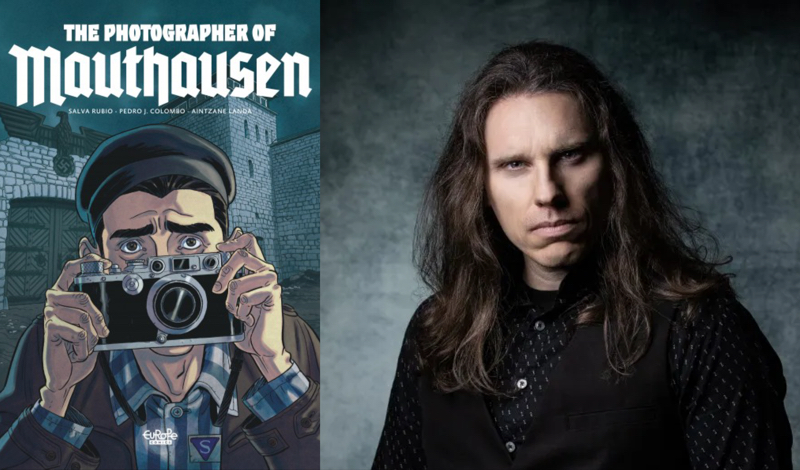
Graphic Novel Review | The Photographer of Mauthausen | cover and author photograph

The Photographer of Mauthausen by Salva Rubio (writer), Pedro J Colombo (illustrator) and Aintzane Landa (colourist) tells the story of Boix, a Spanish photographer and veteran of the Spanish Civil War. Following his part in the civil war, Boix was exiled to France and joined the French army before being captured by the Germans. The Photographer of Mauthausen starts with Boix's arrival at Mauthausen in 1941.

Boix starts off his internment as a translator but soon finds a position in the photography lab. Somehow, inexplicably, SS-Hauptscharführer Paul Ricken takes a liking to to Boix and recruits him as assistant to his macabre photography project. In this role, Boix is exposed to the many atrocities being committed at Mauthausen (in addition to the ones he had already witnessed).

Boix realises initially that this evidence needs to be preserved and several prisoners get involved in making this happen. However, as news reaches camp of an impending Russian victory, Boix realises that he needs to get proof of the atrocities to people on the outside of the camp.

Boix was successful and both his testimony and the photographic evidence proved that Nazis such as Kaltenbrunner and Speer were not only aware of what was happening at Mauthausen but they were complicit in the atrocities too.

The value of The Photographer of Mauthausen is in the questions that it raises about justice and remembrance. At the time of the Nuremberg trials, the photos were used to obtain convictions but Boix expresses frustration on page in the graphic novel about why people weren't more concerned about what happened at Mauthausen and the atrocities committed.
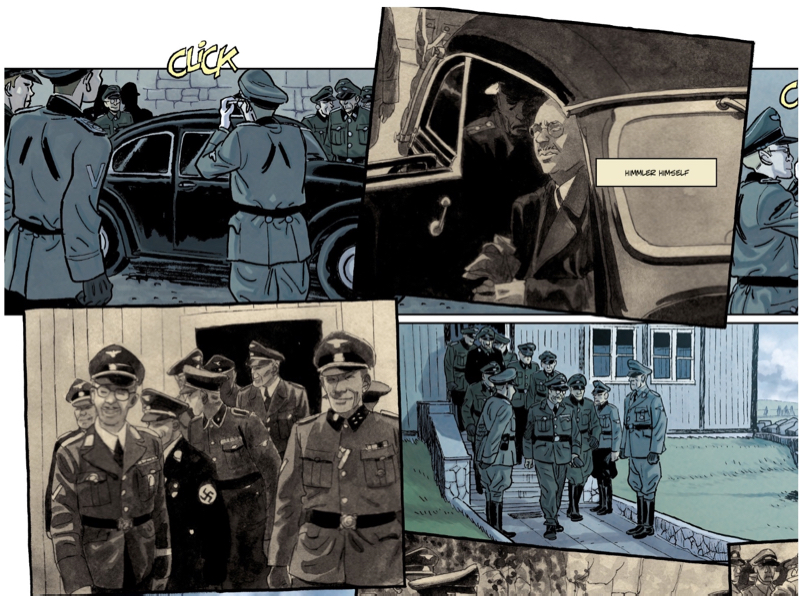
Graphic Novel Review | The Photographer of Mauthausen | Page from graphic novel depicting the photographer capturing various Nazi officers

The Photographer of Mauthausen is an excellent graphic novel that tells, in an accessible format, an important story in the annals of Holocaust history while serving as an educational source on both Nazi atrocities and the trials following the war.

I give The Photographer of Mauthausen a superb five out of five stars. The graphic novel is extremely well illustrated and written and recommended for those interested in history, graphic novels and the Holocaust.

★★★★★

SHARE:

Sunday, 8 December 2013

Audiobook review: The War That Ended Peace by Margaret MacMillan

The War That Ended Peace UK cover

I believe that each generation thinks of the First and Second World Wars in a different way, depending on whether our peers, parents, grandparents or even great-grandparents fought in them. In my case, my great-grandfathers fought in the First World War and my grandfather in the Second. I have a living memory of my grandfather living with injuries sustained in the Second World War and I recall the stories he told me about his time in all of the major theatres of the war.

Yet somehow I have never quite been able to fathom how total war was possible. I saw the glory days of Europe at the turn of the century, with its world fairs and expositions, followed by the roaring twenties and the Great Depression. I knew about the First World War, of course I did, but I struggled to connect the culture of innovation, harmony and discovery with total war and absolute devastation.

This perception was not helped by the way in which the outbreak of the war was explained to us in school. Countless articles and books began with statements along the lines of, “when Gavrilo Princip assasinated Archduke Franz Ferdinand on the Latin Bridge in Sarajevo in 1914, he had no idea of what he was setting in motion”.

This never made sense to me. We were taught that the First World War was an inevitable consequence of this one act of assassination but I could never accept that, and rightly so.

The War That Ended Peace UK coverWith the centenary of the outbreak of the First World War taking place next year, I thought what better choice than Margaret MacMillan's The War That Ended Peace, narrated by Richard Burnip and released on audiobook format by Audible.

The War That Ended Peace begins with a description of The Exposition Universelle of 1900. This world fair was held in Paris to showcase the great achievements of the world in terms of innovation, technology and advancement. The proceedings were imbued with a general feeling of well-being and confidence, even in the presence of a healthy atmosphere of competition between the participating nations.

How then did the world descend into chaos? MacMillan warns in the very first chapter that Europeans were complacent, that they should have paid more attention to the American Civil War and Franco-Prussian Wars.

What follows is an extremely well-researched and in-depth look at the personalities behind the war. Each chapter looks at the motivations, insecurities and observations of the key political players in the context of rising distrust and rivalry between the nations. Meanwhile, alliances form in the most unexpected of places while old alliances fail. The detailed biographies focus not just on Britain’s King George V, Germany’s Kaiser Wilhelm II and Russia’s Czar Nicholas II but include Lord Salisbury, Admiral Jackie Fisher and Alfred von Tirpitz amongst others.

Ultimately, The War That Ended Peace appears to leave more questions than it provides answers. We’re provided with an important insight into the key payers but are we to believe that war was inevitable because of a simple comedy of errors, a clash of egos or a series of unfortunate diplomatic mistakes? Perhaps looking at the wars of the first decades of the 21st century, that is precisely what it was. MacMillan draws parallels between modern day terrorist organisations and the anarchists and activists of the previous century and concludes ominously that there are always choices.

The audiobook version of The War That Ended Peace is narrated by Richard Burnip, an actor and historian who previously narrated Frank Wynne’s I Was Veneer. After listening to several fictional works on audiobook, I decided to experiment and listen to a work of non-fiction in this format. I do like to read non-fiction works but progress can often be slow, especially with historical or political works which can tend to be a bit dry and heavy.

I won’t lie, The War That Ended Peace is long. The print version of the book is 784 pages long and progress through an audiobook is rather defined by the pace of the narration. While superbly enunciated and clearly understandable, Burnip’s narration was extremely slow and I increased the narration speed to 1.25x and even 1.5x to quicken the pace. Nevertheless, Burnip used just the right amount of solemnity and levity in his narration and made it much easier to progress through this lengthy tome than I fear I would have experienced had I tried to read the book. Despite this, it still took almost a month to work my way to the end of the audiobook.

The War That Ended Peace by Margaret MacMillan is available to purchase in audiobook format from Audible.co.uk, in paperback from Amazon.co.uk and in hardcover and Kindle format from Amazon.com.

SHARE:

Tuesday, 11 December 2012

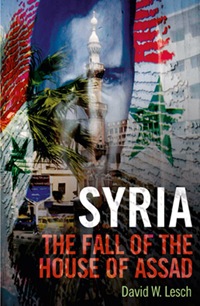
Book Review: Syria: The Fall of the House of Assad by David W. Lesch

David Lesch - Syria - The Fall of the House of Assad - bannerWhen Bashar al-Assad became president of Syria upon his father's death in 2000, many people had high hopes for this young man who gave up his passion for ophthalmology to lead his country. Many expected al-Assad to embark on a series of reforms and lead Syria to a more progressive future.
A decade later and the oppressive and powerful Syrian security-military apparatus reacted with increasing brutality to the Syrian uprisings that were part of the region-wide Arab Spring. Almost two years later and the country remains in the grip of a devastating civil war.

What went wrong in Syria, the country that once held the highest hopes of progression and reform in the region? Author David W. Lesch enjoyed exclusive access to Assad as a leading Middle East scholar and consultant between 2004 and 2009 and in Syria: The Fall of the House of Assad, Lesch goes into detail about the rise and fall of the house of Assad.

Syria: The Fall of the House of Assad is by turns quite fascinating. It begins with a discussion of al-Assad's first years in office, the Damascus Spring and the increasing international pressure following 9/11 and the assassination of former Prime Minister of Lebanon, Rafic Hariri.

David Lesch - Syria - The Fall of the House of Assad - coverWith its secularism and the overwhelmingly positive perceptions of Syrians of Bashar al-Assad and his wife Asma, many thought that Syria would be immune to the effects of the Arab Spring. The next portion of the book discusses why many in the Syrian government, military and Assad's inner circle thought that Syria was different, including Assad himself. This is followed by a breakdown of precisely why Syria was no different to the rest of the countries in the region and the reasons behind the escalating protests.

The following two chapters are dedicated to the Syrian response to the uprisings compared to the mounting opposition and popular action that took place amid reports of increasing atrocities.

Of particular interest was the next section of the book dealing with the the often confounding international response. Lesch goes into some detail regarding the divisions within and between the member states in both the United Nations and the Arab League and their evolving affiliations to Syria during this time.

As the book draws to a close at the end of the summer of this year, what is particularly startling is that the government and president of Syria continue to give the same empty promises of reform and cooperation as they did two years ago.

Syria: The Fall of the House of Assad is an important book with valuable information covering both the background and current situation in Syria. The book does not go into much detail on the individual atrocities and massacres, other than to mention them and the consequences thereof, and the focus is on the background to the decisions made by key local, regional and international players.

It can be a little difficult to follow at times and the author does tend to jump back and forward in time, but I appreciate the layout of the book into clearly defined sections over the benefits that a strict chronological analysis would have brought.

I certainly recommend Syria: The Fall of the House of Assad to anyone interested in understanding the situation in Syria and would recommend it to academics and interested parties alike. Lesch makes a good attempt to present the book so that it will be accessible to non-academic readers.

Syria: The Fall of the House of Assad is available to purchase at  Amazon.co.uk and Amazon.com.

SHARE:

Wednesday, 29 August 2012

Before the Spring: Invasion of Iraq and Iraq War (2003-2011)

This is the second in a series on A Decade of Conflict Leading up to the Arab Spring.

The United States invasion of Iraq took place between 19 March and 1 May 2003.  It was presented to the American public and the world at large as an action that would rid the world against terrorism, protect against Saddam Hussein’s weapons of mass destruction, and liberate the people of Iraq. 

The invasion was seen to be successful because it resulted in the toppling of Saddam Hussein’s Ba’ath Party government in just 21 days and allowed the subsequent occupation of Iraq.  It was the first action in what was to become the Iraq War which officially lasted until 18 December 2011.

The difficulty is that Iraq held no weapons of mass destruction, was not in any way involved in the 9/11 terrorist attacks on America (which was the galvanising force behind American support for the invasion), and left the people of Iraq traumatised and devastated after being subjected to nearly a decade of brutal force.

Army Sgt stands guard near burning oil well in Rumaylah Oil Fields in Southern IraqArmy Sgt stands guard near burning oil well in Rumaylah Oil Fields [Wikicommons]

It is likely that the invasion of Iraq, a sovereign state, by United States forces was illegal and then Secretary-General of the United Nations, Kofi Annan, said as much in 2004.  Far from freeing the Iraqi population, the war resulted in the death of at least 100,000 Iraqi citizens (with some estimates rising to 1 million civilian deaths, see Casualties of the Iraq War).

A heavy bombing campaign lead to the wide scale destruction of infrastructure and services in Iraq, leaving the population without water, electricity, sewerage systems and hospitals.  The bombs dropped on Iraq were laced with depleted uranium resulting in a lasting radioactive contamination that will likely remain for generations.  There has been a sharp increase in childhood leukaemia, cancer and infant mortality in highly bombarded regions in Iraq.

The war in Iraq resulted in a humanitarian crisis of massive proportions that has spilled over into neighbouring countries. 

“UNHCR estimates that more than 4.7 million Iraqis have fled their homes, many in dire need of humanitarian care. Of these, more than 2.7 million Iraqis are displaced internally, while more than 2 million have escaped to neighboring states.” - UNHCR, "Iraq Refugee Emergency"

Malnutrition and disease outbreaks are widespread in a population with a disproportionate amount of widows and orphans.

Finally, much was made of the positive effect that the war would have on the liberation of women in Iraq.  In their book What Kind of Liberation? Women and the Occupation of Iraq, Nadje Al-Ali and Nicola Pratt discuss the challenges facing the women of Iraq.  They have noted an increase in neo-conservatism and the rise of violence against women, oppression and honour killings.  Women and young girls are often forced into prostitution or become victims of sex trafficking and exploitation.  Despite the rise of women-headed households, Iraqi women face great obstacles in becoming employed or gaining an education.

More so than ever before, every step of the Iraq War was subject to media scrutiny with many news outlets employing permanent correspondents and embedded reporters in key Iraqi locations.  While news outlets struggled to remain neutral amid accusations of propaganda and censorship, Al-Jazeera was noted for being one of the few news outlets to portray Iraqi casualties and present to audiences a view of the devastation in Iraq.

As with the Second Intifada, the people in neighbouring Arab countries received these broadcasts and took to the streets in protest against the Iraqi War.  The sentiment was increasingly anti-USA, anti-United Kingdom and anti-Israel with protests in Syria, Tehran, Cairo and later Baghdad and Basra in Iraq itself. 

Once again, in the context of rising distrust and conflict following the 9/11 attacks, increasing reports of discrimination and Islamophobia, and war in both Israel and Iraq, Arab speaking people began to feel solidarity to one another and an identification with the Palestinian and Iraqi causes.

Further reading:

SHARE:

Sunday, 10 June 2012

This Day In History: 10 June 1942

The Destruction of Lidice

On 10 June 1942, Nazi forces completely destroyed the Czechoslovakian town of Lidice which is located just north-west of Prague.  They surrounded the village and rounded all 173 of the men up, taking them to a local farm where they were all shot to death. The women and children were separated and unspeakable atrocities were then committed against them.  Four pregnant women had their unborn children forcibly aborted and they were then sent to concentration camps while the majority of the rest of the women were sent to work at Ravensbrück concentration camp where most of them perished. 

Lidice Children's MemorialLidice Children's Memorial. Photo credit: Moravice [Source]

Eighty-eight children were transported to the Polish city of Lodz, south-west of Warsaw.  Seven of them were selected for Germanisation but the rest were taken to nearby Chelmno on 2 July 1942 and were gassed to death. 

The village of Lidice was razed to the ground, buildings were destroyed and even graves in the cemetery were dug up and destroyed.  The absolute cleansing of Lidice was complete.

The Assassination of Reinhard Heydrich

Reinhard Heydrich was a Nazi official and one of the major architects of The Holocaust.  He spoke at the Wannsee conference in January 1942 where he called for Jews to gathered from across Europe to be worked to death in concentration camps or exterminated. 

He was assassinated on the morning of 27 May 1942 by British trained Czech and Slovak parachutists.  His death caused an intense stage of mourning amongst Nazi circles and Hitler called for the explicit destruction of any village found to be harbouring Heydrich’s killers.  He ordered that all males should be killed, women transported to a concentration camp, children Germanised or otherwise dealt with, and the village razed to the ground.

The Assassination of Reinhard HeydrichHeydrich’s car at scene of assassination. Photo credit: Bundesarchiv [Source]

Intelligence incorrectly linked the towns of the Lidice and Ležáky and Hitler’s orders were carried out to the letter in a terrible and brutal act of revenge carried out against innocent men, women and children.

Lidice Lives!

In the aftermath of Heydrich's assassination, Adolf Hitler is said to have proclaimed that “Lidice shall die forever!”  When he heard of Hitler’s plan to destroy Lidice and the terrible price that the people Lidice paid, a Labour MP in Stoke on Trent, England decided to start the Lidice Shall Live campaign.

Through his work, Lidice was rebuilt and a home created for the 153 women and 17 children who returned after the war.

You can read more about Barnett Stross’s work and the incredible generosity of the people of Stoke on Trent in helping to rebuild Lidice over at Dáithaí C’s blog: Lidice Lives.  You can also read about the anti-fascist art exhibition in Melbourne in 1942 (partly inspired by the events at Lidice) at the Art and Architecture, Mainly blog: Anti-Fascist Art Exhibition, Melbourne 1942

SHARE:

Thursday, 24 February 2011

Book Review: The Breakup of Yugoslavia and the War in Bosnia by Carole Rogel

The Breakup of Yugoslavia and the War in Bosnia Twenty years ago the state of Yugoslavia began to fall.  Significant events in late 1990 and early 1991 lead Slovenia and Croatia to declare independence on June 1991.  What began in early 1991 resulted in five years of brutal warfare in first Croatia and then Bosnia.  The war was characterised by massacres, ethnic cleansing and genocide and represented a particularly bloody period in the history of the European region. 

The Breakup of Yugoslavia and the War in Bosnia by Carole Rogel provides a useful history of the region and covers the period from around the fourteenth century right up to the signing of the Dayton Peace Agreement in December 1995.  It is an extremely useful resource for someone wishing to gain an introduction to the events in the former Yugoslavia but is unfortunately limited in that it was published in 1998, before the Kosovo War.

Designed specifically for student research, the book begins with a comprehensive timeline of events from the 500s and 600s to 1997.  There are five main chapters of the book:  “The Breakup and the War: A Historical Overview”; “The Collapse of Tito’s Yugoslavia”; “The War in Bosnia-Herzegovina”; “A War of Myths, Propaganda, and Balkan Politics”; and “The Response of the International Community”. 

The next section of the book consists of a series of biographies of all of the big players in the war including Slobodan Milosevic, Franjo Tudjman and Alija Izetbegovic of Serbia, Croatia and Bosnia respectively; Bosnian Serbs Ratko Mladic and Radovan Karadzic; and various diplomats and mediators including Richard Holbrooke, David Owen and Cyrus Vance.  Unfortunately, this section is where the timing of the publication of the book is most problematic: I felt I could not read any of the entries without reverting to Wikipedia for updates.  Still, Radovan Karadzic was only arrested in July 2008 and Ratko Mladic is still on the run for war crimes so it is unlikely that even the revised edition of the book, The Breakup of Yugoslavia and Its Aftermath (2004, ABC-CLIO/Greenwood) would give a complete history.

The Breakup of Yugoslavia and Its Aftermath Perhaps the most useful section of the entire book is the final section before the comprehensive glossary entitled “Primary Documents of the Breakup and the War”.  This section included a series of speeches and excerpts from books and articles and each item was given a brief introduction.  The documents included the infamous Memorandum of the Serbian Academy of Sciences and Arts (1985); Warren Zimmerman’s damning cable to the US on his recall in 1992 and Tadeusz Mazowiecki’s shocking letter of resignation as UN Human Rights Advocate on moral grounds in 1995.  Also included are excerpts from Zlata’s Diary: A Child’s Life in Sarajevo and sections of the Bosnia vs Serbia proceedings at the ICJ where the Bosnian people charged genocide.

I’m not quite certain why I purchased the earlier edition of this book instead of the revised edition.  I suspect that I followed a link from a book review of the former and had not noticed the latter edition.  Nevertheless, I would recommend the book as a good starter text but would certainly advise to rather purchase The Breakup of Yugoslavia and Its Aftermath.

Buy The Breakup of Yugoslavia and the War in Bosnia (1998)  from Amazon.com ¦ Amazon.co.uk

Buy The Breakup of Yugoslavia and Its Aftermath (2004) from Amazon.com ¦ Amazon.co.uk

SHARE:

Monday, 9 August 2010

Sixty-five years ago: Hiroshima and Nagasaki

Hiroshima leveled by A-bomb
Photo credit © United Press International, Inc

Sixty-five years ago today, the second atomic bomb was dropped on Nagasaki, Japan.  80,000 people died that day and 140,000 were killed three days earlier when the first atomic bomb was dropped on Hiroshima.  You can read about the specific details and the human suffering in this post from last year: This Day in History: 6 – 9 August 1945.


Photo essay: Hiroshima, the pictures they didn't want us to see

This is an incredibly shocking photo essay on the victims and devastation of the atomic explosions in Japan.  The photos are quite graphic and may be disturbing to some people.

hiroshima-damage

“Beneath the center of the explosion, temperatures were hot enough to melt concrete and steel. Within seconds, 75,000 people had been killed or fatally injured with 65% of the casualties nine years of age and younger.”

“Hibakusha is the term widely used in Japan referring to victims of the atomic bombings of Hiroshima and Nagasaki. The Japanese word translates literally to "explosion-affected people".

bomb2

They and their children were (and still are) victims of severe discrimination due to lack of knowledge about the consequences of radiation sickness, which people believed to be hereditary or even contagious.”


This is why the Nuclear Non-Proliferation Treaty is so important.  No country can ever have the power to exact this kind of devastation on the civilians of another country, no matter what their grievance with the government or policies of that country. 

SHARE:

Saturday, 17 July 2010

15th Anniversary of Srebrenica Genocide

Sunday, July 11 marked the 15th anniversary of the Srebrenica genocide.  In marked contrast to the reconciliation and nation building that we saw last year in Rwanda, the anniversary in Srebrenica was marked by funerals and yet more denials.

Link: Bosnians mark Srebrenica genocide with 775 victims [World Bulletin]

© World Bulletin / Srebrenica genocideWhile the atrocity occurred 15 years ago, the process of finding and identifying the victims is ongoing.  The link above is an extremely well written article about the massacre.

“Hundreds of thousands Bosnians gathered in Sarajevo, commemorating the victims of Srebrenica massacre, the Europe’s worst genocide after WWII as trucks loaded with the remains of 775 newly identified victims of the Srebrenica massacre left the morgue there to head for the ill-fated eastern town.

The Bosnians gathered near Sarajevo carrying the victims, whose remains were found in numerous mass graves scattered around eastern Bosnia, will be reburied at a memorial cemetery near Srebrenica on Sunday, on the 15th anniversary of the massacre” - World Bulletin

© World Bulletin / Srebrenica genocide© World Bulletin / Srebrenica genocide

To date, 6,186 of the victims have been identified but close to 8,100 remains have been found.  It is estimated that the grand majority of those men and boys were killed on one evening: 11 July 1995.  Bodies are often not intact as the Serbs dug up the bodies and moved them in an effort to conceal the massacre. 

© World Bulletin / Srebrenica genocide  

Link: 15th Anniversary of Srebrenica Genocide [US Dept of State]

World leaders from around the globe recognised the anniversary and offered their condolences.  In the link above, Hillary Rodham Clinton recognised the need to rebuild the nation of Bosnia and Herzegovina.

“A prosperous, free, and unified Bosnia and Herzegovina is the most worthy monument to those who lost their lives at Srebrenica and the best guarantee against such a tragedy ever repeating itself” - Hillary Rodham Clinton

Link: Commemoration of Srebrenica Massacre [UN]

UN Secretary-General Ban Ki-moon spoke at a ceremony commemorating the massacre in new York on Monday. 

“We recognize the burden of families and loved ones who carry the memories and pain with each step.  And, we vow, together, never again to allow such an atrocity to happen at any time, in any place.  This we owe to the souls of Srebrenica.  This we owe to our common humanity.

This is a day to remember the horror of Srebrenica.  But it is also a time to reassert the power of tolerance and understanding.  All Bosnians, and indeed, all of the people of that part of the Balkans, must re-engage with one other on the basis of mutual respect and trust.

Fifteen years have passed.  The region has made progress.  I am particularly heartened by recent efforts to further smooth the path towards reconciliation.  But there is still a long way to go” - Ban Ki-moon.

Amidst calls for understanding and reconciliation, nation building and peace making, there were still Bosnian Serbs denying what had happened and a ceremony to honour their genocidal leader.

Link: Bosnian Serb party lauds genocide suspect Karadzic [AP]

A ceremony was held last Saturday to mark the 20th anniversary of the founding of the Serb Democratic Party.  The leader Mladen Bosić honoured its founder Radovan Karadžić who is on trial at the ICTY for war crimes and genocide.  To honour this man at this time is beyond insensitive and an obvious attempt at inciting hatred and hurt.  One of the crimes that he stands accused of is the Srebrenica genocide itself.

Link: Bosnian Serb leader denies Srebrenica genocide [AP]

The Prime Minister of Republika Srpska spoke on Monday and denied that the events at Srebrenica constituted a genocide.  Milorad Dodik spoke at an event remembering the estimated 3,500 Serbians killed in the war, many of them soldiers.  Dodik expressed bitterness that the deaths of these soldiers are not remembered in the same way as the victims of the genocide.  I think it is insulting and disgusting to contrast the deaths of those killed in combat against that of 8,000 men and boys who were rounded up and executed.  The crime did not end there either as the campaign of ethnic cleansing increased to include the repeated rape of the remaining women and girls.

SHARE:

Monday, 1 February 2010

This day in history: 01 February 1968

Nguyen Van Lem
Photo by Eddie Adams

On this day in history, February, 1st 1968, Nguyễn Văn Lém was executed by General Nguyen Ngoc Loan. The execution was caught on film by photojournalist Eddie Adams and has become one of the most iconic images of the horror and hostility of war.

Nguyễn Văn Lém was a Viet Cong soldier who was caught during the Tet Offensive and brought before General Nguyễn Ngoc Loan. At the time, General Nguyễn was the Chief of the Republic of Viet Nam National Police. He simply pulled out his service sidearm and summarily executed the Viet Cong soldier in front of Eddie Adams and television cameraman Vo Suu.

In 1969, Eddie Adams won a Pulitzer Prize for this photograph.

SHARE:

Friday, 25 September 2009

Vietnam War – The Impact of Media

I'm reading The Girl in the Picture at the moment which is the story of one of the most famous photographs of the Vietnam War:

I’m only right at the beginning but this is the first time I’ve read about events such as the Tet Offensive and the Hui Massacre.  I’ve become really interested in the role of the media during the Vietnam War and the ways in which the American public were manipulated and played by the media.  It makes me very aware of the current media coverage of Iraq and Afghanistan and the massive difference in the news as represented by the different news agencies. 
“To see is to believe but in whose context?” – Charlton Heston, Vietnam War: The Impact of Media
The following video narrated by Charlton Heston does have a strong anti-communist bias but I found it quite interesting in that it shows us one thing: we as the public can never know the truth because the media will take images and video footage and make it represent whatever it is they want us to believe.  Were the Americans wrong to go into Vietnam?  Were they guilty of war crimes, massacres and atrocities?  Or did the media completely forsake the American troops, condemning them when the troops and the South Vietnamese needed them most?  Well, I guess it depends which news channel you are watching.
Vietnam War - The Impact of Media
Narrated by Charlton Heston (56 mins)

For the record, my own view on the current war against terrorism is that American and British troops are being led like lambs to the slaughter in a war where there are no clearly identified targets or goals and therefore, no chance of ever succeeding.  Politicians should stop using young men ad women as their personal pawns and toy soldiers.
SHARE:

Saturday, 5 September 2009

NATO Airstrike Kills Over 40 Civilians

It is just over ten years since NATO led sustained airstrikes against Serbia and NATO has bombed two hijacked fuel tankers in Kabul today killing over forty civilians.  Do we not learn from the mistakes and tragedies of the past?


AFP/Getty Images [source]

Link: NATO airstrike kills more than 90 in Afghanistan [CNN]

In Kabul, Afghanistan today NATO carried out airstrikes on a pair of hijacked fuel tankers.  Ninety people were killed, including Taliban militants but reports from Afghan officials say that almost half of the victims were civilians.

The spokeswoman for NATO’s International Security Assistance Force, Captain Elizabeth Mathias, has claimed that they had believed there were no civilians near the fuel tankers at the time of the attack.  It is difficult to know who is telling the truth because Afghan officials might have motives for inflating the number of civilian dead and of course NATO officials are going to say that they believed there were no civilians in the area.

I have a friend who lived in Serbia at the time of the 1999 NATO attacks.  Over the years that I have come to know her, I’ve learned that she is just like me.  We like the same music, share similar social and political interests and for several years we’ve shared a dream of one day meeting up in her town of Novi Sad.

In the years I have known her, I’ve also come to know about the devastation that Novi Sad experienced during the NATO bombings. 

“Devastated by NATO bombardment, during the Kosovo War of 1999, Novi Sad was left without all of its three Danube bridges, communications, water, and electricity. Residential areas were cluster bombed several times while its oil refinery was bombarded daily, causing severe pollution and widespread ecological damage” - Wikipedia

Apart from the immediate injuries and deaths and the continuing suffering due to pollution and environmental damage, there is also lasting psychological damage.  The residents experienced almost three months of sustained attacks; that is three months of fear and trauma.

So when Captain Elizabeth Mathias says of today’s attacks:

"Because of the prevalence of reports of civilian casualties, we don't want to be seen as ignoring the situation," Mathias said. "We don't want to wait. If something happened, we want to apologize." - CNN

I have to say that it is not enough.  It is not good enough and they have not done enough to protect civilian lives or ensure that human beings do not experience pain, suffering, fear, trauma and loss of life.  The human cost of this war has been unacceptable and while I support the men and women that choose to fight for their country, I do hope that one day all parties are brought to account for the deaths and injury to military personnel and civilians on all sides.

“Thou shalt give equal worth to tragedies that occur in non-English speaking countries as to those that occur in English speaking countries” – Thou Shalt Always Kill – Dan le Sac vs Scroobius Pip

I just get the feeling sometimes that if we had declared war on an English speaking country such as Australia or even South Africa that maybe people would care. If we were bombing France or Sweden, maybe people would take more notice. This war and the killing of civilians will continue for as long as we think of the Afghan people as somewhat different to us, as somehow less than human.

SHARE:

Sunday, 9 August 2009

Liberia: Guardians of the Future

Link: Loving Child Soldiers Back Into Society [Ode]

One of the most horrific effects of war in Africa in the past decade or so has been the use of child soldiers.  Despite the criticism that the book has received, I still absolutely recommend that you read Long Way Gone by Ishmael Beah if you would like to read an autobiographical account of a child soldier from Sierra Leone.

Today’s post is about former child soldiers from Liberia and the changes they have made since the end of the war in 2003.


Child soldier fighting for Charles Taylor's government [source]

I came across this brilliant website today: guardiansofthefuture.org.  According to their front page, Future Generation Guardianship refers to the notion that:

“People who live today have the sacred right and obligation to protect the commonwealth of the Earth and the common health of people and all our relations for many generations to come.

Future Generation Guardianship is one way to do that. It is a new twist on an ancient idea” - guardiansofthefuture.org

The Future Generation Guardians are a handful of former child soldiers that have worked hard over the past six years to rebuild their lives, resume their education and move away from the life of violence, drugs and alcohol that they experienced as child soldiers. They want to talk about what happened to them, build and heal meaningful relationships, help rebuild Liberian society and be of service to their community.

Do visit the touching section featuring stories and photos taken by the children themselves.  More photos can be found at the site futureguardiansofpeace.org which also features a section on how you can get involved and help these young people to reform and grow into contributing members of a developing society.

SHARE:

Saturday, 8 August 2009

This Day in History: 6 – 9 August 1945


Clothing remains of victim of Hiroshima atomic bomb

Please excuse my tardiness but it has been a hectic week!  This anniversary was too important to ignore though especially considering I had recently taken the photograph above which depicts the clothing remains of of a victim of the atomic bomb in Hiroshima.

On 6 August 1945, the Enola Gay (a US military B-29 bomber) dropped the atomic bomb on the Japanese city of Hiroshima and up to 140,000 people were killed.  Three days later on 9 August 1945, the second atomic bomb was dropped on Nagasaki and 80,000 people were killed.  The bombings resulted in the surrender of Japan to the Allied forces and is attributed with bringing World War II to an end.

But at what cost?  The predominantly civilian victims of the atomic bombs experienced their skin literally melting off their bodies.  Those closest to the bombs died within seconds but about 15-20% of the victims died from the effects of flash burns, radiations burns and injuries sustained in the fall out.  In later weeks and months, they succumbed to radiation sickness, illness and malnutrition.  There have also been several linked cases of leukaemia and other cancers in the area since the event due to remaining radiation.

The horrific but acclaimed Japanese manga series Barefoot Gen illustrates the effects of the bomb.  Take a look at this short video.  You can watch the full feature length film on YouTube.  That link takes you to the playlist and consists of nine 10-minute clips.

My grandfather fought in World War II and I am not taking sides.  I just think it is important to realise that we can never do this again.  That we must trust in organisations such as the United Nations and that atomic war can never, ever be allowed to happen again.

This excellent article presents a United Press news story that appeared at the time.

SHARE:

Monday, 18 May 2009

Sri Lanka: breaking news - LTTE surrender

Link: After 70,000 dead, Tigers surrender in war-weary Sri Lanka

It appears that the surviving LTTE leaders have declared an end to their campaign to build their own breakaway state. There remains a small area where holdout fighters are still trapped but apparently the leader of the LTTE has indeed been killed.

"In other capitals, and in the office of United Nations Secretary-General Ban Ki-moon, there were grave criticisms of Sri Lankan President Mahinda Rajapaksa for a campaign of unprecedented violence that appeared to ignore humanitarian concerns and the Geneva Conventions as the Sri Lankan military bombed and shelled tens of thousands of Tamil civilians whose homes and lives are intermixed with the Tiger forces. There have been at least 7,000 civilian casualties in the north" - TheGlobeandMail.com

The fierce battles have resulted in about 250,000 refugees, many of whom are wounded. These civilians have been displaced and cannot return home for fear of reprisals from remaining LTTE members. The article states that the LTTE regime was a punitive and strict regime. Once again, the sheer magnitude of the humanitarian cost of this conflict is immense and these people have been victims of both the LTTE regime and the governments programme of shelling and bombing.

SHARE:

Sunday, 17 May 2009

Sri Lanka: Fear of mass suicide as LTTE surrender

Link: Fears of mass suicide as Tamil Tigers face final defeat [TimesOnline]

A week ago, Moggy at TPM Cafe warned of this exact possibility:

“It is therefore unsurprising that LTTE members, regardless of their ideology, would prefer a relatively quick death via explosion or cyanide capsule rather than surrender and risk being tortured, raped, starved and/or imprisoned prior to being killed” - Moggy @ TPM Cafe

The Tamil Tigers are a banned organisation in the UK and I’ve found that international news reports often reflect this, focusing on the terrorist nature of LTTE activities rather than the humanitarian crisis.  The above article TimesOnline article has painted quite a grim humanitarian picture though and these are the salient details:

  • The LTTE have offered to lay down their weapons in return for a guarantee of their safety but will consider suicide otherwise.  Until earlier this year, the Tamils had run what was essentially a mini-state in the north of the country.  The significance of this is that if they do opt for suicide, it is entire family units (including wives and children) that will take the cyanide capsules.  The number of possible casualties is about 10,000.  They are willing to surrender to a third-party international force and as part of the agreement there must be a commitment to an political process that will guarantee the political and human rights of the Tamil people.
  • Doctors have reported that due to shelling of the area (which is the size of Hyde Park), there are about 2000 to 3000 unburied corpses and they cannot access the sick and wounded because of continued shelling.  Families have been trapped in bunkers for a week without access to food and water.
  • Aid agencies and journalists have been prevented from entering the region but estimates say that between 30,000 and 80,000 civilians are trapped.

Not only are the civilians being used as human shields, they are also all under suspicion of being in league with the LTTE, as Medico International reports: 

“More than 30 000 persons have managed to flee the enclave through the front lines into the area controlled by the army. Around half of them have been brought into the city of Vavuniya., where, some heavily injured, they have been interned in prison camps run by the army and allied paramilitaries. They are all under general suspiscion (sic) of being LTTE members and are being subjected to systematic torture, rape and shootings, especially the young men and women” - Medico International

So by all accounts, it seems that we are on the threshold of a loss of between 10,000 and 80,000 lives this weekend. That is a terrifying possibility.  Without urgent international intervention, the cost of human lives is going to be immense.

SHARE:

Friday, 15 May 2009

Recommended reading: birthday books

I’m not your average girl, I can tell you.  These are the books I bought with the money I got for my birthday:

Rwanda

Into the Quick of Life: The Rwandan Genocide - The Survivors Speak
Author: Jean Hatzfeld

I have read this book before but wanted to own my own copy of it. I discussed this book in detail here. This is a heartbreaking book where survivors of the 1994 genocide discuss their experiences and how they survived the attacks.
A Time for Machetes: The Rwandan Genocide - The Killers Speak
Author: Jean Hatzfeld

The second book from the above author but his time from the killers' perspectives. This is going to be a hard book to read and is at the bottom of the pile at the moment.  That is not to say that I don’t want to read it, it is just that I am going to read the other books first.
The Strategy Of Antelopes: Rwanda After the Genocide
Author: Jean Hatzfeld

This is the final book in the set and I have been waiting for some time for this book to finally be released. The author has gone back into Rwanda and interviewed both hutus and tutsis again to discuss whether reconiliation and forgiveness is possible.

Zimbabwe

Dinner with Mugabe: The Untold Story of a Freedom Fighter Who Became a Tyrant
Author: Heidi Holland

I saw this book in South Africa in April and I am glad to finally have my hands on it. The book has received good reviews on Amazon and is said to be a fair attempt to understand Mugabe. In the words of the author: "Discovering that Robert Mugabe is a real person making hideous decisions is not to let him off the hook but is to observe how and why he lost his way" (Dinner with Mugabe, page xiv).

Vietnam

The Girl in the Picture: The Remarkable Story of Vietnam's Most Famous Casualty
Author: Denise Chong

This book has also received good reviews at Amazon and I am hoping it will give me some beginners insight into the Vietnam war; this is a topic I have been interested in my whole life but know relatively little about. It is precisely for reasons like this that I started this blog.

Cambodia

Survival in the Killing Fields
Author: Haing S. Ngor

It appears that with the recent genocide trials starting in Cambodia, this book has been brought back into print again which is great news because I had been struggling to get a copy of it before. The Khmer Institute has done an in-depth analysis of the inaccuracies in another book I had reviewed on Cambodia, First They Killed My Father.  This book is on their list of recommended books to read and thus I am looking forward to reading it.
SHARE:
© A Passion to Understand

This site uses cookies from Google to deliver its services - Click here for information.

Blogger Template Created by pipdig