Saturday, 19 August 2023

Graphic Novel Review: The Photographer of Mauthausen by Salva Rubio, Pedro J Colombo & Aintzane Landa ★★★★★

Most online accounts of Ernst Kaltenbrunner and Albert Speer mention that they were convicted at the Nuremberg trials but few accounts mention the testimony and evidence provided by Francisco Boix that enabled those convictions. Nor do they mention the bravery and sacrifices of the people involved in preserving and delivering that evidence to the outside world.

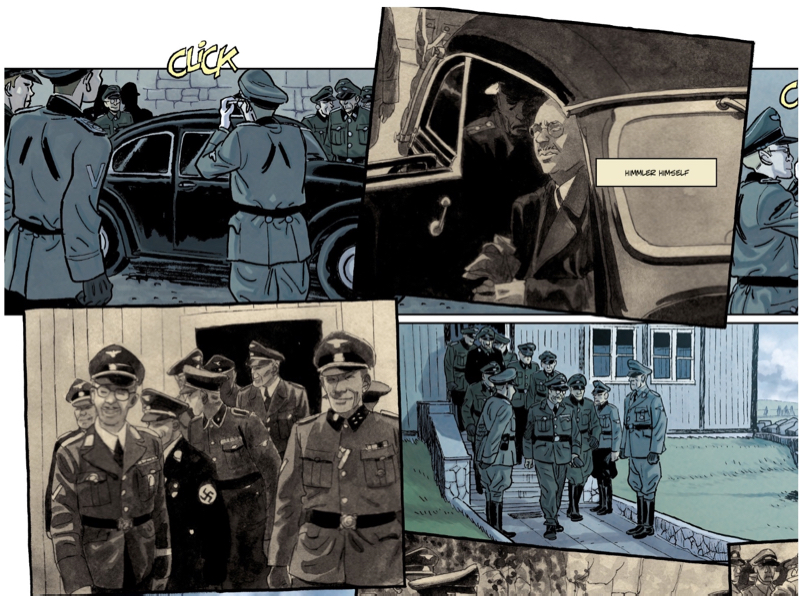
Graphic Novel Review | The Photographer of Mauthausen | cover and author photograph

The Photographer of Mauthausen by Salva Rubio (writer), Pedro J Colombo (illustrator) and Aintzane Landa (colourist) tells the story of Boix, a Spanish photographer and veteran of the Spanish Civil War. Following his part in the civil war, Boix was exiled to France and joined the French army before being captured by the Germans. The Photographer of Mauthausen starts with Boix's arrival at Mauthausen in 1941.

Boix starts off his internment as a translator but soon finds a position in the photography lab. Somehow, inexplicably, SS-Hauptscharführer Paul Ricken takes a liking to to Boix and recruits him as assistant to his macabre photography project. In this role, Boix is exposed to the many atrocities being committed at Mauthausen (in addition to the ones he had already witnessed).

Boix realises initially that this evidence needs to be preserved and several prisoners get involved in making this happen. However, as news reaches camp of an impending Russian victory, Boix realises that he needs to get proof of the atrocities to people on the outside of the camp.

Boix was successful and both his testimony and the photographic evidence proved that Nazis such as Kaltenbrunner and Speer were not only aware of what was happening at Mauthausen but they were complicit in the atrocities too.

The value of The Photographer of Mauthausen is in the questions that it raises about justice and remembrance. At the time of the Nuremberg trials, the photos were used to obtain convictions but Boix expresses frustration on page in the graphic novel about why people weren't more concerned about what happened at Mauthausen and the atrocities committed.

Graphic Novel Review | The Photographer of Mauthausen | Page from graphic novel depicting the photographer capturing various Nazi officers

The Photographer of Mauthausen is an excellent graphic novel that tells, in an accessible format, an important story in the annals of Holocaust history while serving as an educational source on both Nazi atrocities and the trials following the war.

I give The Photographer of Mauthausen a superb five out of five stars. The graphic novel is extremely well illustrated and written and recommended for those interested in history, graphic novels and the Holocaust.

★★★★★

SHARE:

Saturday, 30 January 2021

Unspeakable: The Tulsa Race Massacre by Carole Boston Weatherford and Floyd Cooper | Book Review

Greenwood District, Tulsa, Oklahoma was once home to a thriving African American community. On May 31st and June 1st 1921, a mob of armed white Tulsans attacked the community, killing as many as 300 African Americans and displacing 8,000 more. 2021 will mark the 100th anniversary of what became known as the Tulsa Race Massacre, the history of which was suppressed for seventy-five years.

Unspeakable The Tulsa Race Massacre by Carole Boston Weatherford and Floyd Cooper | Book Review

Unspeakable: The Tulsa Race Massacre is a picture book by author Carole Boston Weatherford and illustrator Floyd Cooper. It's short at 32 pages but aims to help young readers understand these terrible events so that "we can move toward a better future for all". It's aimed at the 8-12 years age group.

Reading Unspeakable: The Tulsa Race Massacre was physically painful. In the beginning, the book describes the thriving community of Greenwood District and the high street that became known as the "Black Wall Street". The descriptions of culture, fashion and community reminded me so much of what I've read about Sophiatown and District Six in South Africa, communities with vibrant cultures that were similarly razed to the ground.

Weatherford has done a fine job of simplifying the events for young readers, but presenting sufficient detail to draw older readers into healthy debate and discussion. It would be a good platform to stimulate further research and self-study too. The author's and illustrator's notes were particularly interesting, detailing their personal reasons for being involved in this work. Of particular note is the author's comment that the event was not even taught in Oklahoma schools until the twenty-first century.

Unspeakable The Tulsa Race Massacre by Carole Boston Weatherford and Floyd Cooper | Book Review

The illustrations by Floyd Cooper are exquisite, showcasing the fashions and vibrancy of Greenwood District, and ultimately the violence and devastation. The illustrations do a great job of bringing the events and people to life, ensuring that the reader relates to them and to the injustice of the events.

Unspeakable: The Tulsa Race Massacre is published by Carolrhoda Books, an imprint of Lerner Publishing Group

I would wholeheartedly recommend this book and am pleased to note that it's being released in both the US and UK (and presumably around the world).

An advance, electronic copy of this book was provided by Netgalley for the purposes of this review.

SHARE:

Sunday, 4 October 2020

Book Review: West of Jim Crow: The Fight Against California's Color Line by Lynn Hudson ★★★★☆

I know very little about American civil rights history from the late 19th to early 20th century. This is not surprising; my focus has primarily been on Africa (especially South Africa) and on genocides in the 20th century. It has been interesting to learn that anti-miscegenation laws and job-colour bars weren't the invention of Apartheid South Africa but originated in North America. Specifically, a set of so-called Jim Crow laws emerged in America from about 1880 that sought to enforce racial segregation and these laws would be a highly influential on laws adopted by South Africa.

West of Jim Crow: The Fight Against California's Color Line by Lynn M. Hudson | Book Review

In West of Jim Crow: The Fight Against California's Color Line, Lynn M Hudson focuses on the African Americans who moved to California to escape Jim Crow, expecting freedom and the benefits of full citizenship but instead realising that Jim Crow and racial segregation were all too present in the west.

This is not simply a recounting of the racism, fear-mongering and obsession with eugenics that featured so prominently in white society for the century after the Reconstruction Era (although these are mentioned in some detail throughout the book). West of Jim Crow is about the tireless efforts of Black Americans to assert their citizen rights, establish respectability, secure equal opportunities and protect their men and women from the scourge of lynching and the rise of the KKK.

It is also notably about the role of Black women, their agency and the significant roles they took in journalism, activism and other roles to secure their rights both as women and as human beings. As Lynn M Hudson remarks on many occasions, just because there is little in the written records about Black women's struggles for freedom and activism, does not mean there wasn't significant agency and activism present.

West of Jim Crow is structured around six chapters, each concentrating on a specific event in Californian history:

  • Reconstruction: the initial gains and setbacks in the period following the Civil War, with the rise of Jim Crow and associated Jim Crow entertainments and minstrelsy
  • The Panama Pacific International Exposition: a look at the systematic erasure of civil rights gains, the emergence of the NAACP, the popularity of Birth of a Nation and the rise of eugenics
  • The Rise and Fall of Allensworth: the town founded by and for African Americans, doomed to fail because of misrepresentation, geographical and environmental issues
  • On Lynching: an account of the events that divided a country into those who supported lynching and those who were appalled by it; eerily prescient of Trump, tiki-torch marches and the gun lobby
  • On the Ku Klux Klan: fighting arson and intimidation while the KKK infiltrated law enforcement and local government in California
  • The Fight to Desegregate Pasadena's Municipal Swimming Pools: how activists began to use the damages of Jim Crow to argue for civil rights, winning the Pasadena pool case and later the Brown v Board of Education case

West of Jim Crow: The Fight Against California's Color Line by Lynn M. Hudson | Book ReviewWest of Jim Crow covers an incredible wealth of information and provides an interesting, readable account of African American history in California. Initially I felt a bit exhausted by the repetitive, circular mode of writing, featuring titbits and breadcrumbs followed by elaboration and exposition. I've noticed that this form of writing is favoured by many historians and while it can be taxing to read, the truth is it is preferable to a dry, linear account and also aids significantly in the reader's retention and comprehension of historical information.

Despite this small reservation, I give West of Jim Crow an excellent four out of five stars and highly recommend to those wishing to know about this particular area of Black history.

★★★★☆

West of Jim Crow: The Fight Against California's Color Line is available to purchase from Amazon.com and Amazon.co.uk (disclosure: affiliate links. I will earn a small amount if you purchase using these links, at no additional cost to you).

My thanks to University of Illinois Press and Netgalley for advance, electronic copy of this book.

SHARE:

Thursday, 3 September 2020

Alfred Birney’s ‘The Interpreter from Java’ - Blog Tour and Guest Post

I’ve previously covered the suppressed history of Dutch atrocities in post-war Indonesia on this blog in 2012 and I was very interested to hear about Alfred Birney’s novel about a man named Alan Nolan who discovers his father’s memoirs about the atrocities he committed in the Dutch East Indies during the war with Japan – his life as an assassin, the murder of Indonesians in the service of the Dutch and his escape to the Netherlands to avoid execution. Today I’m taking part in the blog tour for the English-language release of The Interpreter from Java and thank Alfred Birney for the guest post below.


Colonial Shame by Alfred Birney

The Netherlands’ colonial past has been resurfacing regularly in the national media since 2016, spurred on in part by the success of my novel The Interpreter from Java. Slavery has also become a staple of public debate, though activists often face a barrage of criticism for asking the Dutch to take a broader look at their own history.

Colonial history has never been top of mind in the Netherlands, but things took a dramatic turn for the worse with the introduction of a new education system in the 1970s: secondary school students were allowed to pick and choose much of their own curriculum and history lost its status as a compulsory subject. And so we set about producing entire generations with the historical awareness of your average mollusc. Grist to the mill of a nation that was all too eager to sweep its own colonial history aside while pointing the finger at Germany, a country more inclined to shoulder the burden of guilt and apologise for its wartime atrocities. That same finger was pointed at Japan for having the temerity to invade the Dutch East Indies. But what about the troops – over 100,000 of them – dispatched from the Netherlands to reassert Dutch colonial rule after the war by mowing down Indonesian freedom fighters? No British-style Round Table Conferences preceded Indonesia’s independence.

Alfred Birney portrait - credit Eddo HartmannUnsurprisingly, the Dutch were happy to join in the worldwide protests against the US bombing of Vietnam. If there’s one thing we’re good at, it’s railing against abuses that occur far from our own little patch of mud. But many Americans now look back with a profound sense of what was done in their name. Countless movies and songs about that wretched Asian war have seen the light of day. A ten-part series on the Vietnam War, complete with blunders and atrocities, is now available on Netflix. And what have Dutch post-colonial sensibilities produced? Little more than small-screen adaptations of books from before 1900.

The Dutch government is spending over four million euros on an ‘independent study’ into war crimes committed during our great colonial war, a war we lost. This is a farce. Everything of note has already been recorded and filed away, nothing new will surface. These millions are earmarked for the Royal Netherlands Institute for South East Asian and Caribbean Studies, the Netherlands Institute for War, Holocaust and Genocide Studies and the Netherlands Institute for Military History.

A study conducted by three government-funded institutes – how independent is that? The men in charge say they welcome cooperation with Indonesia, yet failed to invite a single Indonesian to their obligatory kick-off event. They are eager to talk to Indonesian eyewitnesses from the colonial war of independence, all of whom are long dead.

While the stated aim of this study is to analyse the violence on both sides, the Netherlands refuses to simply translate the work of Indonesian historians. Every effort will be made to explain Dutch violence in the broader context of post-war decolonisation, a framework of international political, administrative, judicial and military justifications. International, eh? They’ll be blaming the Allies next!

But there is hope. Truly independent researchers in the United States and Flanders are sifting through the facts and taking up their pens. Free from that peculiar mix of colonial shame and arrogance that inflicts the Dutch, they will one day rap us on the knuckles as firmly as we have done with other nations.


The Interpreter from Java is translated by David Doherty, published by Head of Zeus and available in hardcover from today.

Photo credit portrait of Alfred Birney © Eddo Hartmann

SHARE:

Wednesday, 29 August 2012

Before the Spring: Invasion of Iraq and Iraq War (2003-2011)

This is the second in a series on A Decade of Conflict Leading up to the Arab Spring.

The United States invasion of Iraq took place between 19 March and 1 May 2003.  It was presented to the American public and the world at large as an action that would rid the world against terrorism, protect against Saddam Hussein’s weapons of mass destruction, and liberate the people of Iraq. 

The invasion was seen to be successful because it resulted in the toppling of Saddam Hussein’s Ba’ath Party government in just 21 days and allowed the subsequent occupation of Iraq.  It was the first action in what was to become the Iraq War which officially lasted until 18 December 2011.

The difficulty is that Iraq held no weapons of mass destruction, was not in any way involved in the 9/11 terrorist attacks on America (which was the galvanising force behind American support for the invasion), and left the people of Iraq traumatised and devastated after being subjected to nearly a decade of brutal force.

Army Sgt stands guard near burning oil well in Rumaylah Oil Fields in Southern IraqArmy Sgt stands guard near burning oil well in Rumaylah Oil Fields [Wikicommons]

It is likely that the invasion of Iraq, a sovereign state, by United States forces was illegal and then Secretary-General of the United Nations, Kofi Annan, said as much in 2004.  Far from freeing the Iraqi population, the war resulted in the death of at least 100,000 Iraqi citizens (with some estimates rising to 1 million civilian deaths, see Casualties of the Iraq War).

A heavy bombing campaign lead to the wide scale destruction of infrastructure and services in Iraq, leaving the population without water, electricity, sewerage systems and hospitals.  The bombs dropped on Iraq were laced with depleted uranium resulting in a lasting radioactive contamination that will likely remain for generations.  There has been a sharp increase in childhood leukaemia, cancer and infant mortality in highly bombarded regions in Iraq.

The war in Iraq resulted in a humanitarian crisis of massive proportions that has spilled over into neighbouring countries. 

“UNHCR estimates that more than 4.7 million Iraqis have fled their homes, many in dire need of humanitarian care. Of these, more than 2.7 million Iraqis are displaced internally, while more than 2 million have escaped to neighboring states.” - UNHCR, "Iraq Refugee Emergency"

Malnutrition and disease outbreaks are widespread in a population with a disproportionate amount of widows and orphans.

Finally, much was made of the positive effect that the war would have on the liberation of women in Iraq.  In their book What Kind of Liberation? Women and the Occupation of Iraq, Nadje Al-Ali and Nicola Pratt discuss the challenges facing the women of Iraq.  They have noted an increase in neo-conservatism and the rise of violence against women, oppression and honour killings.  Women and young girls are often forced into prostitution or become victims of sex trafficking and exploitation.  Despite the rise of women-headed households, Iraqi women face great obstacles in becoming employed or gaining an education.

More so than ever before, every step of the Iraq War was subject to media scrutiny with many news outlets employing permanent correspondents and embedded reporters in key Iraqi locations.  While news outlets struggled to remain neutral amid accusations of propaganda and censorship, Al-Jazeera was noted for being one of the few news outlets to portray Iraqi casualties and present to audiences a view of the devastation in Iraq.

As with the Second Intifada, the people in neighbouring Arab countries received these broadcasts and took to the streets in protest against the Iraqi War.  The sentiment was increasingly anti-USA, anti-United Kingdom and anti-Israel with protests in Syria, Tehran, Cairo and later Baghdad and Basra in Iraq itself. 

Once again, in the context of rising distrust and conflict following the 9/11 attacks, increasing reports of discrimination and Islamophobia, and war in both Israel and Iraq, Arab speaking people began to feel solidarity to one another and an identification with the Palestinian and Iraqi causes.

Further reading:

SHARE:

Wednesday, 15 August 2012

Before the Spring: The Second Intifada (2000 – 2005)

This is the first in a series on A Decade of Conflict Leading up to the Arab Spring.

Also known as the Al-Aqsa Intifada. 

The Second Intifada was a period of unrest and conflict between Israeli armed forces and Palestinian citizens.  It took place in the occupied Palestinian territories in Israel, starting on 28 September 2000 and lasting until 2004/2005.  It began in the context of the failure of the Oslo Accords, an attempt for peace negotiated between Israeli and Palestinian leaders.

Violence and protests erupted when Ariel Sharon, then an Israeli opposition party leader, entered the Temple Mount / Al-Haram Al-Sharif area (a disputed area which has significant religious importance to both Jews and Muslims) and stated that "the Temple Mount is in our hands and will remain in our hands. It is the holiest site in Judaism and it is the right of every Jew to visit the Temple Mount".  This was seen as extreme provocation and the grounds for years of conflict and unrest.

The-Second-Intifada Palestinian protestors during the Second Intifada [Gallo/Getty]

Depending on which source you consult, the Israelis and the Palestinians are painted as the primary aggressors, with both sides using questionable tactics. For example, the overview section on Wikipedia notes the Palestinians’ use of suicide bombings, rocket and mortar attacks, lynchings, kidnappings shootings, stabbings, stonings and assassinations.  The Israelis are simply painted as imposing checkpoints and curfews (see: “Second Intifada: Overview”). 

Both sides refer to events such as the Muhammad al-Durrah murder (caught on camera by a French cameraman), the Ramallah lynching, the murder of Israeli teenager Ofir Rahum, and the battle of Jenin to further support their position.

Perhaps the figures speak for themselves?  In the Introduction section of the same article, Wikipedia cites B’Tselem statistics of a final death count of up to 5,500 Palestinians, 1,100 Israelis and 64 foreigners.

In the first few days of the clashes in September 2000, Israelis responded to stone throwing, riots and demonstrations with both live fire and rubber bullets and the death toll rose from 7 Palestinians in the first day to 47 after five days.  Amos Malka, then head of Israeli military intelligence, is famous for stating that 1,300,000 bullets were fired by Israeli soldiers in that first month alone.

“By the end of the year, at least 275 Palestinians had been killed and thousands had been wounded, along with 19 members of the Israeli security forces and five Israeli civilians, according to the Israeli human rights group B'Tselem.

Palestinian stone-throwers were met with Israeli snipers; gunmen, with helicopter gunships and tanks. What began as a popular protest movement quickly began to look like a war…

… Demonstrations were being met with overwhelming force by Israel and it made popular protest impossible.” - Al-Jazeera, "Remembering the Second Intifada"

After a year, Palestinians took to suicide bombings and sniper attacks.  The attacks were said to have a significant psychological effect on both Israeli military and civilians.  By the end of 2004, there had been 135 attacks and more than 500 casualties but nowhere near how many Palestinians were being killed by Israeli armed aggression.

“Israel's campaign to suppress the uprising took a heavy toll on ordinary Palestinians.

After four years, at least 2,859 Palestinians had been killed and tens of thousands injured. Israel destroyed more than 3,700 Palestinian homes and placed more than 7,300 Palestinians in Israeli prisons according to B'Tselem.

Significantly, the Palestinian leadership was also decimated by a concerted campaign of assassination.” - Al-Jazeera, "Remembering the Second Intifada"

Indeed, there were 273 assassinations of Palestinian leaders by Israeli undercover units, the most notorious being the July 2002 bombing of a compound that killed Salah Shehade, commander of the Izz ad-Din al-Qassam Brigades along with 15 other people including Shehade’s wife and his nine children. 

The bombing was thought to be so barbaric that it inspired the “Pilot’s Letter”, a signed declaration by several Israeli air force pilots that they would not conduct bombing campaigns over Palestinian occupied territory.  However noble, the letter was roundly damned by the Israeli military with several pilots being fired in both military and civilian sectors and more being forced to retract their signature.

The Second Intifada was a long and protracted period of conflict in which the primary casualties were civilians.  Israeli forces were indiscriminate in their reprisals against suspected terrorists while Palestinian attacks specifically targeted civilian populations. 

It is important to understand how these events were viewed by people in the Middle East and the role these sentiments played in the Arab Spring.

Intense media coverage by Al-Jazeera inspired Arabs and lead to solidarity protests across the Arab world. The protestors identified with and supported the Palestinian cause and they were disappointed in their own leaders for not using their influence with the USA to assist against perceived Israeli brutality. Protests, attacks and flag burning occurred in Lebanon, Tunisia, Egypt and Syria.

Further reading:

SHARE:

Friday, 10 August 2012

The Suppressed History of Dutch Atrocities in Indonesia

The piece below is written by Paul Doolan and was published today in the Australian e-journal On Line Opinion as “In the Netherlands, a suppressed history makes the headlines”.  In this article, Doolan discusses the fascinating history of oppression and atrocities in post-war Indonesia during their fight for independence and how this history was all but erased from the Dutch public conscience in for over 60 years. The article is shared under the Creative Commons license with due credit given to both Paul Doolan and On Line Opinion.


The problem with the past sometimes, is that it isn't past at all, as the Dutch have been forced to face up to recently. For the Dutch, the history of the mid- 20thcentury was quite simple until very recently: a freedom loving people (the Dutch) were attacked by an aggressive neighbor (Germany) and suffered for five years until, with the help of some friends, they were liberated. Conveniently forgotten was that, following this episode, the Dutch state mobilized the largest army in its history and fought a war against the Indonesian independence movement. The Dutch lost the conflict, and in December 1949 their former colony, the Dutch East Indies, gained independence. During the following decades this tropical misadventure formed an almost blank page in the nation's history. But that, it seems, is changing. Events during the past year have forced the Dutch nation to reconsider the myth that for over a half century has formed their collective memory. Especially in the past couple of months, history has become front page news.

Eerste beeld van executies in indie

The Dutch had ruled most of Indonesia for 350 years, but found themselves prisoners of the Japanese from 1942 to 1945. With the defeat of Japan, Indonesian nationalists declared independence. The Dutch tried, with great difficulty, to reassert their control of the archipelago. After over four years of bitter conflict The Netherlands was forced to concede independence to Indonesia in December 1949.

By the end of the war numerous cases of military excesses had come to the attention of the Dutch public. Massacres by Dutch Special Forces on the island of South Celebes (present day Sulawesi) had been the subject of parliamentary debate. A massacre in the village Rawagede had been the subject of debate at the United Nations Security Council in 1948. Such incidents gradually led a minority of the Dutch press to turn against the war. In February 1949 leftist De Groene Amsterdammerpublished a letter from an unidentified officer. He wrote that Dutch officers:

defend with passion and conviction the assertion that, for instance, if you are shot at from a kampong [village] than this kampong should be set on fire from four sides before the inhabitants have the chance to run away. And whoever then tries to escape (…) you shoot with a machine-gun, preferably not bothering with if these include women of children.

The officer then drew a comparison with Putten, a village that had become infamous as being the site of one of the worst Nazi atrocities perpetrated on Dutch soil. The officer wrote of summary executions of prisoners who are "simply shot behind the head and then buried." He described the Indonesians as living under "military terror."

But after the loss of their colony in December 1949 and the return of their soldiers the Dutch authorities quietly and quickly put the lid on this uncomfortable period of contemporary history. For many decades, with only the occasional exception, the possibility that Dutch forces had been guilty of atrocities, or even war crimes, was kept out of public consciousness. But last September history ended up in the court room and a court verdict in The Hague found the Dutch state responsible for carrying out a massacre of over 300 unarmed Indonesians in 1947 in the village of Rawagede, Indonesia, and called on the state to award compensation to the plaintiffs – seven elderly widows of those massacred.

Photos emerge of Dutch war crimes in Indonesia

Recent months have seen an increase in public attention on Dutch military atrocities. Earlier this year a national television channel, NCRV, broadcast a documentary on the Dutch atrocities committed on Sulawesi in 1946-1947, when around 3,000 Indonesians were executed without trial by special Dutch forces. It turns out that an official parliamentary inquiry into these events had taken place in 1954, but the report was kept top secret. The NCRV managed to get hold of a copy and for the first time the Dutch public heard excerpts from the report which would seem to indicate that widespread atrocities had had the support of the military and political leadership, and had then been officially hushed up. A few months after the broadcast a foundation representing the widows of ten victims of the Dutch on Sulawesi began a legal procedure against the Dutch state. The lawyer representing the foundation is Liesbeth Zegveld, who also led the successful case on behalf of the widows of Rawagede. The odds are that the Dutch state will be found responsible for war crimes again.

In early July historians from three research institutes of worldwide reputation issued a public statement, claiming that the Dutch state has never come clean on its colonial past and called for the government to fund a large scale research project that would systematically look at the behavior of the Dutch military in Indonesia during the years 1945-1950 and examine the role of the Dutch political elite in the conflict. The fact that the history of the war of decolonization in Indonesia has become a hot topic can be seen by the fact that this announcement by academic historians was reported on national news, in newspapers and on radio and television. It isn't often that history makes the headlines. Yet more was to follow.

Dutch atrocities in Indonesia

On July 10th the national newspaper, de Volkskrant, published two photos that seem to show three Indonesians standing in a mass grave, being executed by Dutch soldiers. The photos had belonged to a deceased former Dutch soldier and had been rescued from a rubbish dump. Remarkably, these were the first ever photos of Dutch executions ever to be published – 63 years after the end of the war. De Volkskrant ran the report on its front page and within hours it was being reported on the radio and television. I've just returned from a two week visit to the Netherlands and everyone I spoke to had seen the photos. The most common reaction was: "why have we been lied to all these years?" Perhaps we can expect to find an answer some time in the not too distant future.

About the Author


Paul Doolan teaches history at Zürich International School, Switzerland and lectures in Political Systems at the College for International Citizenship in Birmingham, England.

Paul blogs at ThinkShop

SHARE:

Sunday, 10 June 2012

This Day In History: 10 June 1942

The Destruction of Lidice

On 10 June 1942, Nazi forces completely destroyed the Czechoslovakian town of Lidice which is located just north-west of Prague.  They surrounded the village and rounded all 173 of the men up, taking them to a local farm where they were all shot to death. The women and children were separated and unspeakable atrocities were then committed against them.  Four pregnant women had their unborn children forcibly aborted and they were then sent to concentration camps while the majority of the rest of the women were sent to work at Ravensbrück concentration camp where most of them perished. 

Lidice Children's MemorialLidice Children's Memorial. Photo credit: Moravice [Source]

Eighty-eight children were transported to the Polish city of Lodz, south-west of Warsaw.  Seven of them were selected for Germanisation but the rest were taken to nearby Chelmno on 2 July 1942 and were gassed to death. 

The village of Lidice was razed to the ground, buildings were destroyed and even graves in the cemetery were dug up and destroyed.  The absolute cleansing of Lidice was complete.

The Assassination of Reinhard Heydrich

Reinhard Heydrich was a Nazi official and one of the major architects of The Holocaust.  He spoke at the Wannsee conference in January 1942 where he called for Jews to gathered from across Europe to be worked to death in concentration camps or exterminated. 

He was assassinated on the morning of 27 May 1942 by British trained Czech and Slovak parachutists.  His death caused an intense stage of mourning amongst Nazi circles and Hitler called for the explicit destruction of any village found to be harbouring Heydrich’s killers.  He ordered that all males should be killed, women transported to a concentration camp, children Germanised or otherwise dealt with, and the village razed to the ground.

The Assassination of Reinhard HeydrichHeydrich’s car at scene of assassination. Photo credit: Bundesarchiv [Source]

Intelligence incorrectly linked the towns of the Lidice and Ležáky and Hitler’s orders were carried out to the letter in a terrible and brutal act of revenge carried out against innocent men, women and children.

Lidice Lives!

In the aftermath of Heydrich's assassination, Adolf Hitler is said to have proclaimed that “Lidice shall die forever!”  When he heard of Hitler’s plan to destroy Lidice and the terrible price that the people Lidice paid, a Labour MP in Stoke on Trent, England decided to start the Lidice Shall Live campaign.

Through his work, Lidice was rebuilt and a home created for the 153 women and 17 children who returned after the war.

You can read more about Barnett Stross’s work and the incredible generosity of the people of Stoke on Trent in helping to rebuild Lidice over at Dáithaí C’s blog: Lidice Lives.  You can also read about the anti-fascist art exhibition in Melbourne in 1942 (partly inspired by the events at Lidice) at the Art and Architecture, Mainly blog: Anti-Fascist Art Exhibition, Melbourne 1942

SHARE:

Wednesday, 30 May 2012

Prijedor: An Anatomy of A Genocide

prijedor-genocide-kozarac-massacre-1 Kozarac memorial [Source: Ranko Cukovic/Reuters]

If there were a guidebook for preparing for a genocide, it is likely that it would include several fundamental steps.  The budding genocidaire would be advised to seek out a society characterised by increasing socio-political tensions, preferably in the grips of a war or economic collapse.  The media would be used to conduct a campaign of propaganda, vilifying one ethnic group and blaming them for the ill fortunes of another. Radio and news stations would need to be taken over, newspapers controlled.

The enemy would need to be identified, dehumanised.  The coup de grace would be getting the enemy to participate in identifying themselves, making them carry passbooks and identity cards, wear arm bands or paint their doors.  And then you kill them.

If this reads as flippant, it is certainly not meant to be but it underlines the precise reason why genocide education is so important.  After the horrors of the Holocaust, there is no way that the painstakingly well-planned and systematic genocides in Rwanda and Bosnia should have gone unnoticed before it was too late, but they did.  And they followed a frighteningly similar pattern to that described above.

Prijedor is a town in north western Bosnia and Herzegovina.  According to the 1991 census, prior to the war in 1992-1995, Bosniaks formed 43.9% of the town’s inhabitants, 42.3% were Serbs while the rest were Roma, Ukrainians, Croats and Serbs.  In the aftermath of the war, 94% of the Bosniaks and Bosnian Croats had been removed from the area in a brutal campaign of ethnic cleansing that saw Bosniaks and Bosnian Croats murdered, raped and interred in concentration camps.

It began shortly after Slovenia and Croatia declared independence in 1991.  A local Serbian newspaper Kozarski Vjesnik began to print propaganda, instilling fear of local Bosniak and Croatian populations and imploring Serbs to arms themselves against these perceived threats.  The statements were inflammatory and emotive, using historically loaded terms such as Ustaše and Mudžahedini to refer to Bosnian Croats and Bosniaks respectively.  The local radio station Radio Prijedor was taken over, as was the television transmitter station.

There were rumours abounding of a document known as the “Silent Night”, a list of Serbian intellectuals, political leaders and community figures that were supposedly being targeted by Bosniak militants.  Such propaganda paved the way for the the next phase of identification and removal.

It is reported that on 31 May 1992, the Bosnian Serb authorities in Prijedor issued a decree that all non-Serb civilians should mark their houses with white sheets or flags and that they should wear white armbands when out of their homes.  This was witnessed by European Commission Monitoring Mission observers in August 1992 and is exactly what the Nazis did to Jews during the Holocaust, yet nothing was done to stop the upcoming extermination.

Thousands of Bosniaks and Bosnian Croats died in Prijedor and the surrounding villages and thousands more still were forcibly removed from their homes, raped, executed and arrested and sent to nearby Keraterm, Omarska and Trnoplje camps.  Inhabitants in camps were subjected to further regimes of torture and beatings, many to the point of death, and widespread rape and sexual assault of both male and female prisoners occurred. 

It could be said that a blueprint of the Nazi atrocities against the Jews was taken and applied precisely against the local non-Serb population in Bosnia and just as entire regions of Poland and Europe remain cleansed of Jews, so have regions of Bosnia been cleansed of non-Serbs.  It beggars belief that this happened in 1992.


Tomorrow marks 20 years since Bosnian Serb authorities decreed that non-Serbs should identify their homes and persons with white sheets, flags and armbands.  To this day, and in spite of ICTY judgements, local authorities have not apologised for or acknowledged these atrocities. 

To this end, 31 May is marked as White Armband Day Worldwide and you are invited to show your solidarity with victims of mass atrocities committed in Prijedor and around the world by wearing a white armband or placing a white sheet or flag on your window.

Visited the Stop Genocide Denial website for more details.

Further reading:

Bridging the Gap in Prijedor, Bosnia and Herzegovina [ICTY]
31 May – White Armband Day Worldwide [Stop Genocide Denial]
Milomir Stakić case information sheet (PDF) [ICTY]
Milomir Stakić judgement (PDF) [ICTY]
Duško Tadić judgement (PDF) [ICTY]
Prijedor Massacre [Wikipedia]
Aftermath of the Bosnian Genocide: In the Land of War Criminals [Bosnia Genocide]

SHARE:

Monday, 30 January 2012

This Day in History: 30 January 1972

I doubt that there are many people unfamiliar with the massive U2 hit “Sunday Bloody Sunday” but few people know what the song is about and the tragedy that inspired it. 

It was forty years ago today that soldiers of the British First Parachute Regiment (1 Para) opened fire on unarmed protestors, killing thirteen immediately and wounding fourteen others, with one man dying several months later of his wounds.


Banner and Crosses carried by the families of the Bloody Sunday victims on he annual commemoration march.
Photo credit: Sean Mack [
source]

As a South African, I find the similarities between this event and those of the 16 June 1976 to be particularly chilling.  Both events featured young people marching against civil rights abuses, both involved armed forces opening fire on unarmed protestors and both resulted in the deaths of innocent people.

So what happened on the day that would forever be known as Bloody Sunday or the Bogside Massacre?

The Bogside Area, Derry, Northern Ireland, 30 January 1972

The Northern Ireland Civil Rights Association (NICRA) organised a march to protest against the practice of internment without trial which was introduced in August 1971.  Authorities decided to let the peaceful march go ahead but there was a heavy army presence.  The march was intended to culminate at the Guildhall but barricades were erected and the protestors were redirected to Free Derry Corner.


Bottom of William Street one minute before the British First Parachute Regiment opened fire, killing thirteen civilians – an event now known as Bloody Sunday, Derry, Ireland, 1972
Photo credit: Gilles Peress [
source]

Eye witness accounts at the Museum of Free Derry speak of some altercations at the barricade, with protestors throwing stones, but nothing unusual by Derry standards.  The mood was upbeat when the march began just before 3pm but it was shortly before 4pm that the first shot rang out.

Five more shots were reported at 3.55 pm but it was reported that at 4.10pm soldiers of the Support Company opened fire on the crowd and did not stop firing until 30 minutes later.

Seven of the fourteen victims were teenagers and many were shot from behind as they were fleeing the scene or attempting to assist others.


Fr Daly waving a bloody handkerchief as he and several others carry the fatally wounded Jackie Duddy, 17, past British soldiers on January 30, 1972, known as Bloody Sunday.
Photo credit: Stanley Matchett [
source]

The first victim was seventeen-year-old Jackie Duddy. 

Four witnesses, Edward Daly, then a Catholic priest, Mrs Bonner, Mrs Duffy and Mr Tucker, all stated that Duddy was unarmed at the time he was shot and that he was running away from soldiers when he was shot. Three of these witness stated that they saw a soldier take deliberate aim at Duddy as he fled across the courtyard of Rossville Flats – CAIN Web Service

The Roots of the Protest

It is not sufficient to only look back to 1971 to understand the situation in Derry on the day of the march.  The Museum of Free Derry gives a comprehensive background to the rise of the civil rights movement in Northern Ireland, dating back to when the country was formed in 1920.

Politics and location had worked in favour of the mainly Protestant Unionists (those in favour of remaining part of Britain) while the mainly Catholic Nationalists saw increasing infringements on their civil rights.

Significantly, NICRA was formed in 1967 to campaign against inequalities in the allocation of public housing, discrimination in jobs and workplaces, and an unfair voting system.  It seems bizarre that in the late 1960s in Northern Ireland, property plural voting still existed and citizens had to campaign for "one man, one vote". 

It is believed that the blossoming civil rights movement became a mass movement on the 5 October 1968 when police attacked protestors at a NICRA rally in full view of the world’s media.

In the two years that followed, conflict escalated between between Unionists and Nationalists and tensions increased when Terrence O'Neill’s November 1968 Reform Package angered and disappointed both parties.  Riots began to break out with increasing frequency throughout 1969 and 1970, with increasing activity by the once-dormant IRA. 

The government felt justified then in introducing internment without trial on 9 August 1971.  Known as Operation Demetrius, this involved dawn raids by the British Army over two days, involving the mass arrest and internment without trial of 342 people suspected of being involved Irish republican paramilitaries.

The operation resulted in the displacement of 7,000 people as families fed to Ireland and other locations.  Those arrested were housed in internment camps, scarily reminiscent of the Nazi-era concentration camps and perhaps a precursor for the detention facilities at Guantanamo Bay. 

The Denial

If the facts above make you deeply suspicious of Britain’s track record in human rights, wait until you hear about the aftermath of the events of Bloody Sunday.  On 19 April 1972, a report by Lord Chief Justice, Lord Widgery, largely exonerated the British Army of any blame for Bloody Sunday.

The report by the Lord Chief Justice, Lord Widgery, stated that if the illegal march - protesting against internment without trial - had not taken place there would not have been any deaths - BBC News

The most severe criticism that Widgery offered was that the shooting "bordered on the reckless" but his ridiculous account was accepted not only by the British government and Northern Irish Unionists, but much of the British and international media too.

It was not until 30 January 1998 that British Prime Minister Tony Blair announced a new enquiry into Bloody Sunday.  Known as the Bloody Sunday Inquiry, the inquiry lasted for 12 long years before the Saville Report was published on 15 June 2010.  The report was so damning of the actions of British soldiers and the aftermath that Prime Minister David Cameron immediately apologised on behalf of the United Kingdom for the “unjustified and unjustifiable” events of Bloody Sunday.

"The report leaves me in no doubt that serious mistakes and failings by officers and soldiers on that terrible day led to the deaths of 13 civilians who did nothing that could have justified their shooting," he said - BBC News

Such is the extent of the cover up and distortion of the events of Bloody Sunday that members of the public, jaded from years of IRA attacks, were incensed by Cameron’s words.  They have been so terrorised over the years, and lied to on so many occasions by the media and their own government, that they forget that fourteen innocent people were murdered that day.

SHARE:

Tuesday, 9 August 2011

This Day in History: 9 August 1956

1948: The National Party Victory

South Africa, 1948: the United Party (led by incumbent Prime Minister Jan Smuts) and the Herenigde Nasionale Party (Reunited National Party) (led by DF Malan), competed against each other in the national elections.  This was an election where only white South Africans could vote, and realising that many of the electorate felt threatened by black political and economic aspirations, Malan promised a system of grand Apartheid if he was victorious.

The HNP was victorious and when they came into power in 1948, they implemented Apartheid.  The HNP was eventually renamed the National Party and thus, the same party was in power from 1948 to 1994, when the African National Congress took power in the first democratic elections in South Africa that featured universal franchise.

Apartheid Whites Only
Source

1950: The Group Areas Act

One of the first acts to be enacted following the implementation of Apartheid was the 1950 Group Areas Act.  The Group Areas Act divided up urban areas and assigned different racial groups to different residential and business areas. This meant that the black, white, Indian and coloured populations could not live together or own businesses in the same areas.  The 1913 Native’s Land Act had already ruled that only white people could become landowners in South Africa.

1952: The Pass Laws

The 1923 Native Urban Areas Act had made it compulsory for black men in cities to carry passes on them.  Any man found without a pass would be arrested and sent to a rural areas.  In 1952, the Native Laws Amendment Act and the Natives (Abolition of Passes and Coordination of Documents) Act were enacted to assist in policing the 1950 Group Areas Act.  The Native Laws Amendment Act required that no black South African could remain in an urban areas for longer than 72 without the necessary documentation.  The Natives (Abolition of Passes and Coordination of Documents) Act required that all black South African men over the age of 16 had to carry a single reference book.  It also noted that women would be required to carry such reference books at some time in the future.

Dompas
Source

The Injustice of the Dompas

The reference book (enduringly referred to as the dompas in Afrikaans) would stipulate where and for how long a person could remain and it included photographs, fingerprints and employer details.  It was a horrifically limiting document because black South Africans were subject to persecution if they were found to be outside of their stipulated area.  That meant that a man could not visit his brother who was working in the next neighbourhood, for instance.  If he lost his job, his right to remain in an urban area could be rescinded by any government employee and he could be made to return to rural areas immediately. 

Blacks in urban areas were often forced to leave their families behind in rural areas.  The consequence of this is that they could be subject to arrest, punishment and persecution if they were discovered to be travelling to or from those rural areas too.  Basically, each time a black person wanted to move within the country, they had to seek permission and that permission was recorded in their pass book.

Life in the Homelands

In the decades leading up to the 1950s, the majority of black South Africans in urban areas had been men.  They were often migrant workers, employed on mines and in factories and women were often left behind to look after the family.  The problem with the rural areas (and Homelands) allocated to black people is that they were specifically chosen on the basis of their dry, arid and unsustainable nature.  The very worst pockets of land in South Africa were allocated to rural black populations. 

A combination of factors lead to more and more women moving to urban areas in the early days of Apartheid.  Some scenarios include the death of income earners in precarious conditions in mines and factories; neglect from partners who took up with mistresses in town; and severe poverty caused by the high cost of living in urban areas, the inability to send enough money home, and the inability to sustain families in the arid conditions of the Homelands and rural areas.  Women were also permitted to join their spouses in urban areas if he had been born in that area or had laboured continuously in an area for over ten years.

(Incidentally, many of these factors continue today and many children are brought up in rural areas by grandparents and the extended family as poverty and economic needs continues to drive families apart).

1955: Plan to Issue Pass Books to Women

In response to the growing number of black women in urban areas, the government announced in September 1955 that all black women would be issued reference books with effect from January 1956.

9 August 1956
15BAHA-Women's-March-4
©Baileys Archives [Source]

The protest on 9 August 1956 was not the first protest against the Pass Laws and it was one action among one of the most colourful and successful liberation struggles in history.

What was outstanding about this protest is that it surprised many parties, the government and liberation movement included and it showed that women were active, organised and militant.


On 9 August 1956, 20,000 women marched to the Union Buildings in Pretoria in protest of the pass laws and the roll out of reference books for women.  The march was organised by the Federation of South African Women in conjunction with the ANC Women’s League and was attended by such great women as Helen Joseph and Albertina Sisulu.

Women came from all over the country to attend the protest, from as far afield as Durban and Cape Town, and black, white, coloured and Indian women attended the march.

The crowd left bundles of petitions filled with 100,000 signatures at Prime Minister JG Strijdom’s doors as he was not at the Union Buildings that day. 

In a masterpiece of peaceful protest, the women stood for a full half an hours’ silence, many with children on their backs, as they protested the assault on their freedom and integrity that the pass laws represented.

9 August 1994

Apartheid ended in 1994 when the African National Congress came to power.  Since 9 August 1994, the day has been commemorated as National Women’s Day in South Africa.  It is a public holiday and that is why South Africans celebrate women’s day on a different day to the rest of the international community.

SHARE:

Sunday, 17 April 2011

Book Review: Treblinka Survivor: The Life and Death of Hershl Sperling by Mark S. Smith

Treblinka Survivor coverTreblinka was a Nazi extermination camp situated near the village of Treblinka in Poland.  Extermination or death camps were different to concentration camps in that they were never designed for the incarceration of prisoners but simply to expedite the efficient extermination of thousands of people at a time.  At a conservative estimate, over 850,000 people entered Treblinka Death Camp between July 1942 and October 1943 and less than seventy came out alive.

Hershl Sperling was one of the inmates who escaped during the Treblinka Uprising on Monday 2 August 1943.  Prisoners attacked the SS headquarters, destroyed petrol tankers, and set buildings alight.  They entered into the extermination portion of the camp, killing informants and attacking watchtowers before finally escaping through the perimeter fence and across the anti-tank defences.  Many of the survivors lost their lives within the camp, while crossing the anti-tank defences, or during the relentless pursuit through the surrounding woods and in fact, most of the escapees were caught and murdered within that first 24 hours.

Treblinka Concentration Camp Sign

Of the escapees that survived the woods and reached the surrounding houses, many were betrayed and handed over to the SS by local residents.  Yet a local family helped sixteen-year-old Hershl Sperling and two others by feeding them and helping them to escape to the south-west, towards Warsaw.  He made it to Warsaw but Sperling was eventually recaptured on a train and sent to Auschwitz via Radom, then on to Birkenau, Sachsenhausen, Kaufering and Dachau where he was liberated. 

By the time he was eighteen-years-old, Hershl Sperling had survived two Nazi death camps, five concentrations camps, the escape from Treblinka, a death march, starvation, malnutrition and slave labour.  What would cause a man who had survived the greatest horrors of the twentieth century to jump off a bridge in Scotland 44 years later?

Treblinka Survivor: The Life and Death of Hershl Sperling by Mark S. Smith is an attempt to understand what Hershl went through and the events that eventually lead up to his death.  Much of the book is based on Hershl’s own testimony (Treblinka by Hershl Sperling) which appeared in a journal published shortly after the war entitled From The Last Extermination: Journal for the History of the Jewish People During the Nazi Regime.  As an eyewitness testimony, this work is extremely valuable and is translated and published in full at the end of the book. 

WW2-Holocaust-Poland

Author Mark S. Smith was a childhood friend of Hershl’s son, Sam Sperling and the book follows four main storylines: Hershl’s life before and during the Holocaust, as related by him to his sons and through his written testimony; Hershl’s life and struggles after the Holocaust, as recalled by the author, his sons and others who knew him; the struggles and experiences of his sons Alan and Sam as they grew up in the house of Holocaust survivors; and finally, the experiences of the author as he travelled to Poland and America to research the book, with visits to the sites of Treblinka and Auschwitz.  

KZ Treblinka, Lageplan

Treblinka Survivor: The Life and Death of Hershl Sperling is an extremely well-written book.  It is an authentic historical account and not dry as one might imagine, but highly readable. Having said that, there were parts that I had to force my way through as the sense of horror builds and I realised that yet another mind-blowing revelation awaited me.

The book is especially powerful as the original testimony is interspersed with a huge body of research and the author's commentary.  It is also corroborated by the testimony of other camp survivors as well as the meticulous records kept by the Nazis. 

The accounts of life and death in Treblinka were shocking and may upset sensitive readers.  This is simply the most disturbing book I've ever read.  The accounts and descriptions were vivid and well-written and I found it hard to rid my mind of the images the book evoked.

Photo of Treblinka site from 1945, mass graves were disturbed, and bones and personal effects are visible

The sheer scale of the murder at Treblinka was astounding. Ten to fifteen thousand people were systematically murdered each day between July 1942 and October 1943.  This was no concentration camp, no internment or work camp: this was a death camp.  Hershl notes in his testimony that up to 24,000 were killed on one particularly ‘efficient’ day.

It is not surprising that I experienced nightmares and sleeplessness while reading this book and felt quite unable to think of anything else.

Treblinka - Rail tracks

This is a devastating and horrific book but an important one and one that I am glad to have read.  The account of how lost Hershl felt after the Holocaust and especially after the death of his wife, of his depression and struggles with alcoholism, seemed to highlight the depths of despair to which he sank.  Anyone who has ever suffered from acute depression might understand how Hershl could ever utter, "this is worse than Treblinka".

Caught in that twilight between death and dying for so long that his reactions were forevermore a manifestation of denial, bargaining, numbness and grief, it seems that Hershl Sperling never entirely escaped Treblinka.  The author explains that he was in a perpetual state of fight or flight, in the motion of the survival instinct.  Perhaps his suicide was one last stand to live or die at his own hands and not at the hands of the Nazis or the ghosts that haunted him.

Treblinka Memorial - each stone represented a community destroyed at Treblinka

Treblinka Survivor: The Life and Death of Hershl Sperling is a devastating book and it is certainly not for the faint of heart. It is, however, an important and authentic historical account of one of the great horrors of the Holocaust and I would certainly recommend it to anyone with a desire to know and understand what happened during that time.

I appreciated the author’s mentions of the genocides in Rwanda and Srebrenica as well as the on-going situation in Darfur.  It reminds us that genocide, mass murder and hatred did not end in 1945 but carried on with a destructive force right up to the present day.  It is important to know what happened during the Holocaust and even more so now as the last of the survivors begin to pass on. 

I cannot fault Treblinka Survivor: The Life and Death of Hershl Sperling and would wholeheartedly recommend this book in spite of the gruesome subject matter and the necessarily graphic descriptions that must accompany it.

I give Treblinka Survivor: The Life and Death of Hershl Sperling five out of five stars.

Purchase Treblinka Survivor: The Life and Death of Hershl Sperling at Amazon.co.uk ¦ Amazon.com.

Photo credits:

  1. Treblinka Concentration Camp sign at Yad Vashem (David Shankbone) (GNU Free Documentation License)
  2. Map of the Holocaust in Poland during World War II, 1939-1945 (Dennis Nilsson) (Creative Commons)
  3. KZ Treblinka, Lageplan (Commons:Bundesarchiv) (Creative Commons)
  4. Treblinka 1945 (Public Domain) (Wikimedia)
  5. The symbolic "remains" of the railroad in Treblinka (Little Savage) (Wikimedia Commons)
  6. Treblinka's Memorial in Winter (Little Savage) (Wikimedia Commons)
SHARE:

Tuesday, 15 March 2011

Heinrich Himmler Issues Jewish Extermination Orders

Reichsführer-SS Heinrich Himmler gave this speech on October 4, 1943 is Poznan, Poland.  He didn’t imply or suggest but openly and explicitly called for the extermination and destruction of the Jewish people.  He ranted about theft and enrichment but stated that it was a moral good to rid the Germany people of their enemy and that ultimately, their souls would not be tarnished by this action. 

SHARE:

Thursday, 24 February 2011

Book Review: The Breakup of Yugoslavia and the War in Bosnia by Carole Rogel

The Breakup of Yugoslavia and the War in Bosnia Twenty years ago the state of Yugoslavia began to fall.  Significant events in late 1990 and early 1991 lead Slovenia and Croatia to declare independence on June 1991.  What began in early 1991 resulted in five years of brutal warfare in first Croatia and then Bosnia.  The war was characterised by massacres, ethnic cleansing and genocide and represented a particularly bloody period in the history of the European region. 

The Breakup of Yugoslavia and the War in Bosnia by Carole Rogel provides a useful history of the region and covers the period from around the fourteenth century right up to the signing of the Dayton Peace Agreement in December 1995.  It is an extremely useful resource for someone wishing to gain an introduction to the events in the former Yugoslavia but is unfortunately limited in that it was published in 1998, before the Kosovo War.

Designed specifically for student research, the book begins with a comprehensive timeline of events from the 500s and 600s to 1997.  There are five main chapters of the book:  “The Breakup and the War: A Historical Overview”; “The Collapse of Tito’s Yugoslavia”; “The War in Bosnia-Herzegovina”; “A War of Myths, Propaganda, and Balkan Politics”; and “The Response of the International Community”. 

The next section of the book consists of a series of biographies of all of the big players in the war including Slobodan Milosevic, Franjo Tudjman and Alija Izetbegovic of Serbia, Croatia and Bosnia respectively; Bosnian Serbs Ratko Mladic and Radovan Karadzic; and various diplomats and mediators including Richard Holbrooke, David Owen and Cyrus Vance.  Unfortunately, this section is where the timing of the publication of the book is most problematic: I felt I could not read any of the entries without reverting to Wikipedia for updates.  Still, Radovan Karadzic was only arrested in July 2008 and Ratko Mladic is still on the run for war crimes so it is unlikely that even the revised edition of the book, The Breakup of Yugoslavia and Its Aftermath (2004, ABC-CLIO/Greenwood) would give a complete history.

The Breakup of Yugoslavia and Its Aftermath Perhaps the most useful section of the entire book is the final section before the comprehensive glossary entitled “Primary Documents of the Breakup and the War”.  This section included a series of speeches and excerpts from books and articles and each item was given a brief introduction.  The documents included the infamous Memorandum of the Serbian Academy of Sciences and Arts (1985); Warren Zimmerman’s damning cable to the US on his recall in 1992 and Tadeusz Mazowiecki’s shocking letter of resignation as UN Human Rights Advocate on moral grounds in 1995.  Also included are excerpts from Zlata’s Diary: A Child’s Life in Sarajevo and sections of the Bosnia vs Serbia proceedings at the ICJ where the Bosnian people charged genocide.

I’m not quite certain why I purchased the earlier edition of this book instead of the revised edition.  I suspect that I followed a link from a book review of the former and had not noticed the latter edition.  Nevertheless, I would recommend the book as a good starter text but would certainly advise to rather purchase The Breakup of Yugoslavia and Its Aftermath.

Buy The Breakup of Yugoslavia and the War in Bosnia (1998)  from Amazon.com ¦ Amazon.co.uk

Buy The Breakup of Yugoslavia and Its Aftermath (2004) from Amazon.com ¦ Amazon.co.uk

SHARE:

Saturday, 4 December 2010

Student Uprisings: Otpor!

The current spate of student protests across the United Kingdom has divided opinions and the media has rushed to portray the students as hooligans and radicals.  But what if you lived in a country where students could not protest or risked their lives by doing so?  What about those protests that changed the face of history or left indelible marks on the politics of an entire region or nation?

Otpor
Otpor – Resistance (uploaded on Flickr by Igor Jeremic)

University of Belgrade, October 1998.   The increasingly authoritarian and paranoid regime of Serbian dictator Slobodan Milošević introduced repressive laws in an attempt to curb media freedom and the autonomy of universities.  Otpor (Отпор in Serbian Cyrillic, meaning ‘resistance’) was formed by 15 students at the University of Belgrade to protest these laws.

In 1999, NATO bombed Serbia in response to massive human rights abuses and crimes against humanity taking place in Kosovo during the Kosovo War.  In the aftermath of the NATO bombings, Otpor changed their focus to a non-violent campaign of protest against Slobodan Milošević and the movement grew rapidly from just a couple of hundred members to thousands and then tens of thousands.  Students engaged in peaceful marches, met in coffee shops and schools, and made use of graffiti and propaganda posters to convey their message. 

The Milošević regime responded with a brutal counter-attack against the student organisation.  Up to 2000 students were arrested, many were beaten on streets and in police stations and the mass media responded by branding the students as hoodlums and terrorists.

Otpor logo OTPOR Sign Novi Sad 2001 Gotov je!

During the 2000 presidential campaign, Otpor launched the “Gotov je” campaign.  Gotov je  (Готов је in Cyrillic, see above right) means “he is finished” and it was a widespread campaign to encourage voters to turn up at the polls and to use their vote to remove Slobodan Milošević from power.  The campaign was specifically aimed at disillusioned voters and youth abstainers.  It is estimated that six tons of gotov je stickers (or approximately two million) were printed in six weeks and affixed to buildings, cars, street signs and in shop windows.

Prior to the elections, eighteen opposition parties combined in an attempt to present a unified position against the ruling party.  The opposition was called the Democratic Opposition of Serbia coalition and Vojislav Koštunica was their prime candidate.  The elections took place on September 24, 2000.  By midnight on the 24th, both independent sources and coalition staff reported that Koštunica had won over 50% of the votes (thus ensuring a win) but the Federal Electoral Committee stated that no party had won the required majority.  As discrepancies and irregularities began to emerge, allegations of election fraud were rife and this was fueled by Milošević’s transparent ploy to manipulate the vote and force a runoff.

Koštunica called for a general strike which initially started with miners at the countries Kolubara mines which produced most of Serbia’s electricity.  As worker involvement increased, Otpor arranged road blocks across the country and together, they brought the country to a standstill.  On October 5, 2000, several hundreds of thousands of students, workers and other protests converged on Belgrade in what has become known as the Bulldozer Revolution.  The protests were peaceful but during the events, the parliament was partially burned down and the main television station RTS was taken over.  The police, who had been secretly working with Otpor and the opposition for months, stood by and refused to carry out Milošević’s orders. 

Slobodan Milošević resigned a couple of days later and was eventually transferred to the International Criminal Tribunal for the former Yugoslavia to stand trial on war crimes charges.  He passed away on March 11, 2006 before he could be convicted or sentenced.

Otpor is widely acknowledged for the role that they played in bringing down the Milošević regime and they were awarded the MTV's Free Your Mind Award in 2000.


SHARE:
© A Passion to Understand

This site uses cookies from Google to deliver its services - Click here for information.

Blogger Template Created by pipdig