Sunday, 7 July 2013

Millennium Development Goals: Momentum

In the year 2000, the Millennium Summit of the United Nations took place at the United Nations Headquarters in New York City. At the summit, eight Millennium Development Goals (MDGs) were established in what was to become the most successful global anti-poverty push in history. The MDGs are international development goals which all United Nations member states agreed to achieve by 2015 in partnership with international organisations such as the UNDP, UNICEF, WHO and the IMF.

The Millennium Development Goals are:

  1. Eradicate poverty and extreme hunger
  2. Achieve universal primary education
  3. Promote gender equality and empower women
  4. Reduce child mortality
  5. Improve maternal health
  6. Combat HIV/AIDS, malaria and other diseases
  7. Ensure environmental stability
  8. Develop a global partnership for development

As we near the deadline for the achievement of the goals, the United Nations have provided a set of 8 infographics to update us on the progress made by the program and the work that still lies ahead of us. With less than 1,000 days to go, it is time to accelerate action and overcome poverty once and for all.

MDG1_July copy

MDG2_July copy

MDG3_July_v2 copy copy

MDG4_July copy

MDG5_July copy

MDG6_July copy

MDG7_July_v2 copy

MDG8_July copy

Visit Millennium Development Goals: Momentum for more information and be sure to Tweet with the hashtag #MDGMomentum to raise awareness.

SHARE:

Saturday, 18 September 2010

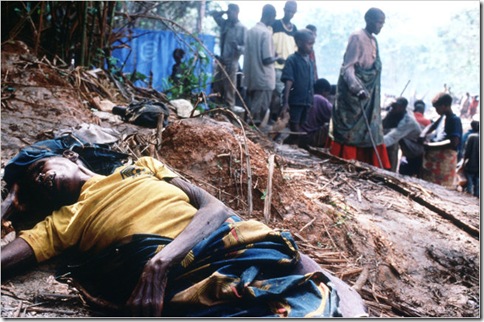
Leaked United Nations report into Congo

Rwandan refugees passed a body in a refugee camp in Congo in 1997.
Image © Roger Lemoyne/Liaison, via Getty Images

Three weeks ago, a United Nations mapping report “documenting the most serious violations of human rights and international humanitarian law committed within the territory of the Democratic Republic of the Congo between March 1993 and June 2003” was leaked to the press.  The purpose of the report is a mapping exercise to detail over 600 cases of serious atrocities that occurred in the DRC during the ten year period and it includes of attacks against Tutsi and Banyamulenge civilians and Hutu refugees.  This is a massive 508 page document that gives harrowing detail of rapes, murders, torture and war crimes committed against both civilian and militia targets. 

Unfortunately, the appalling and shocking nature of the crimes has become overshadowed in the political storm that has resulted since then.  Quite simply, the report could possibly implicate the Rwandan government in an act of genocide against Hutu refugees that fled to what was then Zaire after the 1994 genocide.  Civilians made up of men, women and children were not separated from the Interahamwe militia in refugee camps and the report contains allegations that Rwandan soldiers were indiscriminate and unrelenting in their attempts to pursue the former militias.  The New York Times reported in the article U.N. Congo Report Offers New View on Genocide that the massacres were systematic and that insufficient effort was made to protect (or even exclude) civilians from the attacks.  The New York Times then reported that the U.N. Delays Release of Report on Possible Congo Genocide and that Rwanda were so angry about the report that they were threatening to pull peacekeeping troops out of Darfur.

On his blog Congo Siasa, Jason Stearns reminds us that:

“The report's intention is to call for accountability for the mass atrocities committed during ten years of conflict in the Congo, not to single out Rwanda for "acts of genocide." Indeed, Angolan, Burundian, Ugandan, Chadian and Congolese officials are also cited for war crimes in the report. While the systematic massacre of Rwandan Hutu refugees stands out as one of the worst crimes committed during the war and deserves to be highlighted, the press should have put the report in context and highlighted its call for a tribunal and a truth and reconciliation commission” - Thoughts on the UN mapping report (Congo Siasa, August 28, 2010)

The most interesting portions of the United Nations document are commentary on why the Truth and reconciliation commission failed and the insight into the nature of sexual violence in the area.  I have uploaded the full document which you can either read online or download (5.79mb). 


The above mentioned report refers to the specific period from 1993 to 2003.  What it does not cover is the ongoing violence against women and children in the area.  It is reported that starting in July 2010, rebels forces took over an area in eastern Congo and up to 242 women were raped.  The New York Times article Rape Victims in Congo Raid Now More Than 240 details how Congolese and Rwandan rebels groups took over villages in the Walikale region of North Kivu “assaulting their victims in groups of two to six”. 

The Rwandan forces involved are members of the Hutu power rebel group Democratic Forces for the Liberation of Rwanda (DFLR).  The group is also known as FDLR after their French name Forces démocratiques de libération du Rwanda.  This group is opposed to Tutsi rule and influence in the region and is made up of many former Interahamwe members. 

As usual, there are reports of United Nations inaction.  They were aware of the attacks since 30 July and that nothing was done to prevent the numbers of victims rising to over 242 by early September.

SHARE:

Sunday, 21 March 2010

This Day in History: 21 March 1960: Sharpeville Massacre

Sharpeville Massacre
Photo: AFP

South Africa, 21 March 1960

On 21 March 1960, the Pan Africanist Congress organised a peaceful march in Sharpeville, Soweto.  During the protest, black South Africans burnt their pass books which restricted their movement to other areas in terms of the Pass Laws Act of 1952 which stipulated where, when, and for how long a person could remain.

The police opened fire on the peaceful march and killed 69 human beings and injured 178 others.

Sharpeville Day has since been commemorated each year in South Africa on 21 March and in 1994, the day was made into a national public holiday called Human Rights Day.  The idea is for South Africans to remember the great human rights sacrifices and transgressions that occurred against the black people of South Africa in the road to freedom.

The photo above showed people lying wounded in the streets of Sharpeville.  Today, Sharpeville remains an impoverished area where many people are living in shacks without running water or indoor sanitation.

In 1966 the United Nations proclaimed the 21 March the International Day for the Elimination of Racial Discrimination.  Rmembering the event of 21 March 1960, the United Nations General Assembly called on the international community to redouble its efforts to eliminate all forms of racial discrimination.

What have you done to eliminate racism today?

SHARE:

Thursday, 10 December 2009

Human Rights Day

Human Rights Day 2009 End Discrimination

Today is Human Rights Day and it was on this day in 1948 that the Universal Declaration of Human Rights (UDHR) was adopted by the United Nations General Assembly.  The UDHR has become a universal standard for defending and promoting human rights and I discussed the declaration back in July: The Universal Declaration of Human Rights.  The basic foundation of the Universal Declaration of Human Rights is that "all human beings are born with equal and inalienable rights and fundamental freedoms".

Every year on 10 December, Human Rights Day is observed and celebrated around the world and some of today’s events in South Africa, New York and Geneva are listed on the Office of the High Commissioner for Human Rights website.

The focus of Human Rights Day 2009 is non-discrimination.  Despite stating some 61 years ago that all humans were born equal, that we all had inalienable rights, millions of people worldwide fight against discrimination each day.

“The realisation of all human rights - social, economic and cultural rights as well as civil and political rights – is hampered by discrimination. All too often, when faced with prejudice and discrimination, political leaders, governments and ordinary citizens are silent or complacent”

Source: Office of the UN High Commissioner for Human Rights

Discrimination is perhaps on of the most tangible areas in which every day people can get involved in the struggle for global human rights.  Take a look at your workplace and how certain workers or classes of people are treated.  It is okay to tell people that racism is not okay, that all workers should be treated equally and that in the workplace, no one is actually better than anyone else.

People often discriminate because they can get away with it or because they think that others around them agree with such behaviour.  Be firm in your principles and slowly but surely you might come to change the world around you.

Complacency is discrimination’s best friend

SHARE:

Monday, 30 November 2009

World Aids Day: Universal Access and Human Rights

December 1 is World Aids Day and the World Aids Campaign has selected "Universal Access and Human Rights" as the theme for the 2009/2010 campaign. The timing of this campaign is vital as it is linked to the United Nation’s Millennium Development Goals.

In September 2000, the United Nations signed the United Nations Millennium Declaration which included eight international development goals to be achieved by 2015.

The sixth goal was to combat HIV/AIDS, malaria, and other diseases and the measurable target associated with this goal and relevant to the current World Aids Day campaign was target 6B: “Achieve, by 2010, universal access to treatment for HIV/AIDS for all those who need it”.

Avert have an excellent page detailing where we stood with this target at the end of 2008 and how we have progressed in the years since the declaration was signed.  At the end of 2003, only 5% of those that required treatment for HIV/AIDS were receiving it and this rose in a steady curve to 42% at the end of 2008. 

While the growth to date has been promising, the trend did start to decline by last year and it is probably safe to say that the goals will not be met by the end of 2010.  In fact, by the time the 2008 figures were released, the WHO, UNIADS and INICEF had conceded that most countries would not reach the 2010 target.

What does this mean for the World Aids Day campaign 2009/2010?

I believe that had the UN not set the Millennium Development Goals in 2000, the huge amount of progress made so far may not have been achieved.

There are a couple of important factors that need to be addressed in the race to meet these goals:

Governmental involvement

It is impossible to reach targets of universal access to treatment without governments subscribing to this goal and taking steps to implement it in their countries.  By way of an example, the AIDS denialist administration of South African president Thabo Mbeki and his Health Minister Manto Tshabalala-Msimang set the cause of universal treatment of HIV/AIDS back by years.  It is estimated that two million people might have died prematurely due to Mbeki’s failure to take decisive action and his denial that HIV causes AIDS [source].

The cost of treatment

The overwhelming factor affecting the provision of universal treatment is lack of funding and the global economic downturn has resulted in funding of projects being reduced or stopped altogether.

“It is estimated that to achieve universal treatment targets an investment of $7 billion will be required in 2010 for treatment and care alone. This is of the estimated $25 billion needed to achieve all targets including prevention, care for orphans and vulnerable children, and other programme support costs. Considering less than $14 billion was invested in tackling HIV and AIDS in 2008, a funding shortfall, while not inevitable, is likely unless dramatic increases in financial commitments are made” - avert.org

I believe it is necessary to balance the current financial situation with the long-term effects on economies as in many countries, it is the working-age population that is being decimated by AIDS deaths leaving only the very young and the very old behind.  A similar effect on the population pyramids occurs in times of war.

The commencement of treatment

There are differing beliefs as to when treatment should actually begin.  Economically developed countries like the UK are likely to begin treatment earlier i.e. when the CD4 count drops below 350 cells per cubic millimetre of blood. Less economically developed countries like South Africa wait until that level falls below 200. While this fell in line with the WHO recommendations of 2006, the WHO is now recommending treatment begins at the threshold of 350 as studies have clearly shown that starting antiretroviral therapy (ART) earlier reduces rates of death and disease.

Commitment to treatment

We have not discovered a cure for HIV/AIDS yet.  Once patients start to take antiretroviral drugs (ARVs), they need to take them for life.  It is imperative then that governments or international donors realise that this is a lifelong commitment and that they guarantee this treatment for all patients on ARVs.  The difficulty with this idea is that this means that treatment numbers will only ever continue to grow and there will never be reduction in treatment numbers until prevention plans really start to have an effect.  Therefore, governments and organisations need to continue to budget ever increasing amounts for treatment.

Mother to child transmission

In 2006, the WHO recommended that ARVs be given to pregnant women in their third trimester to prevent mother to child transmission and they had not yet proven the efficacy of ARVs during breastfeeding.  Since then, ARVs have been shown to be effective during breastfeeding in several trials and the 2009 WHO recommendations are that ART be started in the second trimester and that this treatment continue right to the end of the breastfeeding period.

Side effects of antiretroviral drugs

In the past, ARVs have been known to have terrible side effects and this has been a major factor in the lack of retention of ART patients.  Specifically, Stavudine has long-term, irreversible side-effects and the WHO has now recommended that countries phase out use of this drug and use the equally effective and less toxic Zidovudine (AZT) or Tenofovir (TDF).

Links

New HIV recommendations to improve health, reduce infections and save lives [UNAIDS]

Universal access to AIDS treatment: targets and challenges [avert.org]

This post was part of a Bloggers Unite action day.  Click to read more Bloggers Unite World Aids Day posts.

SHARE:

Saturday, 28 November 2009

What Is Genocide?

Srebrenica Srebrenica Mass Grave [photo source]

The primary purpose of this post will be to explore the legal definition of the term “genocide”.  In a later post, I shall discuss problems, limitations and criticisms of the current definition of genocide and try to find out why it is so rarely applied to conflicts around the world.

The term “genocide” did not exist prior to 1944.  The term was coined by a Polish lawyer named Raphael Lemkin as he sought to describe the systematic nature of the Nazi policies and their intention to destroy the European Jews.  He formed the word by combining the Greek word geno- meaning race or tribe and the Latin word –cide meaning killing. 

The term was codified legally by the United Nations in 1948 as they approved the Convention on the Prevention and Punishment of the Crime of Genocide.  The act of genocide was thus criminalised in times of both war and peace.
The convention defines genocide as follows:

“In the present Convention, genocide means any of the following acts committed with intent to destroy, in whole or in part, a national, ethnical, racial or religious group, as such:
  1. Killing members of the group;
  2. Causing serious bodily or mental harm to members of the group;
  3. Deliberately inflicting on the group conditions of life calculated to bring about its physical destruction in whole or in part;
  4. Imposing measures intended to prevent births within the group;
  5. Forcibly transferring children of the group to another group”

- UN General Assembly Resolution 260

Breaches of the Genocide Convention

Did you know that since the creation of the Genocide Convention in 1948, international tribunals have determined only two cases to constitute genocide?

  • Rwandan Genocide: This refers to the genocide that took place in Rwanda in April 1994.  The International Criminal Tribunal for Rwanda (ICTR) is currently prosecuting cases in connection with crimes committed during the genocide.
  • Bosnian Genocide: This refers to the genocide committed in Srebrenica in 1995 by the Serb forces.  There have been attempts to broaden this definition to include crimes of ethnic cleansing committed during the 1992-1995 Bosnian War but this was rejected by the International Court of Justice in February 2007.  The International Criminal Tribunal for the former Yugoslavia (ICTY) is currently prosecuting cases in connection with the Srebrenica genocide.
Contentious Cases

This list may in fact be longer but my research has shown that there are two cases currently being discussed which might constitute genocide:

  • Darfur / Sudan: United States Secretary of State Colin Powell  declared the conflict in Darfur to constitute a genocide in September 2004.  However, the United Nations Security Council-sponsored International Commission of Inquiry on Darfur stated that "the Government of the Sudan has not pursued a policy of genocide.” This was met with dismay but it is important to note that the report further went on to state that despite not meeting the definition of genocide, war crimes and crimes against humanity were nevertheless taking place and were just as serious.  Despite this, the International Criminal Court has filed charges against Sudan's President Omar al-Bashir and three others. I’ll try to find out more about this in the near future.
  • Croatian Genocide Case: The Croatian government waited until the close of the Bosnian Genocide Case before bringing an application to the International Court of Justice to apply the Genocide Convention against the Serbian government.  The Serbian government announced their intention for a counter-suit and in January 2009, the ICJ gave them a deadline of 22 March 2010 to file their Counter-Memorial.

At a later stage I will discuss the problems, limitations and criticisms of the current definition of genocide and an analysis of the reasoning to not classing certain events as genocide (for example, Cambodia).

SHARE:

Monday, 12 October 2009

Child Sexual Exploitation: Silence is Acceptance

Unicef

There is a fantastic photo essay on the UNICEF site entitled Silence is Acceptance. It has a really powerful message to tell about the proliferation of child sexual exploitation worldwide and is accompanied by photographs and personal stories of a number of victims and survivors.

UNICEF does a number of thought provoking photo essays and other titles include: Building a world fit for children, The rights of the child - Part I and The rights of the child - Part II.  Their site is certainly worth a visit; in fact, the “rights of the child” photo essays gave me goosebumps over every single part of my body.  It is a chilling and poignant reminder of how precarious the state of our world’s children that we had to codify and implement such a rights charter.

SHARE:

Wednesday, 30 September 2009

Gordon Brown’s address to the UN General Assembly

British Prime Minister Gordon Brown addressed the UN General Assembly on 23 September 2009.  As a citizen and resident of the UK, I’d hoped to jot down my thoughts on his address earlier but you know, life sometimes gets in the way.  My post on US President Barack Obama’s speech can be found here: Obama addresses the UN General Assembly.

Prime Minister Gordon Brown addresses the 64th session of the United Nations General Assembly

brown-speech-un
[Photo source]

A transcript of his speech can be found at the Labour Matters site.

PM Brown began his speech by taking account of the global economic crisis and immediately asserting his belief that this is a global crisis that can only be solved by nations working together on a global basis and that growth can only be sustained if it is shared. 

It is incredibly curious to me that he would start his speech in such a manner.  I am not a fan of Gordon Brown and I find him to be one of the worst leaders I have ever encountered.  Precisely because he doesn’t lead, he follows, and he is a man desperate for approval from others.  So this opening statement seems to be an attempt to ingratiate himself with the various nations before he begins his address. 

Despite what was a weak start (in my opinion) PM Brown then highlighted the main areas that he wanted to address:

  • climate change
  • terrorism
  • nuclear proliferation
  • global economic recovery
  • poverty and shared prosperity

While he shared nuclear proliferation, climate change and the economic crisis with President Obama, I found it interesting that he included terrorism and poverty as well.

Climate Change

“If the poorest and most vulnerable are going to be able to adapt; if the emerging economies are going to embark on low carbon development paths; if the forest nations are going to slow and stop deforestation - then the richer countries must contribute financially” - Prime Minister Brown, address to UN General Assembly, 23 September 2009 [transcript]

This is so interesting.  While Obama was drawing the line and setting boundaries as to how far the US was prepared to go in solving the world’s problems, Brown was diving right in there.  He said that proposed financing from the British government, drawn from public and private sectors, would be around $100bn a year by 2020.

Terrorism

Or, more accurately, “Why I continue to support an expensive and futile war in Afghanistan”.  He starts off this section by saying that “a safer Afghanistan means a safer world” which sounds good on paper but it doesn’t change the fact that terrorism is still alive and well while innocent civilians and well-intentioned soldiers are getting slaughtered out there.

“It shames us all:

* that the people of Somalia and Sudan are still subject to the most terrible violence.

* that Israel and Palestine have still not found a way to live side by side in security and peace.

* and that for the people of Burma, their elected leader is subjected to a show trial and decades of incarceration.

There is more we can do; there is more we must do. And we must carry forward our efforts to take a more strategic, coherent and effective approach to peacekeeping and peace-building”- Prime Minister Brown, address to UN General Assembly, 23 September 2009 [transcript]

I hope it’s okay to quote so much of the speech but I actually did like this section of the Prime Minister’s speech.  It was powerful but I fear that he has lumped gross violations of human rights, war time conflict and humanitarian crises under the umbrella term “terrorism”.  It is not helpful at all to do that as it implies the legitimacy of one party over another illegitimate and criminal party.  I’m virtually speechless (as in, I have no more words to blog) as my mind goes into the ramifications of the use of the term ‘terrorism’ versus genocide, ethnic cleansing, political oppression and state sanctioned persecution.  The wording of this section was, as I say, powerful but the issues are sorely muddled in this section of his speech.

Nuclear Proliferation

“Once there were five nuclear-armed powers. Now there are nine, with the real and present danger that more will soon follow. And the risk is not just state aggression, but the acquisition of nuclear weapons by terrorists…

…all nuclear weapons states must play their part in reducing nuclear weapons as part of an agreement by non nuclear states to renounce them. This is exactly what the Non Proliferation Treaty intended. In line with maintaining our nuclear deterrent I have asked our national security committee to report to me on the potential future reduction of our nuclear weapon submarines from 4 to 3” - Prime Minister Brown, address to UN General Assembly, 23 September 2009 [transcript]

He started out so well and then he utters that last sentence.  Great, should we reduce terrorist’s access to nuclear weapons by 25% (by the same ratio as 4:3) and then see how the world feels about that?  What you are saying is that Britain will basically sacrifice a token submarine but you expect the entire states of Iran and North Korea to complete disarm. 

Don’t get me wrong, I greatly support nuclear disarmament; I just wish Gordon Brown had not even uttered that last sentence.

Global Economic Recovery

“The great lesson of the last year is that only bold and global action prevented a recession becoming a depression. We have delivered a co-ordinated fiscal and monetary response that the ILO estimates has saved 7 to 11 million jobs across the world” - Prime Minister Brown, address to UN General Assembly, 23 September 2009 [transcript]

Okay, I have to say at this point that I'm getting a little tired.  Unemployment in the UK is at its highest since 1995 and yet Brown is citing global successes in global economic recovery?  It just seems to me that Brown is sometimes unaware of the 2 million unemployed in the UK and the fact that banks are calling in loans left, right and centre.  Britons are in for a lot more misery before they start to see improvements. 

Poverty

“The unyielding, grinding, soul-destroying, so often lethal poverty I saw in Africa convinced me that - unless empowerment through trade justice is matched by empowerment through free education and free health care – then this generation in sub-Saharan Africa will not have the opportunity to rise out of poverty - and will never be fully free” - Prime Minister Brown, address to UN General Assembly, 23 September 2009 [transcript]

After a mixed and at times bizarre address Brown closes by stating that several of the Millennium Development Goals could not be achieved in 50 years never mind the remaining 5 years of the undertaking.  This is depressing and morale-destroying in a way that only Gordon Brown can manage but in a way, I do appreciate his honesty.  He does end on a high note though by citing the inception of universal free health care in Burundi, Sierra Leone, Malawi, Nepal, Liberia and Ghana and by calling on other nations to do the same.  Hmmm, perhaps he could implement that in the UK?

SHARE:

Tuesday, 29 September 2009

Gaza: Goldstone Finds Evidence of War Crimes

Link: Palestinians call for Israel to be 'punished' for Gaza offensive [CNN]

You may notice that of all things in this blog, I have stayed clear of blogging about Israel and the Gaza Strip. I have very strong personal reasons for staying well clear of this debate but this article seems too important to ignore.

I don't want it to be true and I don't want to take sides in this debate. The problem is that I have absolute respect for Judge Richard Goldstone, the man who headed the UN investigation into the conflict that incurred this past December and January in Gaza. He formally presented his findings to the UN Human Rights Council in Geneva today.

"The lack of accountability for war crimes and possible crimes against humanity has reached a crisis point," Goldstone said Tuesday. "This is the time of action." - Judge Richard Goldstone, UN Human Rights Council, Geneva [CNN]

I first heard about Richard Goldstone when he headed the Commission of Inquiry Regarding Public Violence and Intimidation in South Africa regarding the political violence that occurred during the last years of Apartheid. Known as the Goldstone Commission, this enquiry was instrumental in fostering reconciliation at the beginning of the new democratic administration.

It found what we had known for years being that the political violence in the last years of Apartheid was fuelled by a 'Third Force'; by people who wanted the country to be destabilised and ungovernable, who wanted to derail the attempts at reform and the movement towards ending Apartheid.

Goldstone was also a judge of the Constitutional Court of South Africa from July 1994 to October 2003. The Constitutional Court is the highest court in the country of South Africa. This often fills me with pride as South Africa is said to have the most liberal constitution on Earth and they have as their highest court that which protects their constitution and people's human rights.

During his term at the Constitutional Court, Goldstone served as the chief prosecutor of the United Nations International Criminal Tribunals for the former Yugoslavia and for Rwanda from 15 August 1994 to September 1996. It was only later that I would hear from him again, however, and that was when he headed the International Independent Inquiry on Kosovo from August 1999 until December 2001. I bought the full report but was unable to complete reading it as my knowledge was not developed at that time. I hope to give it another try soon.

My question is this: if Judge Richard Goldstone is one of the most respected people on Earth, the one person that has been constant in our investigation of the worst humanitarian crises over the past 20 years, why are we so quick to call his enquiry biased and flawed?

"But Israel's ambassador to the United Nations, Aharon Leshno-Yaar, questioned the report in strong language Tuesday, calling it one-sided and shameful.

"This report is based on carefully picked incidents, cherry-picked for political effect," Leshno-Yaar said. "The authors of this fact-finding report had little thought about finding facts."

Israel did not cooperate in the U.N. investigation, calling it flawed and biased" - CNN

Like I said, I don’t want it to be true.  I think the creation of the state of Israel after the atrocities of World War II was the first major success of the newly formed United Nations and a necessary consequence after the persecution of the Jews but I for one am going to try get my hands on Judge Goldstone’s report and to read his findings.

SHARE:

Wednesday, 23 September 2009

Obama addresses the UN General Assembly

The 64th session of the United Nations General Assembly opened on 15 September 2009 and the General Debate opened today. During the General Debate, each member nation has the chance to address the General Assembly. Today's proceedings began with addresses by the Secretary-General of the United Nations, Mr Ban Ki-moon and the President of the General Assembly, Dr. Ali Abdussalam Treki of Libya. 

President Luiz Inácio Lula da Silva of Brazil was next to address the UN General Assembly followed by President Barack Obama of the United States of America.

I consider President Obama’s address to be one of the most important as the USA is an extremely powerful nation and the USA are one of the permanent members of the United Nations Security Council.  I hope to concentrate on the speeches by the representatives of all five permanent members of the Security Council as well as the speech by President Jacob Zuma of South Africa as this holds specific interest to me personally (being that I am a South African expat).

My brief overview of the UN General Assembly and Security Council can be found here: The United Nations: an overview.

President Barack Obama addresses the 64th session of the United Nations General Assembly

A full transcript of this speech can be found at First Door on the Left.

Obama began by acknowledging that many have come to view America with distrust and scepticism but then went on to list many of the achievements that he has made during his first nine months as president, most notably being the prohibition of torture by the USA.  It is interesting that he mentions in this paragraph his order to close Guantanamo Bay which is interesting because the future of the unit remains uncertain just four months away from the deadline as they struggle to make decisions on how to deal with the remaining detainees.  I personally felt that this was going to be a broken promise but does Obama’s mention of it mean a renewed commitment or was he just hoping to gain mileage from the promise alone of closing it?

“We’ve also re-engaged the United Nations. We have paid our bills. We have joined the Human Rights Council.  We have signed the Convention of the Rights of Persons with Disabilities. We have fully embraced the Millennium Development Goals” – US President Barack Obama, address to UN General Assembly, 23 September 2009 [transcript]

I’m left incredibly uneasy by this later statement by Obama.  I feel that I want to say something like, “what do you mean that the US wasn’t already part of the Human Rights Council, that they hadn’t already fully committed themselves to the Millennium Development Goals of the United Nations?”

There is so much that the United Nations is not achieving, so much that they feel powerless to do and yet they give permanent members of the Security Council the freedom to pick and choose which policies and programmes they will abide by?  No, I am sorry.  To me that is akin to not abiding by the Universal Declaration of Human Rights or the Geneva Convention. 

“This is what we have already done. But this is just a beginning. Some of our actions have yielded progress. Some have laid the groundwork for progress in the future. But make no mistake: This cannot solely be America’s endeavour. Those who used to chastise America for acting alone in the world cannot now stand by and wait for America to solve the world’s problems alone. We have sought — in word and deed — a new era of engagement with the world. And now is the time for all of us to take our share of responsibility for a global response to global challenges” – US President Barack Obama, address to UN General Assembly, 23 September 2009 [transcript]

I think this is a very interesting statement. On the one hand, there is a sense that nations look to the USA to solve all of their problems and provide monetary support.  There seems to be a sentiment (especially in some British media) that the international and domestic financial crisis will not abate until the recession ends in the US, that improvements cannot be made until the US finds a solution.  Obama is saying that nations need to start taking responsibility for their own political situations but he is also saying that nations need to communicate and cooperate in finding global solutions.

On the other hand, there is a extent to which the US has been involved directly in the evolution of certain situations, notably in Iraq and Afghanistan.  It is one thing to declare war on a government but what of the people that have been affected by those wars?  I’m not saying I have the answer to that but I certainly have many questions.   There is also the question of aid and financial support.  Aid is never a gift, is it?  US aid always provides revenue that is streamed back into the US as American companies and personnel are utilised.

My personal feelings are completely incongruent and dichotomous.  I feel that each country should be sovereign and should look after their own problems internally before getting involved in the affairs of others and in the same breath, I wonder what will become of the third world countries that were ravaged by slavery and colonisation if assistance is not provided.  Mostly though, I feel that if a country signs an agreement or makes a promise such as the US and United Kingdom respectively did with Zimbabwe, then they should uphold those agreements or promises.

“The choice is ours. We can be remembered as a generation that chose to drag the arguments of the 20th century into the 21st; that put off hard choices, refused to look ahead, failed to keep pace because we defined ourselves by what we were against instead of what we were for. Or we can be a generation that chooses to see the shoreline beyond the rough waters ahead; that comes together to serve the common interests of human beings, and finally gives meaning to the promise embedded in the name given to this institution: the United Nations” – US President Barack Obama, address to UN General Assembly, 23 September 2009 [transcript]

It seems that Obama is calling for the United Nations to achieve what they originally set out to achieve, to ignore the politics and the spineless diplomacy that continues to allow genocide, war crimes and perpetual humanitarian crises.  If so, I wholeheartedly agree with him.  I wonder if this will be the generation to finally get the United Nations back on track?

Obama reiterated the notion that all nations have rights as well as responsibilities and then he introduced four pillars that he feels are fundamental for the future:

  • non-proliferation and disarmament;
  • the promotion of peace and security;
  • the preservation of our planet; and
  • a global economy that advances opportunity for all people

Obama’s words on nuclear disarmament and non-proliferation were powerful yet chilling as he promised to take action on Iran and North Korea if they continue to ignore international standards with respect to Nuclear Non-Proliferation Treaty.

"The world must stand together to demonstrate that international law is not an empty promise, and that treaties will be enforced. We must insist that the future does not belong to fear" – US President Barack Obama, address to UN General Assembly, 23 September 2009 [transcript]

Obama went on to discuss the promotion of peace and security and spent quite some time on the conflict between the Israelis and Palestinians to great applause from the General Assembly. 

“The United States does Israel no favours when we fail to couple an unwavering commitment to its security with an insistence that Israel respect the legitimate claims and rights of the Palestinians. And — and nations within this body do the Palestinians no favours when they choose vitriolic attacks against Israel over constructive willingness to recognize Israel’s legitimacy and its right to exist in peace and security– US President Barack Obama, address to UN General Assembly, 23 September 2009 [transcript]

Obama then discussed climate change. It has been reported that China and India totally owned the US yesterday in the UN climate change debate as they promised ‘aggressive’ cuts in CO2 emissions compared with Obama’s simple acknowledgement of an historical failure to act and an undertaking to take action in the future.

Obama then discussed the global economy moving from the current financial crisis to a commitment to the Millennium Development Goals and a commitment to approach the 2010 summit with a concrete plan to make the goals a reality.

President Barack Obama is an excellent orator and I love to read his speeches as they fill me with hope and determination for the future. The problem is that words and excellent public speaking are not going to achieve real change but I do hope to be pleasantly surprised in the future and to witness Obama having made a real difference.

SHARE:

Tuesday, 8 September 2009

The Power of Literacy

Bloggers Unite is an initiative by the founders of BlogCatalog to generate interest in important issues by getting bloggers to write about a particular subject on one day of the month. I see this as an effort to learn something new and to think about an issue long enough to write something meaningful and worthwhile about it and therefore, it is a valuable addition to my project to learn more about issues in an effort to understand them.

This is especially relevant in this edition of Bloggers Unite as I believe we tend to take literacy and its benefits for granted and struggle to comprehend the effects that a lack of literacy can have. On to International Literacy Day then.


UNESCO and International Literacy Day
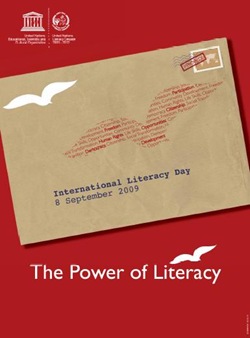
In 1965, the United Nations Educational, Scientific and Cultural Organisation (UNESCO) proclaimed September 8 to be International Literacy Day and it was first observed in 1966.

The aim of International Literacy Day is to highlight the importance of literacy to individuals, communities and societies.

Although the programme has been running for 43 years, literacy is still a huge problem worldwide. This prompted the United Nations to declare the United Nations Literacy Decade which is lead by UNESCO and runs from 2003 to 2012. The overall target for the decade is to increase literacy rates by 50% by 2015 and this falls in line with the United Nations’ Millennium Development Goals regarding the reduction of poverty.

On International Literacy Day each year, UNESCO takes the opportunity to remind the international community of the status of literacy and adult learning globally. On the UNESCO website, the following chilling observation is made:

“Despite many and varied efforts, literacy remains an elusive target: some 776 million adults lack minimum literacy skills which means that one in five adults is still not literate; 75 million children are out-of-school and many more attend irregularly or drop out” - UNESCO

Each year there is a different theme to International Literacy Day and this year the theme is The Power of Literacy.


The Power of Literacy

Literacy is power. Literacy gives individuals the power to make basic choices in their lives and to lead their lives as they want to. That possibly sounds simplistic but a little choice goes a long way.


Image Source

Women and Literacy

Of the 776 million adults that lacks literacy skills, UNESCO notes that two thirds of those are women. That means that around the world, 517 million women are unable to gain skilled employment (if they are permitted to work at all) and they remain powerless to break the cycle of dependence and subservience as they lack the basic skills to empower themselves and make better choices for themselves. Note, I’m not implying that illiterate women make bad choices, I’m simply saying that there are less choices available to them.

This is not just a third world problem either. It applies across societies from Saudi Arabia where women are told what to wear and are prohibited from working or gaining an education to so-called first world countries where a lack of literacy can keep women dependent on a welfare state or working in the most menial of jobs.

The Asia-Pacific Region and Literacy

The United Nations Economic and Social Commission for Asia and the Pacific (UNESCAP) website states that the Asia-Pacific region is home to three-quarters of the world’s illiterate population. They say that illiteracy is both a cause and consequence of poverty, deprivation and under-development. Literacy is not just about reading and writing; literacy gives individuals the tools with which to understand their environment and equips them with problem-solving skills. Literacy leads to improved cognitive functioning and enables people to interact more effectively within their communities.

Think about all the things that we take for granted: voting, banking, reading road signs, following written instructions or using a computer. These are basic necessities that can be made available to individuals through basic literacy but they are part of the world that is closed off to the illiterate.

“[The education of women] acts as a catalyst in virtually every dimension of development and poverty alleviation, with outcomes such as reduced fertility, reduced infant mortality, improved child survival, better family health, increased educational attainment, higher productivity, and general improvement in the nation's economic situation.” - UNESCAP

Literacy and Socio-Economic Indicators

In 1980 the Nicaraguan government embarked on the Sandinista Literacy Campaign as prior to the campaign, between 75% and 90% of the rural population was illiterate. The Literacy Campaign was a resounding success and was awarded the prestigious UNESCO Literacy Award.

The campaign presented a unique opportunity to study the effect of literacy on various socio-economic indicators. “The Impact of Women's Literacy on Child Health and its Interaction with Access to Health Services” by Sandiford, Cassel, Montenegro and Sanchez was published in the Population Studies in March 2005. This excellent study of 4434 women studied the effects of literacy on nutrition and child survival. There were three test groups: women educated through formal primary education, women who became literate through adult education and illiterate and semi-literate women.

Child and infant mortality and malnutrition were found to be significantly lower amongst the adult-educated population than amongst those that remained illiterate.

The significance of this study is that literacy is powerful and improves the lives of those people who gain it. While the study did favour those that had received education earlier in life, the impact of adult-education on formerly illiterate women was significant.

Literacy and Breaking the Chains of the Self-Fulfilling Prophecy

As mentioned earlier, illiteracy is both a cause and a consequence of poverty, deprivation and under-development. Right across the globe, this leads to a phenomenon known as the self-fulfilling prophecy as the children of illiterate parents come to believe that they will not be able to escape the fate that has fallen upon their parents.

Literacy is power and can assist in breaking the chains of the self-fulfilling prophecy. Literacy empowers individuals and gives them access to a greater range of choices. Those educated as adults are better able to support their children and ensure their survival. Basic literacy paves the way for further education and the learning of new skills for both adults and children. Literacy builds communities and ensure that individuals are more productive and that they in turn can continue to support both their families and the community at large.

Perhaps the biggest power of literacy is that it builds a person’s self-confidence and spirit. This power alone can break the cycle and enable people to achieve greater things than their parents were able to achieve. The light that you see in a learner’s eyes, be they an adult or a child, is a light that continues to burn as they master the environment around them.


Visit the UNESCO International Literacy Prize Winners 2009 and see how you can get involved in improving literacy worldwide. Better yet, look up an adult education programme in your neighbourhood and get involved. With just a little time and patience, you’d be surprised at how easy it is to teach an adult to read! With practice and application, it is a skill they will never forget.

SHARE:

Wednesday, 29 July 2009

The United Nations: an overview

Recently, I visited the United Nations in New York. I went on a very informative tour of the facilities and learned a lot about what the United Nations does and what is within their remit.

In my quest to understand what I perceived to be the failure of the United Nations to carry out their purpose, I had overlooked and taken for granted a lot of the important work that the UN does.  In a future post I hope to explain what the UN does but in this post I shall concentrate on the structure of the UN.

As an absolute beginner in this realm, I’m drawing heavily from these sources: The Charter of the United Nations, Wikipedia, The UN website and the notes I took during my tour.  I can’t promise that this post will be of any more value than visiting those sources or taking the tour but I do hope to simplify the workings of the UN to enable me to move on to my main question: Is the UN relevant?

The United Nations

The United Nations is an international organisation that was formed at the end of World War II to replace the League of Nations. The League of Nations had formed at the end of the World War I and their primary purpose was to prevent future wars. They did not, however, have their own armed force and they depended on their members to enforce resolutions and uphold economic sanctions. The League of Nations proved spectacularly incapable of preventing Axis aggression and as first Germany and then other totalitarian states withdrew from the League of Nations, World War II began.

Today, the United Nations has 192 member states and its main headquarters are in New York City. The United Nations buildings are international territory. The United Nations has five main administrative bodies:

  • The General Assembly
  • The Security Council
  • The Economic and Social Council
  • The Secretariat
  • The International Court of Justice (situated in the Hague)

The General Assembly

This is the United Nations General Assembly (UNGA) hall. It was amazing to stand there and reflect on the powers that come together in this room from time to time. Each of the member states has one seat in the General Assembly and one vote.  All members states are considered equal here and this is the only organ of the UN where all member nations have equal representation.

The UNGA meets from September to December each year.  During the first two weeks, each member state has a chance to address the assembly.

The UNGA is the main deliberative assembly of the UN. "Deliberative assembly" basically means that all the members have an equal vote and they meet to decide on the courses of action to be taken by the entire group.  The UNGA may discuss anything relating to the present Charter or relating to the organs of the United Nations but they may not discuss anything that is currently under discussion in the United Nations Security Council.  The UNGA discusses the $2.4billion budget for the UN; decides on which member states should be admitted, suspended or expelled from the UN; appoints non-permanent members to the Security Council and makes recommendations in the form of General Assembly Resolutions.

The public used to be able to sit in on the UNGA but this was stopped after the 1993 attack on the World Trade Centre.

The Security Council

The United Nations Security Council (UNSC) is charged with the maintenance of international peace and security. The UNSC has five permanent members: United States of America, United Kingdom, China, France and Russia. Ten other non-permanent members are elected to serve two-year terms.

Under chapter 6 of the Charter, the UNSC has the power to investigate disputes and advise parties to reach peaceful solutions to their disputes.  The recommendations made under this provision are not binding on UN members. 

Chapter 7 of the Charter moves beyond disputes to acts of aggression or threats and breaches of peace.  Here, the UNSC may make recommendations and take certain actions. Actions will not at first involve armed force and include calling upon members to interrupt economic relations, cease communications or sever diplomatic relations.

If such action is proved to be inadequate, the UNSC has the power to take such [armed] action as may be necessary to restore international peace and security.  Decisions taken under chapter 7 are binding on UN members and all members have to provide armed forces, facilities, right of passage and assistance to such actions if called upon to do so.

The UNSC can also refer matters to the International Criminal Court, where the ICC would not otherwise have jurisdiction and it recommends the role of the Secretary-General to the General Assembly.


I think this is measuring up to be quite a mammoth post so I will stop here and continue on the weekend with The Economic and Social Council and The Secretariat.  I will probably dedicate an entire post to the International Court of Justice as it is perhaps most relevant to this blog.

Sources:
The Charter of the United Nations
The UN website
Wikipedia

SHARE:

Friday, 17 July 2009

The Universal Declaration of Human Rights

Human Rights 

I’m a bit late to the party but I have just discovered that today is Bloggers Unite for Human Rights Day.  I’ve decided to share what I learned during my recent visit to the United Nations in New York.  I was quite surprised to find that certain things, like being able to rest from work, are addressed in the Universal Declaration of Human Rights (UDHR) and I think you might be surprised by some of the items too. 

The UDHR was adopted and proclaimed by the United Nations on 10 December 1948.  It is important in that the UN was the first united body to adopt such a charter and member nations are urged to uphold these rights in their countries.  The UDHR is non-binding resolution though which means it does not pass into law.  I’ll talk about this in more detail later.

The language in the UDHR is quite grand and so I have taken the following simplified version from the website of Human Rights Education Associates:

Simplified Version of the Universal Declaration of Human Rights

Summary of Preamble

The General Assembly recognizes that the inherent dignity and the equal and inalienable rights of all members of the human family is the foundation of freedom, justice and peace in the world, human rights should be protected by the rule of law, friendly relations between nations must be fostered, the peoples of the UN have affirmed their faith in human rights, the dignity and the worth of the human person, the equal rights of men and women and are determined to promote social progress, better standards of life and larger freedom and have promised to promote human rights and a common understanding of these rights.

A summary of the Universal Declaration of Human Rights

1. Everyone is free and we should all be treated in the same way.

2. Everyone is equal despite differences in skin colour, sex, religion, language for example.

3. Everyone has the right to life and to live in freedom and safety.

4. No one has the right to treat you as a slave nor should you make anyone your slave.

5. No one has the right to hurt you or to torture you.

6. Everyone has the right to be treated equally by the law.

7. The law is the same for everyone, it should be applied in the same way to all.

8. Everyone has the right to ask for legal help when their rights are not respected.

9. No one has the right to imprison you unjustly or expel you from your own country.

10. Everyone has the right to a fair and public trial.

11. Everyone should be considered innocent until guilt is proved.

12. Every one has the right to ask for help if someone tries to harm you, but no-one can enter your home, open your letters or bother you or your family without a good reason.

13. Everyone has the right to travel as they wish.

14. Everyone has the right to go to another country and ask for protection if they are being persecuted or are in danger of being persecuted.

15. Everyone has the right to belong to a country. No one has the right to prevent you from belonging to another country if you wish to.

16. Everyone has the right to marry and have a family.

17. Everyone has the right to own property and possessions.

18. Everyone has the right to practise and observe all aspects of their own religion and change their religion if they want to.

19. Everyone has the right to say what they think and to give and receive information.

20. Everyone has the right to take part in meetings and to join associations in a peaceful way.

21. Everyone has the right to help choose and take part in the government of their country.

22. Everyone has the right to social security and to opportunities to develop their skills.

23. Everyone has the right to work for a fair wage in a safe environment and to join a trade union.

24. Everyone has the right to rest and leisure.

25. Everyone has the right to an adequate standard of living and medical help if they are ill.

26. Everyone has the right to go to school.

27. Everyone has the right to share in their community's cultural life.

28. Everyone must respect the 'social order' that is necessary for all these rights to be available.

29. Everyone must respect the rights of others, the community and public property.

30. No one has the right to take away any of the rights in this declaration.

- [Source: hrea.org]

Some of these rights seem obvious, things that we take for granted. It is hard to imagine that people could take these rights away from us.  In my lifetime, I have lived through Apartheid South Africa where black people could not own property, could not vote in government elections, could not gain education above a certain level and were not able to apply for professional jobs that were reserved for white people.  They certainly could not travel freely within the country nor could they marry outisde of their colour. 

This was clearly in violation of several of the rights listed above and the United Nations imposed several layers of sanctions on South Africa which crippled the economy.  In the early 80’s, the government began to bow to this pressure, first repealing certain of these apartheid laws and then beginning a process of all-out reform.  This resulted in the unbanning of the ANC, the release of Mandela and the first democratic elections which saw the ANC gain power in 1994.

Change can happen and the United Nations has played a vitally important part in bringing about change in countries like South Africa.

So why are situations in Zimbabwe, Darfur and Sri Lanka being allowed to happen?  Zimbabwe, Sudan and Sri Lanka are all member states! 

“There has been criticism that the five permanent members of the United Nations Security Council, who are all nuclear powers, have created an exclusive nuclear club whose powers are unchecked. Unlike the General Assembly, the United Nations Security Council does not have true international representation. This has led to accusations that the UNSC only addresses the strategic interests and political motives of the permanent members, especially in humanitarian interventions: for example, protecting the oil-rich Kuwaitis in 1991 but poorly protecting resource-poor Rwandans in 1994” - Wikipedia

It seems that one of the biggest factors at play is that it is diplomatically difficult for the United Nations to place political pressure on their member states.  Perhaps it is time to make the UDHR binding, to make member states reapply periodically for membership and adhere to a more stringent set of membership requirements?  Would that remove the diplomatic hurdle and spur the UN security forces into action?  I don’t know the answer to that question yet but I will keep you up to date on what I learn.

SHARE:

Saturday, 11 July 2009

A Passion to Understand: update

It has been over three weeks since I posted in this blog but there has been a good reason for that as I’ve been on holiday and visited New York and DC.  What I post about in this blog generally relates to current affairs or my journey in understanding various political and social situations and so I thought it wasn’t appropriate to schedule posts while I was away. 

My journey though, my passion to understand, has grown exponentially while I have been away.  A lot of what I did on my holiday had to do with that journey.

United Nations, New York

One of the questions I have asked in the past weeks was ‘Is the United Nations relevant?’  While I was in New York, I took a tour around the United Nations and took copious notes about what they do and how they work.  Most importantly, I learned about what is within their remit and what are their limitations.  I’ll consolidate my notes shortly and post about everything I learned.

New York Public Library

I visited the New York Public Library to try and answer another burning question I have had lately as to why the situations in Darfur and Sri Lanka have not been labelled as genocide.  I spent some time reading up on the matter and took notes from the Encyclopedia of Genocide.  The next post I do will probably be an introduction into what I learned here and an insight into why the term has not been used in Darfur and other regions.

Holocaust Museum, Washington DC

I also visited the Holocaust Memorial Museum in Washington DC.  This is a fantastic museum and although I wasn’t able to tour the main exhibit, I did visit the section on genocide.  I learned about the war in the former Yugoslavia and the genocide that occurred there.  This was very rewarding and I am pleased as I have been wanting to learn more about that situation for some time.

My activities might seem like strange things for a person to do on their vacation but this trip was very much a voyage of discovery for me.  I travelled alone and had a lot of time to think about where I want to go with my life.  Well, I know where I want to go.  I want to work for the UN or one of the aid organisations and go into these places and help communities and individuals recover.  I want to make the statement “Never Again” become a reality.  This might not be realistic though and so I learned more about what I can do in the meantime and I have decided on three areas to focus on in the short term:
- I’ll continue keeping an eye on current affairs and maintaining this blog
- I've identified a couple of areas in which to do some independent self-study (i.e. those discussed above)
- there are a couple of short-courses and free courses that I can enrol on to expand on my knowledge

I haven’t made a decision yet but I thought I’d draw attention to two free courses from Open University called Who counts as a refugee? and The Holocaust.  These are free courses at an advanced level and take about 10 and 12 hours of study respectively.

SHARE:

Friday, 29 May 2009

The United Nations: Is it relevant?

Link: Praise for Sri Lanka raises questions of how effective UN really is[timesonline.co.uk]

The UN Human Rights Council has praised the Sri Lankan Government over its war against the Tamil Tigers. This is incredible even if you only consider that the Sri Lankan government heavily shelled civilian areas. Naturally, this has caused many people to raise questions about how effective the UN is. The article above raises some very interesting points regarding the members of the UN Human Rights Council and how they seem to allow just about any recognised state to join.

"The Human Rights Council is the replacement for the discredited Human Rights Commission, which once had Libya as a chairman. Yet the new council is little better and has human rights violators such as Cuba, Saudi Arabia, China and Kyrgyzstan as members. They are naturally reluctant to accuse other nations of abusing citizens" - timesonline.co.uk

This is a really valid point. I have pretty much stayed out of the arguments about the UN excepting for my article Gallop Poll Shows Record Disapproval of UN but the question needs to be raised: if there are various legitimate and questionable reasons for the UN simply not being able to fulfil its peacekeeping function, then surely that arm should be dissolved?

The author of the article would disagree, citing the RAND Corporation's findings that two out of three peacekeeping missions were a success. His article concludes that Bush was premature in his opposition to the UN and realised too late that he needed them. In further mitigation, many of the UN's cited failures relate to the Srebrenica and Rwanda situations which occurred in the 90's. Perhaps the most valid way to proceed then would be to judge the UN in terms of their current performance not their past failures. Whatever the case, it seems increasingly obvious that an overhaul of the organisation is needed.

SHARE:
© A Passion to Understand

This site uses cookies from Google to deliver its services - Click here for information.

Blogger Template Created by pipdig