
Tonight Sy from Sy's Prints and I attended a fascinating talk on the role of religion in 21st century conflict. The talk was held at The Royal Commonwealth Society in conjunction with the University of Sussex and International Alert. The talk was skilfully chaired by Dan Smith of International Alert and focused on the impact of religion and resolution of conflict.
Increasing Secularisation?
Dr Fabio Petito (University of Sussex) began the discussion by noting that religion is becoming more dominant in politics in contrast to the once prevailing beliefs that secularism would prevail as society became more developed. There seems to be three possible routes of this increasing dominance: the post-Cold War politics of identity in the context of collapsing Cold War states; the rise of religious terrorism; and the view popularised by Samuel Huntington (but unacceptable to Dr Petito) that religion would increasingly and inherently lead to conflict in the post-Cold War period.
Religious Literacy
Aaqil Ahmed of the BBC noted that when people are threatened, they often revert to religion but that there was never really a point in time when vast numbers of people were especially knowledgable about their religion. This lead to one of the key themes that emerged during the evening. Rama Mani (Centre for International Studies) noted that the version of religion most frequently attached to violent ideologies is a reduced version, one that is not especially characterised by a high degree of religious literacy. There comes a point where religion may be the only remaining source of power for the weak.
Religion vs Power
A related theme was whether there wasn't a contradiction in that most religions preach peace but many practice war? Dr Petito notes that we need to ask what kind of religiosity is more violent? Weak, fragile, uncertain religious identity taught not by traditional means such as the family leads to violence. Rama Mani agreed, noting that those who actively seek coherence and the essence of religion reach more peaceful means. Mention was made of the role of the church in achieving peace in Columbia and South Africa and how it seems that when people mobilise, they reach a more authentic, peaceful solution in contrast to the religious elite who often cuddle up to power.
Ms Mani concluded that religion must give up power and embrace justice, equality and critical enquiry in order to play a role in conflict resolution.
Religion and the Shared Experience
An interesting thread that the Guardian's Andrew Brown brought to the discussion is that in order to hold people together around moral values, you need a narrative or story. This was highlighted by the focus of Archbishop Desmond Tutu and the concept of Ubuntu as it was applied to emphasise the unity of the South African people. Mr Brown also made the interesting point that there are different secularities, each a product of and a mirror image of the prevailing religion at the time.
It was put forward that both religion and secularism are backlashes against prevailing states and that we may well enter a period of increasing secularism again in reaction to current religious extremes. Not only that, but it seems that political conflicts often result in religious solutions (Columbia) just as religious conflicts often lead to political solutions.
It seems clear though that religion cannot simply be dismissed. Dr Petito concluded with the excellent observation that religion brings shared norms and ethics and we must use these a part of the solution.
Increasing Secularisation?
Dr Fabio Petito (University of Sussex) began the discussion by noting that religion is becoming more dominant in politics in contrast to the once prevailing beliefs that secularism would prevail as society became more developed. There seems to be three possible routes of this increasing dominance: the post-Cold War politics of identity in the context of collapsing Cold War states; the rise of religious terrorism; and the view popularised by Samuel Huntington (but unacceptable to Dr Petito) that religion would increasingly and inherently lead to conflict in the post-Cold War period.
Religious Literacy
Aaqil Ahmed of the BBC noted that when people are threatened, they often revert to religion but that there was never really a point in time when vast numbers of people were especially knowledgable about their religion. This lead to one of the key themes that emerged during the evening. Rama Mani (Centre for International Studies) noted that the version of religion most frequently attached to violent ideologies is a reduced version, one that is not especially characterised by a high degree of religious literacy. There comes a point where religion may be the only remaining source of power for the weak.
Religion vs Power
A related theme was whether there wasn't a contradiction in that most religions preach peace but many practice war? Dr Petito notes that we need to ask what kind of religiosity is more violent? Weak, fragile, uncertain religious identity taught not by traditional means such as the family leads to violence. Rama Mani agreed, noting that those who actively seek coherence and the essence of religion reach more peaceful means. Mention was made of the role of the church in achieving peace in Columbia and South Africa and how it seems that when people mobilise, they reach a more authentic, peaceful solution in contrast to the religious elite who often cuddle up to power.
Ms Mani concluded that religion must give up power and embrace justice, equality and critical enquiry in order to play a role in conflict resolution.
Religion and the Shared Experience
An interesting thread that the Guardian's Andrew Brown brought to the discussion is that in order to hold people together around moral values, you need a narrative or story. This was highlighted by the focus of Archbishop Desmond Tutu and the concept of Ubuntu as it was applied to emphasise the unity of the South African people. Mr Brown also made the interesting point that there are different secularities, each a product of and a mirror image of the prevailing religion at the time.
It was put forward that both religion and secularism are backlashes against prevailing states and that we may well enter a period of increasing secularism again in reaction to current religious extremes. Not only that, but it seems that political conflicts often result in religious solutions (Columbia) just as religious conflicts often lead to political solutions.
It seems clear though that religion cannot simply be dismissed. Dr Petito concluded with the excellent observation that religion brings shared norms and ethics and we must use these a part of the solution.




 When Bashar al-Assad became president of Syria upon his father's death in 2000, many people had high hopes for this young man who gave up his passion for ophthalmology to lead his country. Many expected al-Assad to embark on a series of reforms and lead Syria to a more progressive future.
 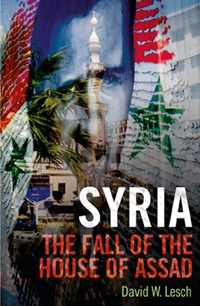 With its secularism and the overwhelmingly positive perceptions of Syrians of Bashar al-Assad and his wife Asma, many thought that Syria would be immune to the effects of the Arab Spring. The next portion of the book discusses why many in the Syrian government, military and Assad's inner circle thought that Syria was different, including Assad himself. This is followed by a breakdown of precisely why Syria was no different to the rest of the countries in the region and the reasons behind the escalating protests.
  is available to purchase at