Saturday, 16 November 2013

Film Review: Utopia (A Film by John Pilger)

A camera pans across a dwelling, revealing a scene of unimaginable poverty. A single, bare mattress lies on a floor and the person in front of the camera examines how up to six children will sleep here head to toe. The crew moves into a bathroom with no basin or mirror and a rank, blocked toilet. Almost a third of this population will die by the time they are 45 and children are plagued by treatable ear and eye infections.

You’d be forgiven for thinking this is a scene in a third word country; perhaps it is South Africa or Brazil, countries which have the highest Gini coefficient of inequality in the world. It is in fact Australia, the world’s twelfth largest economy. This is Utopia, a region 200 miles north-east of Alice Springs in the Northern Territory and the poorest region in Australia.

Utopia A Film by John Pilger poster

Utopia is a documentary by John Pilger. Two years in the making, journalist and film-maker Pilger returns to the country of his birth to investigate the conditions that the Aboriginal Australians are living under. He weaves into the narrative the concentration camp at Rottnest Island up to 1931 and the Stolen Generations travesty of the first half of the 20th century but it is the events of recent years that are most disturbing.

We see footage of young Aboriginal men who have been abused and later died in police custody and learn that the incarceration rate for young Aboriginal men in Western Australia is 8 times higher than that of black men in the last 10 years in apartheid South Africa.

The documentary features the obligatory privileged white Australians blaming Aboriginal Australians for their own poverty and lack of inclusion. Incidentally, footage in Johannesburg’s Apartheid Museum shows white South Africans expressing these same sentiments about black South Africans in the 1960s and 1970s. Meanwhile, journalist Chris Graham observes that all of this happens while governments continue to fail to invest in Aboriginal communities.

John-Pilger-Utopia-AustraliaAs recently as 2006, the Racial Discrimination Act was suspended to launch the Howard government's plan of intervention, a scheme to send the army into indigenous communities to remove their children under fabricated charges of paedophilia. Communities were then subjected to a denial of basic services unless they agreed to hand over the leases to their land.

Utopia is certainly worth watching and indeed, it might be worth watching more than once. My own interest in viewing the documentary stemmed from basic awareness of the massacres of Aboriginal peoples and the Stolen Generation but I was quite unprepared for what I saw.

I was appalled by the level of indifference and even cynicism that politicians continue to display towards the Aboriginal Australians and the continuing lack of support, investment and basic healthcare given to the population. Decade after decade, administration after administration, these people are repeatedly let down and betrayed.

John Pilger Utopia

Utopia is the fourth film that John Pilger has made about Australia and includes many of the people that he met during the making of The Secret Country in 1985. At one point in the documentary, he compares scenes filmed in the 1980s to present day conditions and the results are chilling: very little has changed.

Utopia will be released in the UK at the Curzon Soho on 15 November 2013. A special viewing plus Q&A session with John Pilger will take place at the Picturehouse Soho on 18 November and will be broadcast simultaneously to 30 Picturehouse Cinemas across the country. It will be released on DVD on 16 December and broadcast on ITV on 17 December.

The documentary is scheduled for worldwide release in 2014 and will be launched in Australia at the Museum of Contemporary Art in Sydney  Screenings will take place on 21-23 January 2014 with a special Australia Day screening on 26 January.

SHARE:

Sunday, 7 July 2013

Millennium Development Goals: Momentum

In the year 2000, the Millennium Summit of the United Nations took place at the United Nations Headquarters in New York City. At the summit, eight Millennium Development Goals (MDGs) were established in what was to become the most successful global anti-poverty push in history. The MDGs are international development goals which all United Nations member states agreed to achieve by 2015 in partnership with international organisations such as the UNDP, UNICEF, WHO and the IMF.

The Millennium Development Goals are:

  1. Eradicate poverty and extreme hunger
  2. Achieve universal primary education
  3. Promote gender equality and empower women
  4. Reduce child mortality
  5. Improve maternal health
  6. Combat HIV/AIDS, malaria and other diseases
  7. Ensure environmental stability
  8. Develop a global partnership for development

As we near the deadline for the achievement of the goals, the United Nations have provided a set of 8 infographics to update us on the progress made by the program and the work that still lies ahead of us. With less than 1,000 days to go, it is time to accelerate action and overcome poverty once and for all.

MDG1_July copy

MDG2_July copy

MDG3_July_v2 copy copy

MDG4_July copy

MDG5_July copy

MDG6_July copy

MDG7_July_v2 copy

MDG8_July copy

Visit Millennium Development Goals: Momentum for more information and be sure to Tweet with the hashtag #MDGMomentum to raise awareness.

SHARE:

Monday, 22 April 2013

War, Peace and Faith: The Ambiguous Role of Religion in 21st Century Conflict

Tonight Sy from Sy's Prints and I attended a fascinating talk on the role of religion in 21st century conflict. The talk was held at The Royal Commonwealth Society in conjunction with the University of Sussex and International Alert. The talk was skilfully chaired by Dan Smith of International Alert and focused on the impact of religion and resolution of conflict.

Increasing Secularisation?
Dr Fabio Petito (University of Sussex) began the discussion by noting that religion is becoming more dominant in politics in contrast to the once prevailing beliefs that secularism would prevail as society became more developed. There seems to be three possible routes of this increasing dominance: the post-Cold War politics of identity in the context of collapsing Cold War states; the rise of religious terrorism; and the view popularised by Samuel Huntington (but unacceptable to Dr Petito) that religion would increasingly and inherently lead to conflict in the post-Cold War period.

Religious Literacy
Aaqil Ahmed of the BBC noted that when people are threatened, they often revert to religion but that there was never really a point in time when vast numbers of people were especially knowledgable about their religion. This lead to one of the key themes that emerged during the evening. Rama Mani (Centre for International Studies) noted that the version of religion most frequently attached to violent ideologies is a reduced version, one that is not especially characterised by a high degree of religious literacy. There comes a point where religion may be the only remaining source of power for the weak.

Religion vs Power
A related theme was whether there wasn't a contradiction in that most religions preach peace but many practice war? Dr Petito notes that we need to ask what kind of religiosity is more violent? Weak, fragile, uncertain religious identity taught not by traditional means such as the family leads to violence. Rama Mani agreed, noting that those who actively seek coherence and the essence of religion reach more peaceful means. Mention was made of the role of the church in achieving peace in Columbia and South Africa and how it seems that when people mobilise, they reach a more authentic, peaceful solution in contrast to the religious elite who often cuddle up to power.

Ms Mani concluded that religion must give up power and embrace justice, equality and critical enquiry in order to play a role in conflict resolution.

Religion and the Shared Experience
An interesting thread that the Guardian's Andrew Brown brought to the discussion is that in order to hold people together around moral values, you need a narrative or story. This was highlighted by the focus of Archbishop Desmond Tutu and the concept of Ubuntu as it was applied to emphasise the unity of the South African people. Mr Brown also made the interesting point that there are different secularities, each a product of and a mirror image of the prevailing religion at the time.

It was put forward that both religion and secularism are backlashes against prevailing states and that we may well enter a period of increasing secularism again in reaction to current religious extremes. Not only that, but it seems that political conflicts often result in religious solutions (Columbia) just as religious conflicts often lead to political solutions.

It seems clear though that religion cannot simply be dismissed. Dr Petito concluded with the excellent observation that religion brings shared norms and ethics and we must use these a part of the solution.
SHARE:

Sunday, 10 March 2013

Moving Forward with “A Passion to Understand”

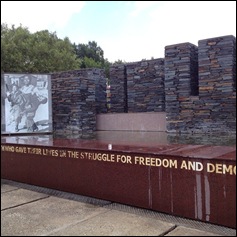
Hector Pieterson Memorial and MuseumWho Gave Their Lives to The Struggle

If I had to choose to go forward with only one of my blogs and to delete the other two, I would choose A Passion to Understand which is a bit strange seeing as this is the blog I neglect the most. I have justified that neglect somewhat because I am working full time and studying in the evenings and because those studies will eventually enable me to move forward with some of the themes raised in this blog.

I am a couple of months away from obtaining my AAT qualification and will then move to one of the professional qualifications such as CIPFA or ACCA (those are the biggest contenders at the moment).  My dream is to work in a volunteer capacity in emerging or post-conflict economies and to work towards establishing proper governance and accountability in those countries, whether in the private or public sector.

I’m really happy where I work at the moment and my employer is a global forerunner in establishing these programmes so I am unsure whether the volunteer work would be on short term contracts through organisations such as AfID or whether I’d aim for longer term pursuits. In my dreams, I’m working internal audit for international development agencies.


Upcoming Themes on A Passion to Understand

Despite having a very good reason for neglect, the fact remains that the themes of this blog are very important to me and I wish to continue learning about them and breaking them down in such a way that others can learn about them too. For this reason, I have formed a plan to cover the following themes in the next 6 – 9 months:

The Arab Spring: I will complete my series on A Decade of Conflict Leading up to the Arab Spring with posts on:

  • Israel / Hezbollah War in Lebanon (2006)
  • Gaza War (2008 – 2009)
  • Book review of The Battle for the Arab Spring: Revolution, Counter-Revolution and the Making of a New Era by Lin Noueihed and Alex Warren

Apartheid: I will continue my focus on South Africa and Apartheid with posts on:

  • The Apartheid Museum, Johannesburg
  • Hector Pieterson Memorial and Museum, Johannesburg
  • Book review of Soweto: 16 June 1976 by Elsabé Brink, Gandhi Malungane, Steve Lebelo, Dumisane Ntshangase, Sue Krige

This will be followed by a second series later in the year or early next year focusing on Apartheid laws and the violence during the 80s and early 90s.

Former Yugoslavia: I will spend some time focusing on Bosnia this year and the Bosnian War with posts on:

  • Impressions of Mostar and Sarajevo
  • Book review of Zlata's Diary by Zlata Filipović
  • Book review of The Serbs: History, Myth and the Destruction of Yugoslavia by Tim Judah (if I can finish it. It is not light reading)

Get Involved with A Passion to Understand

There are two opportunities to get involved with the blog at the moment.

Interviews: I contact both author and key contact interviews on the blog and am always looking for new people to speak to. Previous interviewees include Mark S. Smith, author of Treblinka Survivor: The Life and Death of Hershl Sperling and Dr. Ajaz Khan of Lendwithcare.org. 

If you would like to speak to me about your work, please don’t hesitate to get in touch.

Write for us: If you would like to contribute to A Passion to Understand, please email me with your topic and I will consider it for inclusion on the blog. This is open to bloggers, activists, key contacts, students and other interested parties and no commercial links will be considered.

Please email me at the address below or contact me on Twitter @APassionBlog.

 mail

SHARE:

Wednesday, 27 February 2013

On Tolerance and Racism

I've tried for the longest time to get my head around the overt racism and race relations in the UK. I find that people will often say the most offensive things to me, mistakenly assuming that because I am South African I will be racist too. My opinion has always been that it is not that people in the UK have become less racist, more tolerant or accepting of others, but that they've learned to hide their views better.

In this article on institutional racism in the police force, Adam Elliott-Cooper seems to make a similar point.

"The ‘unlearning’ of racism and other forms of discrimination is still rather like a primary school teacher instructing a group of pre-adolescents not to swear. The teacher tells the children which words are unacceptable, and that they may be punished if they do not comply. Equality training generally focuses on learning which words relating to race, ethnicity, gender, physical ability or sexual orientation are/are not offensive to the apparently over-sensitive social group(s) to which they relate." - The Voice, "Anti-Racism Has Been Reduced To Politically Correct Exercise"

It seems to me that in light of this, campaigns such as the one to wipe out racism in sports are always going to miss the mark. Don't get me wrong, I think they are fantastic and necessary. However, the lesson people seem to be learning is to tolerate people of other races (or genders or other minorities) until they fall out of line, in which case they are open to abuse. And that abuse almost always takes the form of heightening and focusing on their race, gender or other assumed defining factors.

At the heart of this is the arrogance in thinking that whiteness is the norm, in casting people as "other" and assuming some fictional right to pass such judgements. Surely it is time to abandon the idea of tolerance?

I don't know what the answer is but I have observed something that was present in South Africa but seems to be missing in the UK. I don't know whether it is political correctness, but in my circles in South Africa, we celebrated each others cultures. I worked with Muslims, Hindis, Tamils, Jews, Catholics and Baptists as well as members of the ZCC and NGK. My colleagues spoke Xhosa, Zulu, Tswana, English and Afrikaans. We absolutely learned and appreciated religious holidays, cultures, customs in births, deaths, marriages and naming of children. More than anything, this taught me respect and understanding, appreciation and consideration for others.

While I wish this were infinitely more eloquent, my rather long-winded point is that we learned acceptance and an appreciation of other people's race, religion, creed and culture. While that will never erase the power and class differentials in South Africa, while it can never come close to closing the gap created by Apartheid, it seems to me to be a far better starting point than tolerance and implicit transience of that tolerance.

SHARE:
© A Passion to Understand

This site uses cookies from Google to deliver its services - Click here for information.

Blogger Template Created by pipdig