Saturday, 19 August 2023

Graphic Novel Review: The Photographer of Mauthausen by Salva Rubio, Pedro J Colombo & Aintzane Landa ★★★★★

Most online accounts of Ernst Kaltenbrunner and Albert Speer mention that they were convicted at the Nuremberg trials but few accounts mention the testimony and evidence provided by Francisco Boix that enabled those convictions. Nor do they mention the bravery and sacrifices of the people involved in preserving and delivering that evidence to the outside world.

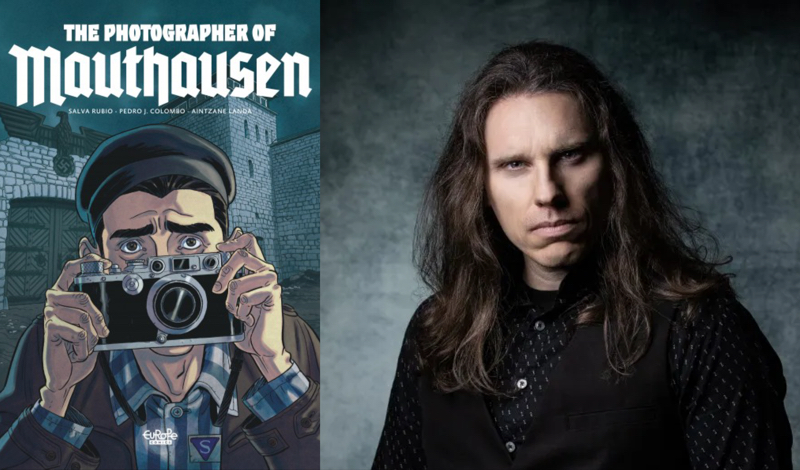
Graphic Novel Review | The Photographer of Mauthausen | cover and author photograph

The Photographer of Mauthausen by Salva Rubio (writer), Pedro J Colombo (illustrator) and Aintzane Landa (colourist) tells the story of Boix, a Spanish photographer and veteran of the Spanish Civil War. Following his part in the civil war, Boix was exiled to France and joined the French army before being captured by the Germans. The Photographer of Mauthausen starts with Boix's arrival at Mauthausen in 1941.

Boix starts off his internment as a translator but soon finds a position in the photography lab. Somehow, inexplicably, SS-Hauptscharführer Paul Ricken takes a liking to to Boix and recruits him as assistant to his macabre photography project. In this role, Boix is exposed to the many atrocities being committed at Mauthausen (in addition to the ones he had already witnessed).

Boix realises initially that this evidence needs to be preserved and several prisoners get involved in making this happen. However, as news reaches camp of an impending Russian victory, Boix realises that he needs to get proof of the atrocities to people on the outside of the camp.

Boix was successful and both his testimony and the photographic evidence proved that Nazis such as Kaltenbrunner and Speer were not only aware of what was happening at Mauthausen but they were complicit in the atrocities too.

The value of The Photographer of Mauthausen is in the questions that it raises about justice and remembrance. At the time of the Nuremberg trials, the photos were used to obtain convictions but Boix expresses frustration on page in the graphic novel about why people weren't more concerned about what happened at Mauthausen and the atrocities committed.

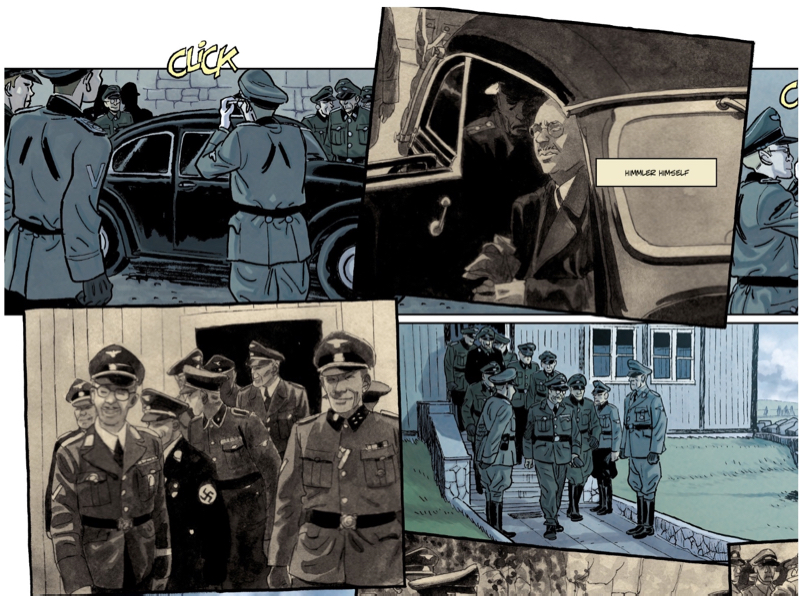
Graphic Novel Review | The Photographer of Mauthausen | Page from graphic novel depicting the photographer capturing various Nazi officers

The Photographer of Mauthausen is an excellent graphic novel that tells, in an accessible format, an important story in the annals of Holocaust history while serving as an educational source on both Nazi atrocities and the trials following the war.

I give The Photographer of Mauthausen a superb five out of five stars. The graphic novel is extremely well illustrated and written and recommended for those interested in history, graphic novels and the Holocaust.

★★★★★

SHARE:

Thursday, 3 September 2020

Alfred Birney’s ‘The Interpreter from Java’ - Blog Tour and Guest Post

I’ve previously covered the suppressed history of Dutch atrocities in post-war Indonesia on this blog in 2012 and I was very interested to hear about Alfred Birney’s novel about a man named Alan Nolan who discovers his father’s memoirs about the atrocities he committed in the Dutch East Indies during the war with Japan – his life as an assassin, the murder of Indonesians in the service of the Dutch and his escape to the Netherlands to avoid execution. Today I’m taking part in the blog tour for the English-language release of The Interpreter from Java and thank Alfred Birney for the guest post below.


Colonial Shame by Alfred Birney

The Netherlands’ colonial past has been resurfacing regularly in the national media since 2016, spurred on in part by the success of my novel The Interpreter from Java. Slavery has also become a staple of public debate, though activists often face a barrage of criticism for asking the Dutch to take a broader look at their own history.

Colonial history has never been top of mind in the Netherlands, but things took a dramatic turn for the worse with the introduction of a new education system in the 1970s: secondary school students were allowed to pick and choose much of their own curriculum and history lost its status as a compulsory subject. And so we set about producing entire generations with the historical awareness of your average mollusc. Grist to the mill of a nation that was all too eager to sweep its own colonial history aside while pointing the finger at Germany, a country more inclined to shoulder the burden of guilt and apologise for its wartime atrocities. That same finger was pointed at Japan for having the temerity to invade the Dutch East Indies. But what about the troops – over 100,000 of them – dispatched from the Netherlands to reassert Dutch colonial rule after the war by mowing down Indonesian freedom fighters? No British-style Round Table Conferences preceded Indonesia’s independence.

Alfred Birney portrait - credit Eddo HartmannUnsurprisingly, the Dutch were happy to join in the worldwide protests against the US bombing of Vietnam. If there’s one thing we’re good at, it’s railing against abuses that occur far from our own little patch of mud. But many Americans now look back with a profound sense of what was done in their name. Countless movies and songs about that wretched Asian war have seen the light of day. A ten-part series on the Vietnam War, complete with blunders and atrocities, is now available on Netflix. And what have Dutch post-colonial sensibilities produced? Little more than small-screen adaptations of books from before 1900.

The Dutch government is spending over four million euros on an ‘independent study’ into war crimes committed during our great colonial war, a war we lost. This is a farce. Everything of note has already been recorded and filed away, nothing new will surface. These millions are earmarked for the Royal Netherlands Institute for South East Asian and Caribbean Studies, the Netherlands Institute for War, Holocaust and Genocide Studies and the Netherlands Institute for Military History.

A study conducted by three government-funded institutes – how independent is that? The men in charge say they welcome cooperation with Indonesia, yet failed to invite a single Indonesian to their obligatory kick-off event. They are eager to talk to Indonesian eyewitnesses from the colonial war of independence, all of whom are long dead.

While the stated aim of this study is to analyse the violence on both sides, the Netherlands refuses to simply translate the work of Indonesian historians. Every effort will be made to explain Dutch violence in the broader context of post-war decolonisation, a framework of international political, administrative, judicial and military justifications. International, eh? They’ll be blaming the Allies next!

But there is hope. Truly independent researchers in the United States and Flanders are sifting through the facts and taking up their pens. Free from that peculiar mix of colonial shame and arrogance that inflicts the Dutch, they will one day rap us on the knuckles as firmly as we have done with other nations.


The Interpreter from Java is translated by David Doherty, published by Head of Zeus and available in hardcover from today.

Photo credit portrait of Alfred Birney © Eddo Hartmann

SHARE:

Tuesday, 11 December 2012

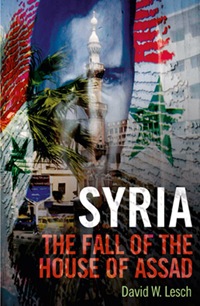
Book Review: Syria: The Fall of the House of Assad by David W. Lesch

David Lesch - Syria - The Fall of the House of Assad - bannerWhen Bashar al-Assad became president of Syria upon his father's death in 2000, many people had high hopes for this young man who gave up his passion for ophthalmology to lead his country. Many expected al-Assad to embark on a series of reforms and lead Syria to a more progressive future.

A decade later and the oppressive and powerful Syrian security-military apparatus reacted with increasing brutality to the Syrian uprisings that were part of the region-wide Arab Spring. Almost two years later and the country remains in the grip of a devastating civil war.

What went wrong in Syria, the country that once held the highest hopes of progression and reform in the region? Author David W. Lesch enjoyed exclusive access to Assad as a leading Middle East scholar and consultant between 2004 and 2009 and in Syria: The Fall of the House of Assad, Lesch goes into detail about the rise and fall of the house of Assad.

Syria: The Fall of the House of Assad is by turns quite fascinating. It begins with a discussion of al-Assad's first years in office, the Damascus Spring and the increasing international pressure following 9/11 and the assassination of former Prime Minister of Lebanon, Rafic Hariri.

David Lesch - Syria - The Fall of the House of Assad - coverWith its secularism and the overwhelmingly positive perceptions of Syrians of Bashar al-Assad and his wife Asma, many thought that Syria would be immune to the effects of the Arab Spring. The next portion of the book discusses why many in the Syrian government, military and Assad's inner circle thought that Syria was different, including Assad himself. This is followed by a breakdown of precisely why Syria was no different to the rest of the countries in the region and the reasons behind the escalating protests.

The following two chapters are dedicated to the Syrian response to the uprisings compared to the mounting opposition and popular action that took place amid reports of increasing atrocities.

Of particular interest was the next section of the book dealing with the the often confounding international response. Lesch goes into some detail regarding the divisions within and between the member states in both the United Nations and the Arab League and their evolving affiliations to Syria during this time.

As the book draws to a close at the end of the summer of this year, what is particularly startling is that the government and president of Syria continue to give the same empty promises of reform and cooperation as they did two years ago.

Syria: The Fall of the House of Assad is an important book with valuable information covering both the background and current situation in Syria. The book does not go into much detail on the individual atrocities and massacres, other than to mention them and the consequences thereof, and the focus is on the background to the decisions made by key local, regional and international players.

It can be a little difficult to follow at times and the author does tend to jump back and forward in time, but I appreciate the layout of the book into clearly defined sections over the benefits that a strict chronological analysis would have brought.

I certainly recommend Syria: The Fall of the House of Assad to anyone interested in understanding the situation in Syria and would recommend it to academics and interested parties alike. Lesch makes a good attempt to present the book so that it will be accessible to non-academic readers.

Syria: The Fall of the House of Assad is available to purchase at  Amazon.co.uk and Amazon.com.

SHARE:

Friday, 10 August 2012

The Suppressed History of Dutch Atrocities in Indonesia

The piece below is written by Paul Doolan and was published today in the Australian e-journal On Line Opinion as “In the Netherlands, a suppressed history makes the headlines”.  In this article, Doolan discusses the fascinating history of oppression and atrocities in post-war Indonesia during their fight for independence and how this history was all but erased from the Dutch public conscience in for over 60 years. The article is shared under the Creative Commons license with due credit given to both Paul Doolan and On Line Opinion.


The problem with the past sometimes, is that it isn't past at all, as the Dutch have been forced to face up to recently. For the Dutch, the history of the mid- 20thcentury was quite simple until very recently: a freedom loving people (the Dutch) were attacked by an aggressive neighbor (Germany) and suffered for five years until, with the help of some friends, they were liberated. Conveniently forgotten was that, following this episode, the Dutch state mobilized the largest army in its history and fought a war against the Indonesian independence movement. The Dutch lost the conflict, and in December 1949 their former colony, the Dutch East Indies, gained independence. During the following decades this tropical misadventure formed an almost blank page in the nation's history. But that, it seems, is changing. Events during the past year have forced the Dutch nation to reconsider the myth that for over a half century has formed their collective memory. Especially in the past couple of months, history has become front page news.

Eerste beeld van executies in indie

The Dutch had ruled most of Indonesia for 350 years, but found themselves prisoners of the Japanese from 1942 to 1945. With the defeat of Japan, Indonesian nationalists declared independence. The Dutch tried, with great difficulty, to reassert their control of the archipelago. After over four years of bitter conflict The Netherlands was forced to concede independence to Indonesia in December 1949.

By the end of the war numerous cases of military excesses had come to the attention of the Dutch public. Massacres by Dutch Special Forces on the island of South Celebes (present day Sulawesi) had been the subject of parliamentary debate. A massacre in the village Rawagede had been the subject of debate at the United Nations Security Council in 1948. Such incidents gradually led a minority of the Dutch press to turn against the war. In February 1949 leftist De Groene Amsterdammerpublished a letter from an unidentified officer. He wrote that Dutch officers:

defend with passion and conviction the assertion that, for instance, if you are shot at from a kampong [village] than this kampong should be set on fire from four sides before the inhabitants have the chance to run away. And whoever then tries to escape (…) you shoot with a machine-gun, preferably not bothering with if these include women of children.

The officer then drew a comparison with Putten, a village that had become infamous as being the site of one of the worst Nazi atrocities perpetrated on Dutch soil. The officer wrote of summary executions of prisoners who are "simply shot behind the head and then buried." He described the Indonesians as living under "military terror."

But after the loss of their colony in December 1949 and the return of their soldiers the Dutch authorities quietly and quickly put the lid on this uncomfortable period of contemporary history. For many decades, with only the occasional exception, the possibility that Dutch forces had been guilty of atrocities, or even war crimes, was kept out of public consciousness. But last September history ended up in the court room and a court verdict in The Hague found the Dutch state responsible for carrying out a massacre of over 300 unarmed Indonesians in 1947 in the village of Rawagede, Indonesia, and called on the state to award compensation to the plaintiffs – seven elderly widows of those massacred.

Photos emerge of Dutch war crimes in Indonesia

Recent months have seen an increase in public attention on Dutch military atrocities. Earlier this year a national television channel, NCRV, broadcast a documentary on the Dutch atrocities committed on Sulawesi in 1946-1947, when around 3,000 Indonesians were executed without trial by special Dutch forces. It turns out that an official parliamentary inquiry into these events had taken place in 1954, but the report was kept top secret. The NCRV managed to get hold of a copy and for the first time the Dutch public heard excerpts from the report which would seem to indicate that widespread atrocities had had the support of the military and political leadership, and had then been officially hushed up. A few months after the broadcast a foundation representing the widows of ten victims of the Dutch on Sulawesi began a legal procedure against the Dutch state. The lawyer representing the foundation is Liesbeth Zegveld, who also led the successful case on behalf of the widows of Rawagede. The odds are that the Dutch state will be found responsible for war crimes again.

In early July historians from three research institutes of worldwide reputation issued a public statement, claiming that the Dutch state has never come clean on its colonial past and called for the government to fund a large scale research project that would systematically look at the behavior of the Dutch military in Indonesia during the years 1945-1950 and examine the role of the Dutch political elite in the conflict. The fact that the history of the war of decolonization in Indonesia has become a hot topic can be seen by the fact that this announcement by academic historians was reported on national news, in newspapers and on radio and television. It isn't often that history makes the headlines. Yet more was to follow.

Dutch atrocities in Indonesia

On July 10th the national newspaper, de Volkskrant, published two photos that seem to show three Indonesians standing in a mass grave, being executed by Dutch soldiers. The photos had belonged to a deceased former Dutch soldier and had been rescued from a rubbish dump. Remarkably, these were the first ever photos of Dutch executions ever to be published – 63 years after the end of the war. De Volkskrant ran the report on its front page and within hours it was being reported on the radio and television. I've just returned from a two week visit to the Netherlands and everyone I spoke to had seen the photos. The most common reaction was: "why have we been lied to all these years?" Perhaps we can expect to find an answer some time in the not too distant future.

About the Author


Paul Doolan teaches history at Zürich International School, Switzerland and lectures in Political Systems at the College for International Citizenship in Birmingham, England.

Paul blogs at ThinkShop

SHARE:

Friday, 18 November 2011

Open Society Justice Initiative Fact Sheet on Cambodian Tribunal

The Open Society Justice Initiative has issued an excellent two page fact sheet on the work of the ECCC and the Cambodia Tribunal.  There was much that I already knew on the fact sheet but a couple of items that were new to me. 

For instance, of interest is the fact that the case will be split into a series of phases in order that each issue might be dealt with in full and that judgement can be reached before moving on to the next phase.  This was decided “due to concerns that the elderly defendants might otherwise die before any judgments are brought, and similar concerns about further delaying justice for surviving victims”.

The first phase of the trial will deal with the period immediately following the Khmer Rouge rise to power in April 1975, when a massive proportion of the population was forcibly removed from Phnom Penh and other cities and forced to work in the countryside and rural areas. 

It is intended that future phases of the case will focus on “crimes committed at co-operatives, worksites, security centres, and execution sites, as well as other crimes, including genocide against minorities”.

There has been quite a lot of controversy surrounding the Cambodia Tribunal lately, especially with respect to cases 003 and 004 regarding officially unnamed defendants.  There have been allegations of mishandling of cases and Judge Blunk resigned in October citing political interference in the case.  Despite these difficulties, I concur with the Open Society Justice Initiative when they state:

“If the trial is carried out independently, transparently, and in accord with international standards, it will make a major contribution to the cause of accountability in Cambodia and to the global movement for international justice”.

SHARE:

Thursday, 17 November 2011

Cambodia Tribunal Declares Ieng Thirith Unfit to Stand Trial

Ieng Thirith
AFP/Archives/Heng Sinith

The Washington Post is reporting that the UN-backed Cambodia war crimes tribunal, the ECCC, has found Ieng Thirith unfit to stand trial on the grounds of diminished capacity due to Alzheimer’s disease. Ieng Thirith has been reported as showing signs of dementia.

This comes just four days before the start of Case 002 in the Extraordinary Chambers in the Courts of Cambodia which is focusing on crimes committed by the Khmer Rouge, a communist, Maoist party that ruled Cambodia from 1975 to 1979 under the leadership of Pol Pot. 

The Khmer Rouge set up a radical form of agrarian communism whereby population was set to work on the land and the urban, educated population was removed from cities.  Working conditions were extreme and between 20 and 25% of the population was literally worked to death.  It has proved impossible to gauge accurate figures but estimates say that between 850,000 and 1.5 million men, women and children died from execution, torture, forced work or starvation.

Case 001 of the ECCC was against Kaing Guek Eav, known as Comrade Duch, who was found guilty of crimes against humanity and sentenced to 35 years in prison in July 2010.  Duch was the prison chief of the notorious Tuol Sleng Jail (S-21) in Phnom Penh during the Khmer Rouge regime and was responsible for the deaths of approximately 15,000 people.

Public gallery of Cambodia Tribunal
Public gallery during testimony of S-21 survivor Vann Nath on 29 June 2009 [Source: ECCC]

Case 002, due to start on 21 November 2011, is the case against Nuon Chea, Ieng Sary, Khieu Samphan and Ieng Thirith.  This case is in an entirely different league to the former case as it is against four former high-ranking, government officials. 

Khieu Samphan, aged 79, was the former Head of State; Nuon Chea, aged 84, was former Deputy Secretary of the Communist Party of Kampuchea; Ieng Sary, aged 85, was the former Deputy Prime Minister for Foreign Affairs; and his wife, Ieng Thirith, aged 78, was the former Minister of Social Affairs.

Despite the numbers of people that perished during the Khmer Rouge regime, legally, the event is not classified as a genocide because the perpetrators were of the same nationality and ethnic group as the victims and there was no systematic attempt to destroy a certain ethnic, racial, religious or national group.

Therefore, case 002 brought charges of war crimes and crimes against humanity against the four defendants.

Nevertheless, in December 2009, charges of genocide were brought against Nuon Chea, Ieng Sary and Khieu Samphan and later against Ieng Thirith in relation to the brutal slaughter and oppression of Cambodia’s ethnic Vietnamese and Cham Muslim minorities during the Khmer Rouge era.  Charges of murder, imprisonment and torture have also been brought against the defendants.

The Cambodia Tribunal was always going to be problematic in that they only began 30 years after the brutal events of the Khmer Rouge era.  We are experiencing similar problems with aging defendants with the Ratko Mladić trial less than 20 years after the events.  The difficulty is that these people committed unspeakable acts and the trials are as important for the punitive element as they are in unearthing the atrocities that were committed.  The ECCC is beset by scandal and setbacks at present and I just hope that they can push through and get to the bottom of this senseless and tragic time in Cambodian history.

SHARE:

Thursday, 11 August 2011

ICTY Judgement: Milan Lukić & Sredoje Lukić

Yesterday I ran an article relating to the book that Milan Lukić wrote, the transcript of which was smuggled out of the UN Detention Centre illegally.  I discovered the videos below on the ICTY YouTube channel and found them to be riveting. 

Cousins Milan Lukić and Sredoje Lukić were sentenced to life and 30 years' imprisonment respectively, for crimes against humanity and war crimes committed in eastern Bosnian town of Višegrad during the 1992-1995 conflict. 

The body of evidence brought against the cousins was extensive and at one point, the judge even refers to a multitude of complaints and testimony that they didn’t even charge the cousins on.  This shows a pattern of murder, rape, extermination and persecution that took place over a period of about three years leading up to 1995. 

They did charge and convict them on several specific incidents including the infamous murder of 59 Muslim women, children and elderly men in a house on Pionirska Street in Višegrad and the murder of at least 60 Muslim civilians in a house in the Bikavac settlement of Višegrad.

Both Milan and Sredoje Lukić showed no remorse during their trial.  They both entered a ‘not guilty’ plea and you can see in the video that Milan shows a specific lack of respect to the proceedings. 

SHARE:

Wednesday, 10 August 2011

Serbian Orthodox Church Endorses War Criminals

This post was written by Daniel Toljaga and was first published as Serbian Orthodox Church Endorses War Criminals on Daniel's blog. This post has been reproduced, in full, with Daniel's express permission and features an important translation of the press release from the Humanitarian Law Center in Belgrade.
serbian-orthodox-church-priests-promote-book-written-by-convicted-war-criminal-milan-lukic
By Daniel Toljaga


A convicted war criminal who burned alive scores of Bosniak civilians and systematically tortured and raped Bosniak women and under-age girls enjoys the uncritical endorsement of the Serbian Orthodox Church.

The Humanitarian Law Center in Belgrade reports that the Serbian Orthodox Church has hosted a book launch at the parish house of the Cathedral of St. Sava in Belgrade to promote a prison memoir, “Ispovest haškog sužnja” (“Testimony of a Hague prisoner”). The book’s author is the convicted war criminal Milan Lukić — a ruthless mass murderer and serial rapist. The Belgrade publisher responsible for promoting the launch is the Serbian Radical Party led by ultra–nationalist politician Vojislav Šešelj. Šešelj himself is currently on trial at the International Criminal Tribunal for the former Yugoslavia (ICTY) in The Hague for crimes against humanity. The manuscript of Lukić’s book was smuggled out of the UN Detention Unit illegally.

This is not the first time Serbian Orthodox Church has aligned itself with war criminals. The recently-captured fugitives, former Bosnian Serb General Ratko Mladić and Croatian Serb leader Goran Hadžić, bragged that the Serbian Orthodox Church helped them evade justice. General Mladić is now on trial as the orchestrator of the Bosnian Genocide; Hadzic is on trial for crimes against humanity committed in Croatia.  The Serbian Orthodox Church sees itself as the moral compass of the Serbian people. Its incomprehensible and repellent actions suggest that the Church is morally adrift.

In 2009 the International Criminal Tribunal at the Hague found Milan Lukić guilty of burning alive more than 120 Bosniak women, children and elderly men in the eastern Bosnian town of Višegrad. He was sentenced to life imprisonment for his terrible crimes.

On 14 June 1992, a group of victims, most of them from the same village, were locked into one room of a house on Pionirska Street, Višegrad, which was then set on fire. Milan Lukić was found to have placed an explosive device in the room which set the house ablaze. He then shot at people as they tried to escape the burning house. At least 59 women, young children and elderly people were burned alive, among them a 2-day-old baby.

Lukić was also found guilty of burning alive at least 60 women, children and elderly men two weeks later, on 27 June 1992, in a house in the Višegrad settlement of Bikavac. He and other members of his paramilitary group, ‘White Eagles’, forced the civilians inside the house, blocked all the exits and threw in several explosive devices and petrol, setting the house on fire.
“The perpetration by Milan Lukić and [his cousin] Sredoje Lukić of crimes in this case is characterised by a callous and vicious disregard for human life,” presiding Judge Patrick Robinson noted.

He observed that, “In the all too long, sad and wretched history of man’s inhumanity to man, the Pionirska street and Bikavac fires must rank high. At the close of the twentieth century, a century marked by war and bloodshed on a colossal scale, these horrific events stand out for the viciousness of the incendiary attack, for the obvious premeditation and calculation that defined it, for the sheer callousness and brutality of herding, trapping and locking the victims in the two houses, thereby rendering them helpless in the ensuing inferno, and for the degree of pain and suffering inflicted on the victims as they were burnt alive.”

Milan Lukić also participated in systematic sexual assaults on Bosniak women and under-age girls in “rape camps” in and around Višegrad. Most notably the Vilina Vlas spa hotel on the outskirts of Višegrad was used as a rape camp while it was, on Lukić ‘s own admission, his military unit’s command post. Approximately 200 women and under-age girls were detained  in Vilina Vlas. The Association of Women Victims of War — led by rape survivor Bakira Hasečić — believes that fewer than ten women prisoners survived their detention.

Rape and sexual slavery charges were added to the indictment against Lukić less than a month before the trial. The day before proceedings were due to begin, the Trial Chamber ruled that the accused did not have enough time to mount an adequate defence. 
I have taken the liberty of translating this short but important press release issued by the Humanitarian Law Center from Serbian into English:
“Humanitarian Law Center urges the institutions and citizens of the Republic of Serbia to condemn publicly the use of the Parish House of the Cathedral of Saint Sava in Belgrade for the launch of a book by the convicted war criminal Milan Lukić during which priests of the Serbian Orthodox Church took part in the eulogisation of a war criminal responsible for some of the most terrible crimes against humanity.
Humanitarian Law Center demands that the Patriarch reveal the names of the priests who took part in this public event and explain to the public why a religious building whose construction was paid for by the state and many individual citizens has been used to celebrate a convicted war criminal who burned women and children alive.
On 29 July 2011, in the parish house of the Cathedral of Saint Sava in Belgrade, an event to promote the book ‘Confession of a Hague Prisoner’ by the war criminal Milan Lukić was attended by several priests of the Serbian Orthodox Church in the company of numerous Lukić supporters. The book is published by the Serbian Radical Party.
The Trial Chamber of the International Criminal Tribunal at the Hague sentenced Milan Lukić to life imprisonment for shooting five Bosniaks beside the Drina River on 7th June 1992, killing seven workers of Varda factory, burning alive at least 120 Bosniak women, children and the elderly in Višegrad’s Pionirska Street and Bikavac district, the ‘cold and brazen’ murder of Hajra Koric and the brutal torture of Bosniak detainees in Uzamnica detention camp near Višegrad. In all these crimes, Milan Lukić, played a ‘dominant role’ and exhibited a ‘callous and vicious disregard for human life’, personally killing ‘at least 132 people’ according to the judges at the International Criminal Court.”
An album of photos from this ‘book’ promotion can be found on Milan Lukić’s Facebook page, which is being maintained by the priests of the Serbian Orthodox Church.
SHARE:

Thursday, 26 May 2011

Ratko Mladic: The Arrest of a War Criminal

Ratko Mladic
Just after 11:00 (GMT) this morning, rumours began to circulate on the Internet that fugitive Ratko Mladic had been captured by Serbian forces.  Initial reports stressed that the man captured was “strongly believed” to be Mladic but that DNA tests would need to be completed in order to formally confirm his identity.  The man arrested today was said to resemble Mladic strongly but was later described to be aging, exhausted and balding.
 

From Military to Genocide

 
Ratko Mladic is a Bosnian Serb who was born in the village of Bozinovici in southeastern Bosnia-Herzegovina.  He became a military officer in the Yugoslav army and rose through the ranks during the war that broke out as Yugoslavia began to disintegrate in 1991. Following the outbreak of war in Bosnia-Herzegovina in April 1992, the Bosnian Serb army was established and Mladic was transferred to the army at the request of Slobodan Milosevic.  By June 1994, Mladic was promoted to rank of Colonel General of the Bosnian Serb army and he began to direct a vicious campaign against the opponents of the Bosnian Serbs.

As commander-in-chief of the Bosnian Serb army, Mladic was widely seen to be responsible for the 46-month siege of Sarajevo and the massacre of 8,000 boys and men at Srebrenica.  Under his command, the Bosnian Serb army conducted a campaign of ethic cleansing, rape, the slaughter of prisoners of war, and the bombing of civilians.
In August 1995, the Eugene Register-Guard ran an article entitled “Serb Leader Ordered ‘Feast’ of Blood” which included eyewitness testimony of the Srebrenica massacre:
On or about July 12, he announced the "feast" of blood, according to Nedzida Sadikovic, who said she was present at the event.
According to her account, Mladic exclaimed, "There are so many," as he spotted the large number of men and boys in the crowd of several thousand refugees. "It is going to be a 'meze'(a long, delectable feast). There will be blood up to your knees," Sadikovic, 42, remembered him saying.
"Beautiful. Keep the good ones over there. Enjoy them," he told his troops, according to Sadikovic.
In July 1995, Ratko Mladic was indicted by the International Criminal Tribunal for the Former Yugoslavia (ICTY) on charges of genocide, war crimes and crimes against humanity.  This was expanded upon in November 1995 to include the crimes committed in Srebrenica in July 1995.

Ratko Mladic remained a fugitive until this morning despite several sightings of him over the years.

Capture


At 1pm today, Serbian time, Serbian President Boris Tadic announced, first in Serbian and then in English, that Ratko Mladic had in fact been arrested.  He stated that the arrest was a result of the full cooperation of Serbia with the Hague tribunal (ICTY) and noted that he had always believed in his strategy of brining war criminals to justice.


This was an interesting statement to make as many people believe that Serbia have always known where Mladic was and only arrested him today as a bargaining tool in their bid to gain inclusion into the EU.  In fact, Bosnian politician Zeljko Komsic went on record today to say exactly that, in a speech at which he expressed his pleasure that Mladic had been arrested but stated that it was too late for his victims.


It is no coincidence that today is the day that Catherine Ashton, the EU foreign policy chief, was to meet Serbian President Boris Tadic and the head of the Serbian negotiation team, Borko Stefanovic, in Belgrade.


During his press announcement this morning, Serbian President Boris Tadic went on to highlight that all crimes must be investigated and all war criminals must be brought to justice.  He called for an independent investigation by mandate of the UN Security Council into the allegations of organ trafficking in Kosovo during the Kosovo war in 1999, as reported by Dick Marty.  It is notable that Tadic referred to Kosovo as Serbia’s autonomous province, reiterating Serbia’s refusal to recognise the independence of Kosovo.

SHARE:

Tuesday, 15 March 2011

Heinrich Himmler Issues Jewish Extermination Orders

Reichsführer-SS Heinrich Himmler gave this speech on October 4, 1943 is Poznan, Poland.  He didn’t imply or suggest but openly and explicitly called for the extermination and destruction of the Jewish people.  He ranted about theft and enrichment but stated that it was a moral good to rid the Germany people of their enemy and that ultimately, their souls would not be tarnished by this action. 

SHARE:

Sunday, 13 March 2011

Bosnia: Rape a Legacy of War

“The war in Bosnia-Herzegovina may have ended fifteen years ago, but for so many of the nation's women, the legacy of wartime rape lives on.”

The use of rape in the war in Bosnia was so systematic and pervasive that the Geneva Convention was modified to include rape.  When rape is widespread and systematic, it is now recognised under the Geneva Convention to be a crime against humanity or war crime.  When it is committed alongside the intent to destroy, in part or whole, a targeted group, rape is now considered to be an element of the crime of genocide.  (See: Rape as a War Crime)

At least 20,000 women were raped in the war in Bosnia between 1992 and 1995.  They were often raped repeatedly or by gangs and rape camps were set up in towns around Bosnia.  Mass rapes also took place during the Rwandan genocide, in Kosovo in 1996 to 1999, in Darfur, and currently in the Democratic Republic of Congo.

“Their problems haven’t gone away because time has passed. They relive their traumas every day,” says Faris Hadrovic, head of UNFPA, the United Nations Population Fund, in Bosnia and Herzegovina.

The video above follows the journey of Enisa, a survivor of the campaign of rape during the Bosnian war.  It is powerful in that it puts a human face to the suffering that was endured by thousands of women in the region.  Enisa is president of the Association of Concentration Camp Torture Survivors which is a Bosnia organisation which seeks to provide support to the surviving inmates of concentration camps.  The provide physical and psychosocial support to survivors.  Of the more than 2,000 members of the association, a quarter were raped. 

Two things struck me about this video:

  • Enisa was about the same age I am now when the war broke out.  We have similar interests (she worked as a social worker) and similar pursuits.  We are the same, we are both women, we are both just living our lives.
  • The men that committed these rapes are, for the most part, walking free and living their lives.  The organisers have been prosecuted in some cases but the perpetrators have not significantly been pursued or identified.

(If you struggle to follow the video in parts because of the simultaneous interpretation, you can read the script or view the shorter news piece entitled Bosnia: Rape a Legacy of War).

SHARE:

Saturday, 12 March 2011

Video: Sound of Silence Bosnia: Rape, Legacy of War

Photographer Armin Smailovic's photographic portraits of survivors of sexual violence during the 1992- 1995 war.

“No one may ever be able to determine how many women in Bosnia and Herzegovina were sexually abused during the 1992 – 1995 war…

… or how many children were born of sexual violence”

More on this tomorrow.

SHARE:
© A Passion to Understand

This site uses cookies from Google to deliver its services - Click here for information.

Blogger Template Created by pipdig