Wednesday, 9 March 2022

Film Review: Dying to Divorce (2021) | The fight to obtain justice for violence against women in Turkey ★★★★★

More than one in three Turkish women have been domestically abused in their lifetime. Femicides are rising and in 2020, 409 women in Turkey died as a result of domestic violence. It is rare that a woman will survive a case of extreme violence, rarer still that she will see justice. BAFTA-nominated director Chloë Fairweather and CPH:DOX F:ACT-award-winning producer Sinead Kirwan have teamed together on Dying to Divorce, a feature-length film on the fight of one courageous lawyer and two brave survivors for justice.
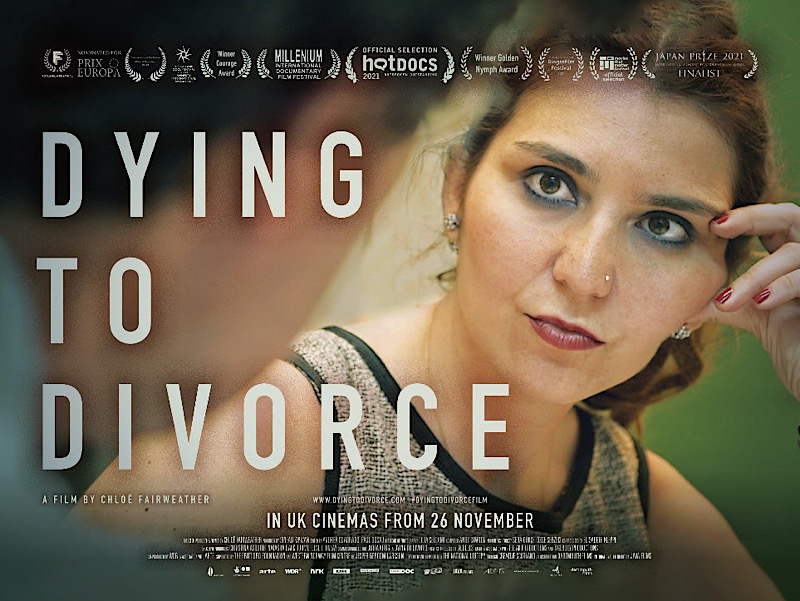
Dying to Divorce | Film Review | Film Poster

Kubra was a world famous television presenter known for her work on Bloomberg Turkey. She was attacked by her husband two days after she gave birth to their daughter. She lost the ability to speak and walk and required extensive speech therapy to testify against her husband in court.

Arzu was fourteen when she was married off to a farmer ten years her senior. He fired seven shot gun shells into her at close range when she asked for a divorce; she lost both her legs and the use of her arms as a result of the attack.

Both women need the help of Ipek Bozkurt to fight their cases in court and obtain custody of their children.

Filmed over five years, Dying to Divorce received recognition from the Academy Awards, BIFA Awards, Rose d’Or Awards, and received a BAFTA longlist nomination. It is a shocking film that delves into the systemic violence against women in Turkey and how their abuse is perpetuated by the court and Erdogan himself.

In one case, a husband was given a reduced sentence for killing his wife because she'd allegedly swore at him and provoked him.

As recently as March 2021, President Erdogan signed a presidential decree withdrawing Turkey from the Istanbul Convention. This Council of Europe treaty seeks to end violence against women and to set legally binding standards for the punishment of perpetrators. By withdrawing from the treaty, Erdogan signals that to men in Turkey that they may continue to abuse women with impunity.

Dying to Divorce could be framed as an edge-of-the-seat legal thriller were it not for the fact that it is devastatingly not fictional.

Still of Ipek Bozkurt in Dying to Divorce | Film Review
I give Dying to Divorce an excellent five out of five stars. Not only is his feature length documentary chilling and eye opening but Chloë Fairweather does an excellent job in keeping the viewer engaged in over five years of footage and developments.
★★★★★

Trailer: Dying to Divorce (2021) - directed by Chloë Fairweather

Dying to Divorce will be broadcast on Sky Documentaries on Wednesday 9 March at 9:00pm.

dyingtodivorce.com

SHARE:

Saturday, 15 December 2012

The 12 Days of Misogyny

It seems that media and advertising agencies worldwide have really gone out of their way this year to contrive the most sexist, misogynistic advertising campaigns. Laura Bates writes for the Independent and explains precisely why it is neither funny nor harmless and above all, why this matters:

"It matters because we are reaching the end of a year in which we have seen what can only be described as a torrent of reports of sexual assaults, paedophilia and abuse going back decades, many of them excused or ignored precisely because of a culture that made light of and normalized such incidents" - The Independent, "FHM, Virgin and Zoo Australia: The 12 Days of Misogyny"

FHM [Photo source: Huff Post UK]


Virgin [Photo source: Telegraph]


Zoo [Photo source: The Independent]
SHARE:

Saturday, 8 October 2011

Seeking Justice for Nepalese Victims of Rape

Nepalese Woman by David Orgel
Nepalese Woman uploaded by David Orgel on Flickr

Nepal was torn apart by a decade of violence and civil war that ended with the Comprehensive Peace Agreement signed on 21 November 2006.  Gender-based violence was a key feature of this conflict and women were raped and brutalised by both the government forces and the Maoist rebels. 

In October 2011, it was widely reported that Justice still eludes Nepal's civil war rape victims.  Five years after the peace agreement was reached, hundreds of women who suffered rape and torture at the hands of armed forces are yet to receive justice.  Rape was viewed by the government’s Royal Nepal Army to be a legitimate form of torture and many women were arrested, detained and tortured on charges of aiding or supporting the Maoist insurgents.

In her book Sexual Violence and Armed Conflict, Jane Leatherman estimates that 40,000 Nepalese children were illegally detained by Maoist insurgents during the conflict and tortured, sexually violated and recruited for military activity.

Victims face multiple hurdles when seeking justice for these attacks.  Despite widespread reporting of the atrocities by organisations such as Amnesty and in reports that appeared in the mainstream media (see: “Children suffer in Nepal conflict”, BBC, 2005), the majority of Nepalese women remain silent about their ordeals.  Rape victims are stigmatised and rejected, especially if the rapes result in pregnancies.

Nepalese human right rights activists have received constant threats of violence which has further contributed to the silence of victims in the country.  In January 2009, Nepalese radio journalist and activist Uma Singh was hacked to death by 12 to 20 men in her room.  Her only crime was to raise awareness of the levels of violence against women in Nepal (see: “Nepal radio journalist murdered”, BBC, 2009).

It is important to note that the sexual violence against women and children that occurred during the armed conflict did not occur in a vacuum but against the backdrop of a patriarchal society where men’s status is elevated and women are forced to remain in subordinate positions. 

The United Nations Population Fund in Asia (UNFPA) has uploaded a video titled “Silent Tears: Gender based Violence in Nepal”.  In the video, they note that:

“Gender-based violence is widespread in Nepal.  Male dominance and female subservience is at the root of violence against women.  95% of the women and girls surveyed reported that they had personally experience violence, 77% of them from their own family members (SAATHI).  nearly 58% reported that such violence was a daily occurrence.”

You can view the video at the end of this post.

Despite these hurdles, a survivor of violence during the armed conflict has come forward but local police are refusing to register her complaint.  The Advocacy Forum Nepal reports that the police invoked a law which states that rapes had to be reported within 35 days of the incident.  International law prohibits such limitations on rape and, in fact, the Nepal Supreme Court issued a directive to the Nepalese government in 2006 to amend the law and remove all conflicts and limitations in serious crimes such as rape.

There has been no progress on this case since the beginning of October 2011.  Despite the many incidents of sexual violence during the conflict, this is the first case to be lodged with the District Police Office.  Human rights organisations continue to lobby the government in this case and it will no doubt have serious consequences for other women seeking justice across Nepal.

Silent Tears: Gender based Violence in Nepal

SHARE:
© A Passion to Understand

This site uses cookies from Google to deliver its services - Click here for information.

Blogger Template Created by pipdig