Wednesday, 11 December 2013

Film Review: When The Dragon Swallowed The Sun

When The Dragon Swallowed the SunIt always interests me when people share quotations attributed, often falsely, to the Dalai Lama. While it is clear that he is an international symbol of peace and unity, I wonder how many people know that the Dalai Lama is an exile and has been living outside of his home country since his escape in 1959.

The Chinese invasion of Tibet in 1950 ushered in a period of increasing religious and political persecution. The 1959 Tibetan uprising against Chinese occupation was crushed with devastating consequences for the leadership of the country. The Tibetan government was declared illegal and the leadership forced into exile, while the 14th Dalai Lama himself escaped over the Himalaya mountains into India. The Chinese government declared 28 March 1959 to be Serf Emancipation Day and insists that it represents the liberation of Tibetans from a system of feudalism and theocracy.

Tibet - Dragon Swallowed the Sun

The modern history of Tibet is one of great tragedy; human rights abuses and atrocities have been regularly documented. Like many others under Chinese rule, hundreds of thousands of Tibetans perished in Mao’s Great Leap Forward from 1960 to 1962. Thousands of Tibetan monasteries were destroyed in this period and yet more were destroyed in the Cultural Revolution from 1966 to 1976.

The Chinese government has met protests in the 1980s and during the 2008 Olympics with brute force and lethal crackdowns. Reports from Tibet speak of arbitrary arrests, excessive punishments, disappearances and torture. While Chinese citizens are lead to believe that Tibetans are exempt from the one-child policy, Tibetans are in fact subjected to involuntary sterilizations, forced abortions and even infanticide.

Despite these well-documented events and a fairly strong worldwide movement to Free Tibet, why is it that Tibet hasn’t been freed?

Dirk Simon is the director of When The Dragon Swallowed The Sun, a feature length documentary on the movement to free Tibet from Chinese occupation. Seven years in the making, the film features interviews with and footage of the 14th Dalai Lama, the exiled prime minister of Tibet as well as the exiled king Lhagyari Trichen Namgyal Wangchuk, the 18th descendant of the Great Religious Kings of Tibet.

Tibet - When the Dragon Swallowed the Sun

The film explores the key split in the movement, between those who have resigned themselves to Tibetan autonomy within China and those who continue to strive for freedom and independence from China. As the young king is crowned, he must struggle to balance his education and youth with the incredible burden and responsibility placed on his shoulders. With the western world far more interested in wooing the Chinese and securing their place in China’s great economic future, the Chinese government steps up their attempt to re-educate Tibetans and eradicate Tibetan culture and religion once and for all.

When The Dragon Swallowed The Sun paints a bleak picture of a movement in tatters but does it work as a documentary? The answer is not quite. With such a provocative title, dramatic cinematic trailer and the promise of the involvement of celebrity figures such as Richard Gere and Archbishop Desmond Tutu, this is a documentary that promises much more than it delivers. Most people picking up this documentary will want to learn more about the history of modern day in Tibet and the reality of life for Tibetans both in the country and those in exile but that isn’t provided.

Interviews with key figures seem out of place, unrelated to the scenes preceding or following them, and they don’t appear to follow any greater direction or narrative. The footage of both historical and current events occurs in its raw form without narration, context or description and the viewer is left to try and decipher the direction that the documentary is taking. With so many disconnected scenes, little insight is provided into the situation.

When The Dragon Swallowed the Sun pack shotUltimately, When The Dragon Swallowed The Sun is disappointing. It is quite beautiful with impressive cinematography, but this is to be expected of a film about one of the most beautiful and remote regions on earth. The film would have benefitted with more focus on historical events and a more nuanced exploration of the difficulties that Tibetan people face under Chinese occupation. It is a pity because this film could have been a great opportunity to spread word about the situation in Tibet.

When The Dragon Swallowed The Sun was released in the UK on DVD 9 December 2013 and can be purchased from Amazon.co.uk.

SHARE:

Tuesday, 15 November 2011

Immigration and Human Rights: Alabama

This is a guest post by Anthony Garcia.

The U.S. economy has not been faring well in recent years. Politicians try to gain election momentum on issues of high rates of joblessness, and this can be used as a justification for racism and human rights violations to flourish. Many citizens from both uneducated and highly educated backgrounds blame immigration for the country’s woes, using rhetoric about job stealing and who is or is not a “real” American to explain why we as a nation are spiraling into debt and losing jobs fast. For many of us in America, especially for minority citizens and Mexican Americans, this type of anti- “alien” rhetoric can ruin lives. Not only does it dehumanize, but it disallows for any nuances in personal situation, completely compartmentalizing and “othering” immigrants of color.

Campesinos harvesting summer squash
Campesinos harvesting summer squash uploaded by Robert Dickey on Flickr

There is potential for crisis on the human rights front now occurring in the southern belt states of the U.S., with state laws seeking to close the flow of illegal immigration. The patrol for illegal immigrants in Border States has moved inward, so people of color are not just being profiled at the border anymore, but they may not be safe from harassment inland either. This has already happened in Arizona, where you can get pulled over for suspicion of being an alien. In other words, if you are a person of any shade darker than lily white, you can be pulled over for just that. The recent laws in Alabama have increased anxiety and business loss for those employers that depend on workers who are willing to do difficult tasks for little pay. Although racial profiling has occurred in the US for years, it is now being sanctioned because conservative politicians are determined that “only Americans” should work in America.

The issue is not a small one; of the 11 million immigrants in the U.S. that are undocumented or considered “illegal aliens,” more than two-thirds are directly placed in the country’s work labor pool. This influx affects the U.S. industrial economy at multiple levels, most notably farming and food production, which critically depends on undocumented “alien” labor. Americans just don’t work such jobs, viewing the pay as too low for work that is manually difficult. America relies on immigrants for survival, but things have been getting even more heated because of the economic strain.

In 2011 four states have already passed legislation making it harder for undocumented workers to simply stay within those jurisdictions, and Alabama has become the fifth. Alabama’s law included an additional concerning requirement for schools to check students’ immigration statuses. Thus, children of color cannot go to school without fear or being harassed and terrorized. There is a lack of a national standard at the federal level, so when states make laws like this that could affect human rights in Alabama, Arizona, and California, there is no means to regulate it yet at a national level in order to make sure that rights are not being violated and people will not be abused.

Campesino Nicholas
Campesino Nicholas uploaded by Robert Dickey on Flickr

Unfortunately, in its zeal to make things “uncomfortable” for targeted groups, Alabama’s state may have infringed on human rights laws, regardless of whether they are undocumented or not. In fundamental areas such as criminal law, education, and emergency health, everyone has a right to certain treatment under federal legislation. The state’s attempt to enforce school immigration checks has brought up the ghosts of its shady past in the Civil Rights movement, and the nation is paying attention. However, the damage in Alabama to countless families has already begun.

In a counter move to the Obama Administration’s protest that the law violated human rights and broke federal law, southern state proponents for tougher immigration pushed for new congressional laws supporting those that exist in Alabama now, trying to part the federal government from interfering with existing state immigration laws. The hope is that by cutting off the Executive branch support, the financial support to sue the affected states will dry up and kill the Department of Justice litigation in its tracks. This political maneuvering despite information that contradicts the belief that Americans want, deserve, and are going to fill the jobs that require food to be picked now, the Alabama legislators have enacted the law, including the school immigration checks.

This has not only disrespected citizens and their outcries, but has had a chilling effect on the communities in Alabama. Parents, worried about immigration officials or law enforcement personnel grabbing their kids on the way to class, have pulled their children out of the institutions. Not only does this hurt the child involved, suddenly losing access to education, it instills fear in multiple generations. Intentionally barring these kids from an education violates federal law, and lays the groundwork for further rights violations.

Alternatives are being discussed, but not fast enough. What is scariest about this law is that despite lack of support from a federal level and a citizen level for many farmers, the law is still enforced. If that is possible, then it is entirely probable that states will continue to enact racist and discriminatory policies that violate federal law and human rights.

About the Guest Author


Anthony recently completed his graduate education in English Literature. A New Mexico native, he currently resides and writes in Seattle, Washington. He writes primarily about education, travel, literature,graduate programs, and American culture.
SHARE:

Tuesday, 8 February 2011

New Reports on Racism and Intolerance in Europe

Passport_en-3The European Commission against Racism and Intolerance (ECRI) has  today released five new reports on racism and intolerance in Europe.  The reports document the fight against racism, racial discrimination, xenophobia, anti-Semitism, and intolerance and concentrate on five countries in Europe: Armenia, Bosnia and Herzegovina, Monaco, Spain and Turkey.

In most cases, the reports cover visits to the countries in March and April 2010 and take into account developments up to June 2010. The exception in Turkey which was visited in October 2009, taking account developments up to March 2010. 

The ECRI is the Council of Europe’s independent human rights monitoring body and is comprised of one expert member from each of the Council’s member states.  The CoE works towards European integration but is distinct from the European Union.  This accounts for the interesting spread of contact visits between EU-members states (Spain), candidate states (Turkey) and other European states (Armenia, and Herzegovina and Monaco).

It is within the remit of the ECRI to take such action as is necessary to combat violence, discrimination and prejudice against people or groups on the basis of race, colour, language, religion, nationality, national origin or ethnic origin.

The reports were announced today in five press releases:

Report on Armenia
Report on Bosnia and Herzegovina
Report on Monaco
Report on Spain
Report on Turkey

Image © ECRI [source]

SHARE:

Thursday, 24 June 2010

Interview with Julia Lalla-Maharajh of the Orchid Project

The practice of female genital cutting or mutilation is currently topical as The Girls Protection Act (H.R. 5137) awaits congressional committee review.  Introduced by Congresswoman Mary Bono Mack (R-CA) and Congressman Joseph Crowley (D-NY) the legislation would make it a federal crime to transport a minor outside of the USA for the purposes of female genital mutilation.  I caught up with the Orchid Project's Julia Lalla-Maharajh to discuss the work that she does in campaigning against this practice and the challenges facing their organisation.  We also discussed their move towards talking about "female genital cutting" (FGC) rather than the more widely used term "female genital mutilation".

The Orchid Project

Could you please tell us a little bit about yourself?
I'm a Londoner, born and bred. I spent a number of years in the corporate sector, but then decided that I wanted to do something more meaningful with my life, that was more congruent with my values. I was lucky enough to win the “Davos Debates” earlier in the year, which was a YouTube/World Economic Forum competition. It asked for an individual human rights campaigner to make a 3 minute film about why their issue should have a dedicated discussion at Davos. To my great surprise, I won the competition, was flown to Davos, networked with many world leaders and my life changed completely.

Where do you live now?
Currently, I'm back in London, staying with friends in Waterloo, but looking already for my next trip. 

What lead up to you volunteering in Ethiopia?
I spent about 15 years working in communications and PR. I had a wonderful career, but towards the end, wanted to explore more in my life.  I was pleasantly surprised that there was a need for people to volunteer overseas with VSO, that matched my skill set. I firstly went to Cambodia for 6 months, then to Ethiopia.

What work did you do there?
I worked as an advocacy adviser on a project, that looked at how to improve the motivation and value of teachers in society.

Could you tell us a bit about how you first became aware of FGC?
I was firstly very shocked at how women were treated in Ethiopian society. I often saw men walking along a road, carrying a stick slung across their shoulders and leading a donkey, with nothing on its back. Behind the man and donkey would be a woman, bent double under the weight of sticks. She literally took the place as lower than a beast of burden.  I started asking questions about the role of women in society and it slowly unfolded. I remember vividly an Ethiopian woman took me to one side and said "No one will tell you about the cut" - to me it was just a euphemism. I slowly uncovered what that meant. I found a passage in the Lonely Planet that said "these women are holding back a scream so strong, it would shake the earth..."

Could you elaborate on the various personalities involved?  I imagine that there are supporters and detractors of the practice and then the girls caught up in the middle.
Yes, you are right. One of the hardest issues about FGC is that it happens to children before the age of consent. However, it is so deeply culturally part of society's tradition. As such, it is held in place because societies believe that girls will not be married unless they go through FGC. It is not carried out to torture little girls - it is carried out because NOT going through FGC would leave girls unmarried, which is considered worse.

Most parents and community members feel it is important to keep FGC in place; there are various charities working to end it. But there are also individuals who want it ended - these can be the most important change agents, particularly when they are former circumcisers, or mothers who have lost daughters, or have somehow been affected themselves.  Sometimes there is a split on the basis of rural or urban, other times the split is about education or not.

Julia with Lalibela a young advocate

Was the practice of FGC in Ethiopia religious, cultural or both?
It's mainly cultural, but religion can serve to falsely hold it in place. Sometimes you have imams and preachers who are strongly against it; other times you have these religious leaders who are strongly for it. 

Can you tell us a bit about your organisation?
The Orchid Project has a simple vision: a world free from female genital cutting. This is possible within the next generation. We want to work with local, national and international organisations, who together can end FGC.
We want to raise awareness, gain support and ensure there are more resources to allow us to end FGC by 2025.

You’ve recently rebranded from End FGM Now to the Orchid Project.  Could you tell us a bit about that?
We wanted something aspirational, something that expressed growth and the potential of the young girls who go through FGC. The colour purple is the universal colour of FGC. We also wanted to avoid controversy in the communities that we want to work with, who practise FGC. The more involved you get in this debate, the more you understand that to start from a position of judgement and blame with the communities involved means that you are unlikely to get change where it matters – at the community level.

We can think what we like in the Western world, but unless we are willing to work with and be really sensitive to change on the ground, very little will happen where it matters. This is also why you might have noticed that we’ve stopped using female genital mutilation and started using the phrase female genital cutting. This is also in recognition that we want to work with affected communities and be sensitive to their needs. If we label something as “mutilation” before we’ve even started to discuss the issues with these communities, we’ve already passed a value judgement. This is not an apologist’s stance, it is one of respect and pragmatism.

How long have you been in business?
We only set up very recently. There are so many NGOs and charities in the world and I wanted to make sure that there was a definite need for what we wanted to do and how we wanted to do it.

Can you tell us a bit about the work that you do?  What work do you do with the UN?
The Orchid Project asks for female genital cutting to be ended within the next generation.  It aims to:

  • raise global awareness
  • get decision makers to increase resources and funding
  • get this money to communities on the ground 
     

Many organisations have worked for years to end FGC. The aim of the Orchid Project is not to duplicate or undermine this work, but to use it to raise further awareness and ensure that local voices are empowered to allow change to happen at the community level.  It’s also vital that this issue is not left in the margins, but taken more mainstream, so that the social, community, economic and health impacts are more widely known.

Why 2025? Because the world’s agencies, such as the United Nations have stated that their wish is to end FGC “within the next generation.”  Unfortunately, there is no end date nor timescale for a generation. We think that there has to be an end in sight and will campaign accordingly. 15 years should be entirely achievable.

Have you been able to make any headway?
I've been invited to give a lunchtime talk at the World Health Organization about the Orchid Project’s work. Sometimes it's small things that make a difference. I bumped into a well known actress yesterday and was able to talk more to her about FGC - who knows whom she might connect with - even in a year or two's time and be able to talk more?  We need action at all levels and a growing raising of consciousness around this issue. 

Two girls in Ethiopia

What are your biggest obstacles (to your business and to combating FGC in general)?
The main obstacles are simply that FGC is a taboo area and that women's issues are in general massively underfunded. Thus FGC could become the lowest of the low issues, if we let it. It is also difficult to really educate people in the complexity of the issue and the need for respect for the communities who practice it. That's not to be apologetic about it, but unless we approach with respect and understanding, we will not be able to work with those communities.

In terms of my NGO, the biggest obstacle is that we are looking to campaign and undertake advocacy. That is not popular with funders because it is hard to monitor and evaluate - yet I believe it is hugely necessary in terms of bringing this issue to the attention of those who hold the power.

Halte l'excision picYou mentioned to me previously that FGC is greatly underreported.  What is the reality of the situation?
Well, as a quick example, we all quote that 3 million girls are at risk of FGC every year. In fact, that figure comes from only 21 out of 28 countries in Africa where it is practised.  This doesn't include the girls in Indonesia, Yemen, Oman, UAE, Kurdistan nor indeed in Europe (in the UK alone there are 20,000 girls at risk every year).

People think this is a third world or African problem.  Could you explain how this impacts on women in communities in the so-called first world countries?
FGC is a global problem.  It exists primarily in 28 countries in Africa but also in Indonesia, Malaysia, Oman, Yemen and Kurdistan. It also affects women and girls in Europe, America, Canada, Australia and other countries with Diaspora communities. As such, we know that 66,000 women in the UK are living with the repercussions of FGC and that 20,000 girls in the UK are at risk every year.  Part of the issues in the developed world is that there is no continuum of care for those women who are affected.

Julia on the Trafalgar Square plinth How can people get involved and is there anything people can do to help?
There is a host of information on how you can help ranging from the simple sharing of information to learning more about the issue in your community. Have a look at Help page on our website.

Julia, thank you very much for taking part in the interview today.  How can we get hold of you?
For now, the best way is to use the Contact page on our website.

SHARE:

Tuesday, 8 June 2010

Video: Comparing Male Circumcision and Female Genital Mutilation

This video was one among several links that Jen left on my first FGM post.  It is a great video that I found helpful in formulating my own growing opinion on FGM which, simply, is that any form of genital mutilation is barbaric and no child should be subjected to any form of tampering whatsoever in their genital regions.  That is not the most eloquent sentence I have ever uttered but I am somewhat hampered by the chilling notion of letting a trained clinician take a “nick” out of my own clitoris never mind a small baby.  Hell no. 

Jen, who runs the blog European Politics and Minority Integration, also left some more great links.  Thank you Jen for always asking me the hard questions.

Following on from Jen’s comments, I have done some research and am happy to say that the AAP retracted their statement:  United States: AAP withdraws statement on FGM.

New York - International human rights organization Equality Now welcomes the AAP’s decision to withdraw its ill-conceived revised policy statement on female genital mutilation (FGM) issued on April 26, 2010. The new policy statement essentially promoted Type IV FGM, as categorized by the World Health Organization (WHO), and suggested that federal and state laws might be more effective if they “enabled pediatricians to reach out to families by offering a ‘ritual nick’.” In a release issued today, the AAP stated that it has “retired” its 2010 revised statement on FGM, is opposed to “all forms of female genital cutting” and “does not endorse the practice of offering a 'clitoral nick.'” - EqualityNow.org

I think it is good news that the AAP retracted their statement because as I mentioned above, I agreed with their statement that pandering to the practice only serves to perpetuate it.

SHARE:

Sunday, 6 June 2010

Female Genital Mutilation: The Girls Protection Act


Link: Immigrant girls at risk of genital mutilation during vacation at parent country [ShetizenJournalist.com]

Link: Equality Now Media Advisory June 3 2010 [Equality Now]

Although FGM was banned in the US by federal law in 1996, many girls have remained at risk during visits home to their parent countries.  Now, a significant bipartisan initiative hopes to close this loophole and “would make it a federal crime to transport a minor outside the United States for the purpose of female genital mutilation”.  Democratic congressman for New York Joseph Crowley and Republican congresswoman for California Mary Bono Mack have introduced “The Girls Protection Act” (H.R. 5137) and will hold a press conference at the New York Women’s Foundation tomorrow morning to highlight this new legislative effort to combat the practice of FGM.  They will be joined by representatives from Equality Now and Sanctuary for Families.
SHARE:

Monday, 31 May 2010

The Truth About Female Genital Mutilation

The other day I was chatting to a friend online and we were discussing the interesting online visual map Because Everything Is Best At Something.  My friend queried the Djibouti entry for female circumcision.  She did not know what it was and also did not know why it would be considered a crime.  We spoke about it briefly and it occurred to me that many people do not know about this most heinous of traditional practices.

female-genital-mutilation

The practice known as female circumcision or female genital mutilation (FGM) is a cultural and religious practice that takes place mainly in many African countries, the Middle East and southern and western Asia.  Whereas many proponents of male circumcision claim the practice to have health benefits, there are very few such claims about FGM.  This is an overtly oppressive practice that is designed to maintain the submission of women.  There are three main types of FGM and various cultural or religious excuses given for the practice.  Whatever the type or reason, what results is that women’s genital are mutilated, their ability to experience sexual pleasure is drastically reduced or removed and there are often very serious consequences of the practice.

Female Genital Mutilation map of Africa
Image source: Wikipedia

Types of Female Genital Mutilation

The World Health Organization identifies four main types of female genital mutilation:

  • Clitoridectomy: This involves the partial or full removal of the clitoris or in rare cases, only the prepuce (which is the fold of skin that surrounds the clitoris).  Sometimes the prepuce or hood of the clitoris can be too tight and there are possible medical reasons to remove or snip it but that is a rare procedure.
  • Excision: This is where the clitoris and major or minor labia are removed.  These are the lips that surround the vagina and they protect the vaginal opening so there is no possible medical benefits to be derived from removing them.
  • Infibulation: This most heinous form of FGM usually involves sewing together of the labia and leaving only a tiny whole through which a women can urinate and pass menstrual blood.  In the area presented in dark brown in the illustration above, the whole of the external genitalia including the clitoris, labia minora and the inside of the labia majora are removed and then the labia majora are held together by thorns.  The girl’s legs are held together for two to six weeks to allow healing.
Victims of Female Genital Mutilation

The World Health Organization notes that the procedure is usually carried out on girls between infancy and fifteen years of age.  Three million girls are at risk of FGM each year and between 100 and 140 million worldwide are living with the effects of FGM.  The practice is spreading to countries such as the United States and United Kingdom through immigrant populations who will undergo procedures in these countries are undertake them during visits home.

Cultural and Religious Reasons for Female Genital Mutilation

Unicef details five reasons for practicing FGM.  These reasons are based in religion and culture and as such are subject to conjecture, myth, tradition and ritual.  In other words, the reasons for practicing FGM are not legitimate and the act of doing so on an underage girl not only constitutes extreme abuse but it is an international crime against children too.  The reasons for the practice of FGM are:

  • Sexual: to control or reduce female sexuality.  It is very difficult, if not impossible for a woman to experience sexual arousal and orgasm once she has undergone any of the procedures listed above.  The whole idea is that sex should not be pleasurable for females and that only dirty or mentally ill women experience arousal and do such things as masturbate.  In addition to a loss of pleasure and arousal, women often experience massive pain and discomfort following any form of FGM but especially infibulation.  The process of infibulation is often reversed to allow for procreation and childbirth and then redone.
  • Sociological: FGM is a ritual that is performed as a rite of passage in many cultures, initiating women into womanhood and integrating them into the community.  Kurdish advocates of FGM state that the practice makes a woman spiritually clean so that she can serve food to men. 
  • Hygiene and aesthetic reasons:  Some cultures believe that female genitalia are unsightly, unhygienic and dirty.  They believe the healthy and self-cleaning mechanism of vaginal secretion to be dirty and something that can be prevented by infibulation.  They believe that FGM can preserve and maintain virginity and that it prevents the desire for masturbation.  They also believe that it can cure hysteria and depression.
  • Health: many advocates of FGM believe that it increases fertility rates and child survival.  Just so there is no confusion about this, I can state categorically that the opposite effect occurs and both fertility and child survival rates are dramatically reduced due to FGM.
  • Religious reasons: many people mistakenly believe that there is a religious requirement to perform female circumcision or cutting but there are in fact no basis in any of the holy Christian, Jewish or Muslim texts.  This is in contrast to male circumcision which is strictly required in both Judaism and Islam.  The practice does appear to be accepted by Sunni Muslims and there is differing opinions within the faith as to whether this has been passed down in their narrations.  There are some interpretations on Sunni law that state it is obligatory.
SHARE:

Thursday, 28 January 2010

Invisible Children: Legacy Tour

It is at times like this that I wish (more than usual) that I lived in the US. 

They are no longer children but they are no longer invisible: former child soldiers, abductees, street children and orphans will be touring the US from February 17, 2010 and May 7, 2010 sharing their experiences and inspiration to audiences around the country.

Visit the Invisible Children website to learn more or download the PDF file of their proposed Spring 2010 Tour Routes and Dates.

SHARE:

Thursday, 10 December 2009

Human Rights Day

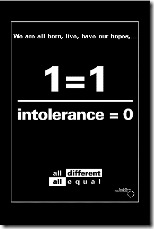
Human Rights Day 2009 End Discrimination

Today is Human Rights Day and it was on this day in 1948 that the Universal Declaration of Human Rights (UDHR) was adopted by the United Nations General Assembly.  The UDHR has become a universal standard for defending and promoting human rights and I discussed the declaration back in July: The Universal Declaration of Human Rights.  The basic foundation of the Universal Declaration of Human Rights is that "all human beings are born with equal and inalienable rights and fundamental freedoms".

Every year on 10 December, Human Rights Day is observed and celebrated around the world and some of today’s events in South Africa, New York and Geneva are listed on the Office of the High Commissioner for Human Rights website.

The focus of Human Rights Day 2009 is non-discrimination.  Despite stating some 61 years ago that all humans were born equal, that we all had inalienable rights, millions of people worldwide fight against discrimination each day.

“The realisation of all human rights - social, economic and cultural rights as well as civil and political rights – is hampered by discrimination. All too often, when faced with prejudice and discrimination, political leaders, governments and ordinary citizens are silent or complacent”

Source: Office of the UN High Commissioner for Human Rights

Discrimination is perhaps on of the most tangible areas in which every day people can get involved in the struggle for global human rights.  Take a look at your workplace and how certain workers or classes of people are treated.  It is okay to tell people that racism is not okay, that all workers should be treated equally and that in the workplace, no one is actually better than anyone else.

People often discriminate because they can get away with it or because they think that others around them agree with such behaviour.  Be firm in your principles and slowly but surely you might come to change the world around you.

Complacency is discrimination’s best friend

SHARE:

Thursday, 24 September 2009

What Is A Crime Against Humanity?

I've just discovered The Pinky Show. Well, I discovered the video I'm about to show you a little while ago but I didn't fully appreciate what The Pinky Show actually is. The Pinky Show is a low-tech animated show that attempts to educate people about misrepresented, supressed or ignored issues. They are a non-profit educational project and they hope to challenge and expand people's beliefs.

This project is very much aligned with my own attempts – to put these issues into a format that people (including myself) will understand; to simplify issues yet still maintain their magnitude and importance.

I found this video at the One Peaceful World blog which is a blog about human rights, international law and conflict prevention among other issues.

In this video, Pinky calls up international law expert Peter Weiss who is vice-president of the Center for Constitutional Rights. Pinky asks him what a crime against humanity is and how it differs from a war crime.  They also discuss the 'superior orders' defense, torture and the role of the International Criminal Court.

This is a fantastic and educational video.

SHARE:

Thursday, 27 August 2009

The Horror of 21st Century Sexual Slavery

Whilst there are legitimate forms of human trafficking, in recent years the term has come to represent the practice of recruitment, transportation, harbouring or receipt of human beings.  These people can be willing participants (for example, refugees wanting passage to another land) but they are often abducted or taken by force.  Once in the hands of the person receiving them, they are often forced into prostitution or slavery (sexual or otherwise), debt bondage or other kinds of forced labour and involuntary servitude.

"Human trafficking is the second largest organized crime in the world, it has become a larger business than drug trafficking and has generated over US$9.5 Billion/year" - United States Department of State

In his column, New York Times journalist Nicholas D. Kristof wrote a piece called The Evil Behind the Smiles. In it, he discussed the experience of Sina Vann, a girl who was kidnapped at age 13, drugged, used for sexual slavery and beaten and tortured repeatedly.

“I had heard about torture chambers under the brothels but had never seen one, so a few days ago Sina took me to the red-light district here where she once was imprisoned. A brothel had been torn down, revealing a warren of dungeons underneath.

“I was in a room just like those,” she said, pointing. “There must be many girls who died in those rooms.” She grew distressed and added: “I’m cold and afraid. Tonight I won’t sleep.”” - The Evil behind the Smiles [New York Times]

Following this piece, Kristof heard from several readers doubting that conditions were so abusive and saying that many women go into prostitution willingly. There is a huge difference between prostitution and sexual slavery.  Prostitutes are paid, slaves are not.

I must admit though, I was also quite naive about sexual slavery and human trafficking at one stage. I was naive about a lot of things until I read Gangs: A Journey into the Heart of the British Underworld by Tony Thompson.  My review of the book can be found here.  The biggest thing I learned from his book is that crime is not fun or exciting or entertaining.  It is destructive and horrible and things like sexual slavery do happen and they destroy the lives of thousands of people.

So I would never pass judgement on people for their naivety, for not being about to comprehend such evil. The video below is by Kristof too.  It is mildly upsetting and may offend sensitive viewers but it is not too graphic.


“Barack Obama’s presidency will symbolise a victory over the long legacy of 19th century slavery.  I hope that his administration will do more to tackle 21st century slavery” - Nicholas D. Kristof in The Face of Slavery

Next week I will feature some of the great organisations that are working to overcome sexual slavery and help victims to recover.

SHARE:

Friday, 17 July 2009

The Universal Declaration of Human Rights

Human Rights 

I’m a bit late to the party but I have just discovered that today is Bloggers Unite for Human Rights Day.  I’ve decided to share what I learned during my recent visit to the United Nations in New York.  I was quite surprised to find that certain things, like being able to rest from work, are addressed in the Universal Declaration of Human Rights (UDHR) and I think you might be surprised by some of the items too. 

The UDHR was adopted and proclaimed by the United Nations on 10 December 1948.  It is important in that the UN was the first united body to adopt such a charter and member nations are urged to uphold these rights in their countries.  The UDHR is non-binding resolution though which means it does not pass into law.  I’ll talk about this in more detail later.

The language in the UDHR is quite grand and so I have taken the following simplified version from the website of Human Rights Education Associates:

Simplified Version of the Universal Declaration of Human Rights

Summary of Preamble

The General Assembly recognizes that the inherent dignity and the equal and inalienable rights of all members of the human family is the foundation of freedom, justice and peace in the world, human rights should be protected by the rule of law, friendly relations between nations must be fostered, the peoples of the UN have affirmed their faith in human rights, the dignity and the worth of the human person, the equal rights of men and women and are determined to promote social progress, better standards of life and larger freedom and have promised to promote human rights and a common understanding of these rights.

A summary of the Universal Declaration of Human Rights

1. Everyone is free and we should all be treated in the same way.

2. Everyone is equal despite differences in skin colour, sex, religion, language for example.

3. Everyone has the right to life and to live in freedom and safety.

4. No one has the right to treat you as a slave nor should you make anyone your slave.

5. No one has the right to hurt you or to torture you.

6. Everyone has the right to be treated equally by the law.

7. The law is the same for everyone, it should be applied in the same way to all.

8. Everyone has the right to ask for legal help when their rights are not respected.

9. No one has the right to imprison you unjustly or expel you from your own country.

10. Everyone has the right to a fair and public trial.

11. Everyone should be considered innocent until guilt is proved.

12. Every one has the right to ask for help if someone tries to harm you, but no-one can enter your home, open your letters or bother you or your family without a good reason.

13. Everyone has the right to travel as they wish.

14. Everyone has the right to go to another country and ask for protection if they are being persecuted or are in danger of being persecuted.

15. Everyone has the right to belong to a country. No one has the right to prevent you from belonging to another country if you wish to.

16. Everyone has the right to marry and have a family.

17. Everyone has the right to own property and possessions.

18. Everyone has the right to practise and observe all aspects of their own religion and change their religion if they want to.

19. Everyone has the right to say what they think and to give and receive information.

20. Everyone has the right to take part in meetings and to join associations in a peaceful way.

21. Everyone has the right to help choose and take part in the government of their country.

22. Everyone has the right to social security and to opportunities to develop their skills.

23. Everyone has the right to work for a fair wage in a safe environment and to join a trade union.

24. Everyone has the right to rest and leisure.

25. Everyone has the right to an adequate standard of living and medical help if they are ill.

26. Everyone has the right to go to school.

27. Everyone has the right to share in their community's cultural life.

28. Everyone must respect the 'social order' that is necessary for all these rights to be available.

29. Everyone must respect the rights of others, the community and public property.

30. No one has the right to take away any of the rights in this declaration.

- [Source: hrea.org]

Some of these rights seem obvious, things that we take for granted. It is hard to imagine that people could take these rights away from us.  In my lifetime, I have lived through Apartheid South Africa where black people could not own property, could not vote in government elections, could not gain education above a certain level and were not able to apply for professional jobs that were reserved for white people.  They certainly could not travel freely within the country nor could they marry outisde of their colour. 

This was clearly in violation of several of the rights listed above and the United Nations imposed several layers of sanctions on South Africa which crippled the economy.  In the early 80’s, the government began to bow to this pressure, first repealing certain of these apartheid laws and then beginning a process of all-out reform.  This resulted in the unbanning of the ANC, the release of Mandela and the first democratic elections which saw the ANC gain power in 1994.

Change can happen and the United Nations has played a vitally important part in bringing about change in countries like South Africa.

So why are situations in Zimbabwe, Darfur and Sri Lanka being allowed to happen?  Zimbabwe, Sudan and Sri Lanka are all member states! 

“There has been criticism that the five permanent members of the United Nations Security Council, who are all nuclear powers, have created an exclusive nuclear club whose powers are unchecked. Unlike the General Assembly, the United Nations Security Council does not have true international representation. This has led to accusations that the UNSC only addresses the strategic interests and political motives of the permanent members, especially in humanitarian interventions: for example, protecting the oil-rich Kuwaitis in 1991 but poorly protecting resource-poor Rwandans in 1994” - Wikipedia

It seems that one of the biggest factors at play is that it is diplomatically difficult for the United Nations to place political pressure on their member states.  Perhaps it is time to make the UDHR binding, to make member states reapply periodically for membership and adhere to a more stringent set of membership requirements?  Would that remove the diplomatic hurdle and spur the UN security forces into action?  I don’t know the answer to that question yet but I will keep you up to date on what I learn.

SHARE:
© A Passion to Understand

This site uses cookies from Google to deliver its services - Click here for information.

Blogger Template Created by pipdig