Sunday, 4 October 2020

Book Review: West of Jim Crow: The Fight Against California's Color Line by Lynn Hudson ★★★★☆

I know very little about American civil rights history from the late 19th to early 20th century. This is not surprising; my focus has primarily been on Africa (especially South Africa) and on genocides in the 20th century. It has been interesting to learn that anti-miscegenation laws and job-colour bars weren't the invention of Apartheid South Africa but originated in North America. Specifically, a set of so-called Jim Crow laws emerged in America from about 1880 that sought to enforce racial segregation and these laws would be a highly influential on laws adopted by South Africa.

West of Jim Crow: The Fight Against California's Color Line by Lynn M. Hudson | Book Review

In West of Jim Crow: The Fight Against California's Color Line, Lynn M Hudson focuses on the African Americans who moved to California to escape Jim Crow, expecting freedom and the benefits of full citizenship but instead realising that Jim Crow and racial segregation were all too present in the west.

This is not simply a recounting of the racism, fear-mongering and obsession with eugenics that featured so prominently in white society for the century after the Reconstruction Era (although these are mentioned in some detail throughout the book). West of Jim Crow is about the tireless efforts of Black Americans to assert their citizen rights, establish respectability, secure equal opportunities and protect their men and women from the scourge of lynching and the rise of the KKK.

It is also notably about the role of Black women, their agency and the significant roles they took in journalism, activism and other roles to secure their rights both as women and as human beings. As Lynn M Hudson remarks on many occasions, just because there is little in the written records about Black women's struggles for freedom and activism, does not mean there wasn't significant agency and activism present.

West of Jim Crow is structured around six chapters, each concentrating on a specific event in Californian history:

  • Reconstruction: the initial gains and setbacks in the period following the Civil War, with the rise of Jim Crow and associated Jim Crow entertainments and minstrelsy
  • The Panama Pacific International Exposition: a look at the systematic erasure of civil rights gains, the emergence of the NAACP, the popularity of Birth of a Nation and the rise of eugenics
  • The Rise and Fall of Allensworth: the town founded by and for African Americans, doomed to fail because of misrepresentation, geographical and environmental issues
  • On Lynching: an account of the events that divided a country into those who supported lynching and those who were appalled by it; eerily prescient of Trump, tiki-torch marches and the gun lobby
  • On the Ku Klux Klan: fighting arson and intimidation while the KKK infiltrated law enforcement and local government in California
  • The Fight to Desegregate Pasadena's Municipal Swimming Pools: how activists began to use the damages of Jim Crow to argue for civil rights, winning the Pasadena pool case and later the Brown v Board of Education case

West of Jim Crow: The Fight Against California's Color Line by Lynn M. Hudson | Book ReviewWest of Jim Crow covers an incredible wealth of information and provides an interesting, readable account of African American history in California. Initially I felt a bit exhausted by the repetitive, circular mode of writing, featuring titbits and breadcrumbs followed by elaboration and exposition. I've noticed that this form of writing is favoured by many historians and while it can be taxing to read, the truth is it is preferable to a dry, linear account and also aids significantly in the reader's retention and comprehension of historical information.

Despite this small reservation, I give West of Jim Crow an excellent four out of five stars and highly recommend to those wishing to know about this particular area of Black history.

★★★★☆

West of Jim Crow: The Fight Against California's Color Line is available to purchase from Amazon.com and Amazon.co.uk (disclosure: affiliate links. I will earn a small amount if you purchase using these links, at no additional cost to you).

My thanks to University of Illinois Press and Netgalley for advance, electronic copy of this book.

SHARE:

Sunday, 28 June 2015

Book Review: Letters to Palestine: Writers Respond to War and Occupation (edited by Vijay Prashad)

Letters to Palestine cover - Vijay Prashad - banner

Gaza, 2014. Following the kidnap and murder of three Israeli youths, the IDF embarked on a seven week campaign against Gaza. In that time, over 2,000 Gazans were killed, most of them civilians and most of them children, while tens of thousands were injured. Hospitals, schools and houses were demolished and half a million Gazans were displaced.

The Gazan conflict divided people like no other conflict. Across social media, timelines were filled with people trying to draw attention to the devastation and destruction in Gaza while pro-Zionists asked what else they could do in the face of continuing Hamas aggression. 

With access to Gaza notoriously controlled and restricted, there was limited reporting on the ground, scant consideration of everyday Palestinians who were living in a state of terror. 

Edited by Vijay Prashad and featuring a host of writers, poets, essayists and activists, Letters to Palestine: Writers Respond to War and Occupation attempts to give a human face to that struggle. 

Reading this collection with a desire to learn more about the conflict from a Palestinian point of view, one might expect little more than anti-Israeli propaganda and rhetoric. Letters to Palestine is nothing of the sort. It is an earnest collection of essays, poems and diary excerpts that seeks to understand both the conflict and history of Palestine. 

In his essay 'Bad Laws', Teju Cole talks about how what he terms 'cold violence' is exacted through a series of laws, by-laws and regulations that are all perfectly legal under Israeli law. Based as they are in restrictions on freedom and movement, he notes that these laws are in contravention with international standards and conventions. He mentions Sheikh Jarrah where Palestinians are slowly losing their permanent residency in East Jerusalem, where the right of return applies to Jews in East Jerusalem but not Palestinians. 

"The historical suffering of Jewish people is real, but is no less real than, and does not in any way justify, the present oppression of Palestinians by Israeli Jews" – Teju Cole, ‘Bad Laws’, Letters to Palestine

In an excerpt from her 'Travel Diary' Noura Erakat begins by describing her anger and anti-Israeli sentiment but over the course of her journey to Palestine begins to develop a more nuanced position. She brings up the subject of privileged Palestinians, those who have done very well out of occupation and observes that not all Palestinians are good-hearted, not all Israelis 'evil'. While capturing the atmosphere in Palestine during her visit, Erakat mentions the work of Zochrot, an Israeli non-profit organisation whose aim is to raise awareness of the Palestinian Nakba and of New Profit who work towards the demilitarisation of Israel. Spanning over eleven days in May 2013, the diaries give a unique snapshot of a moment in Palestinian time.

"Israeli settler colonialism, apartheid and occupation should not cease because Palestinians are good and Israelis are bad"- Noura Erakat, ‘Travel Diary’, Letters to Palestine

Nalja Said shares her 'Diary of a Gaza War, 2014' as a Palestinian living in America during the conflict. Intimate and painfully honest, Said's entries show her worry and despair for her loved ones in Gaza. 

"If you think that Palestinians all hate Jews and are rejoicing in the deaths of those three boys (Naftali Fraenkel, Gilad Shaer, Eyal Yifrah), then you are a racist. That's all I have to say. As my dad used to say, ‘No one has a monopoly on suffering’" – Nalja Said, 'Diary of a Gaza War, 2014', Letters to Palestine

"The boy who was killed was a cousin of my dear friends... You who are reading this are now two degrees from the murdered Palestinian - a child killed in revenge" – Nalja Said, 'Diary of a Gaza War, 2014', Letters to Palestine

In 'Below Zero: In Gaza Before the Latest War', Ben Ehrenreich reminds us of the appalling conditions of loss, devastation, poverty and wretchedness in Gaza even before the war. 

Interspersed throughout the collection is a series of heart-breaking, eye-opening poetry. Poems tell of Kafkaesque experiences of denied entry and the soul-destroying set up of the checkpoints. Notable entries include 'Until It Isn't' by Remi Kanazi, 'Afterwords' by Sinan Antoon and 'Running Orders' by Lena Khalaf Tuffaha. 

"Prove you're human/ prove you stand on two legs/ Run" - Lena Khalaf Tuffaha, 'Running Orders', Letters to Palestine

The last part of the collection is dedicated to an examination of the Palestinian liberation movement in America and its links to the civil rights movement. For the most part, this was too US-centric to be of specific interest to foreign readers but there were some interesting parallels to be drawn to the South African and worldwide anti-Apartheid movement. 

In 'Yes, I Said, "National Liberation"', Robin D G Kelly notes the intersection with Black rights and Ferguson, how the black civil rights movement moved from supporting Israel to recognising the injustices there. 

It would be impossible to capture the scope of this collection here.  Vijay Prashad has done an excellent job in curating a collection of short, powerful pieces that is each powerful in its own right. I would highly recommend this collection to anyone seeking to know more about the situation in Gaza both before and during the conflict last year.

Letters to Palestine: Writers Respond to War and Occupation is published by Verso Books who currently have a sale of 40% off on paperbacks and 50% off on eBooks. The book is also available to purchase from Amazon.co.uk and Amazon.com.

SHARE:

Wednesday, 29 October 2014

Racist Policies and the Situation in Ferguson

Growing up in Apartheid South Africa, it feels second nature to see the direct link between policies and practices of the past and the enduring poverty and inequality in the country. Twenty years after our first democratic elections there are still massive discrepancies in education, housing, healthcare and social care.

Somehow we were lead to believe that matters were different in the United States, that anyone can make it if they try, but that all changed in August.

Link: How a century of racist policies made Ferguson into a pocket of concentrated despair [Raw Story, 28 October 2014]

In an interview with Richard Rothstein, author of a study "The Making of Ferguson", the article discusses how policies of the past created the situation in Ferguson and how unequal treatment of blacks and whites created an enduring cycle of despair that will take generations to overcome. The article mentions the myth of upward mobility in America and how this simply doesn't apply in the face of unscrupulous real estate practices, discriminatory housing policies and the creation of ghettos and slums.

"The federal government subsidized the construction of many, many subdivisions by requiring that bank loans for the builders be made on the condition that no homes be sold to blacks"

"So after a century of policies which denied African-Americans access to jobs that pay decent wages, the likelihood is that their children and their children’s children will still be paying the price for those policies that held their parents and grandparents behind for so long".

Photo credit: REUTERS/Mario Anzuoni

Caption: Demonstrator Keisha Gray cries while protesting the shooting death of teenager Michael Brown in Ferguson, Missouri August 13, 2014.

SHARE:

Saturday, 16 November 2013

Film Review: Utopia (A Film by John Pilger)

A camera pans across a dwelling, revealing a scene of unimaginable poverty. A single, bare mattress lies on a floor and the person in front of the camera examines how up to six children will sleep here head to toe. The crew moves into a bathroom with no basin or mirror and a rank, blocked toilet. Almost a third of this population will die by the time they are 45 and children are plagued by treatable ear and eye infections.

You’d be forgiven for thinking this is a scene in a third word country; perhaps it is South Africa or Brazil, countries which have the highest Gini coefficient of inequality in the world. It is in fact Australia, the world’s twelfth largest economy. This is Utopia, a region 200 miles north-east of Alice Springs in the Northern Territory and the poorest region in Australia.

Utopia A Film by John Pilger poster

Utopia is a documentary by John Pilger. Two years in the making, journalist and film-maker Pilger returns to the country of his birth to investigate the conditions that the Aboriginal Australians are living under. He weaves into the narrative the concentration camp at Rottnest Island up to 1931 and the Stolen Generations travesty of the first half of the 20th century but it is the events of recent years that are most disturbing.

We see footage of young Aboriginal men who have been abused and later died in police custody and learn that the incarceration rate for young Aboriginal men in Western Australia is 8 times higher than that of black men in the last 10 years in apartheid South Africa.

The documentary features the obligatory privileged white Australians blaming Aboriginal Australians for their own poverty and lack of inclusion. Incidentally, footage in Johannesburg’s Apartheid Museum shows white South Africans expressing these same sentiments about black South Africans in the 1960s and 1970s. Meanwhile, journalist Chris Graham observes that all of this happens while governments continue to fail to invest in Aboriginal communities.

John-Pilger-Utopia-AustraliaAs recently as 2006, the Racial Discrimination Act was suspended to launch the Howard government's plan of intervention, a scheme to send the army into indigenous communities to remove their children under fabricated charges of paedophilia. Communities were then subjected to a denial of basic services unless they agreed to hand over the leases to their land.

Utopia is certainly worth watching and indeed, it might be worth watching more than once. My own interest in viewing the documentary stemmed from basic awareness of the massacres of Aboriginal peoples and the Stolen Generation but I was quite unprepared for what I saw.

I was appalled by the level of indifference and even cynicism that politicians continue to display towards the Aboriginal Australians and the continuing lack of support, investment and basic healthcare given to the population. Decade after decade, administration after administration, these people are repeatedly let down and betrayed.

John Pilger Utopia

Utopia is the fourth film that John Pilger has made about Australia and includes many of the people that he met during the making of The Secret Country in 1985. At one point in the documentary, he compares scenes filmed in the 1980s to present day conditions and the results are chilling: very little has changed.

Utopia will be released in the UK at the Curzon Soho on 15 November 2013. A special viewing plus Q&A session with John Pilger will take place at the Picturehouse Soho on 18 November and will be broadcast simultaneously to 30 Picturehouse Cinemas across the country. It will be released on DVD on 16 December and broadcast on ITV on 17 December.

The documentary is scheduled for worldwide release in 2014 and will be launched in Australia at the Museum of Contemporary Art in Sydney  Screenings will take place on 21-23 January 2014 with a special Australia Day screening on 26 January.

SHARE:

Saturday, 18 August 2012

South Africa: Where Life Is Cheap and Death Even More So

One of the top search terms on this blog is “crime in South Africa”, followed by “personal stories of crime in South Africa”.  I don’t know why people are searching those terms, but in my mind there are two main categories of searchers:

1.  Those wanting to visit South Africa and wanting to know if the horror stories are really true.

2.  Those who are still living in South Africa and have begun to wonder if there isn’t something wrong with this picture.

I once belonged to the latter category of people.  I knew many people who were raped, murdered, gang-raped, robbed, burgled, held up at gun point or hijacked.  I was held up at gunpoint in a bank robbery, my home was broken into while I was at home and my dog saved my life, I was attacked in my car. 

Life is cheap in South Africa and death is even more so.  I finally comprehended just how extreme the situation is there following a dinner party two years ago.  We were 7 women having dinner in a flat in London.  I was pressed to talk about the crime in South Africa and as always, I hesitated.  Talking about it leaves me feeling raw and vulnerable and it always, without fail, ushers in nightmares, panic attacks and generalised anxiety in the weeks following it.

But on that evening, I felt safe amongst 6 other women and I talked.  At one point, one of the women left the table and soon after made her excuses and left.  It turns out that my story filled her with such terror that she felt quite traumatised.  In her world, she didn’t know anyone who had died from unnatural causes, no victims of violent crime, barely any victims of crime at all.  Sure, she reads the newspapers, listens to the news.  But her inner circle had never been touched by violence, crime and inhumanity and that is entirely possible in countries other than South Africa. 

All of this has been in the forefront of my mind for the past ten days.  I want to talk about it and raise awareness because I believe that every South African, regardless of age, race, gender, sexual orientation, religion or class has the right to safety, security and dignity.  Four opinion pieces caught my attention over the past 10 days.

“Take your Women’s Day and shove it” [Helen Moffett, 8 August 2012, Books Live]

Helen discussed the parades and money spent on Women’s Day celebrations in South Africa and the laughing stock they had become in the face of a situation where women are raped, murdered, beaten and violated each and every day in South Africa.

Helen was a little bit angry and in light of the situation, I have to ask why we aren’t all more than a little bit angry:

Our rape stats are a global disgrace (Goddess, how many times do I have to FUCKING say this, the WORST in the world for a country not at war – the scale is unimaginable, the suffering ditto), black lesbians have “carve me up and smash my brains in” signs stamped on their backs, rural women and children live in relentless, grinding misery and poverty HUGELY exacerbated by patriarchal strictures, which are of course absolutely sacred (and the fact that the Traditional Courts Bill, which would render these women even more helpless and wretched, is actually allowed to pollute national airtime is a bloody disgrace)

[Read more about South Africa’s Women’s Day]

“Women don't deserve a day” [David Moseley, 14 August 2012, News 24]

Last weekend, violent protests erupted in Lonmin mine and David Moseley remarked that: “There is always something terrible happening in South Africa”.

He referenced Helen’s post and then went on to talk about his greatest fear, that someone he knows and loves will be raped.  It is a valid concern in South Africa where “women are getting raped (almost every 17 seconds in South Africa)” and “a survey … conducted amongst 1 500 Soweto school children … discovered that a quarter of all boys said that "jackrolling" (their lingo for gang rape) was "fun"”.

He closes by saying that:

Women don't deserve a day at all.

They deserve every day, every week, every month, every year. They deserve our undying attention. They deserve a country where they can live without fear.

They deserve life.

It can be really frustrating speaking to South Africans sometimes as their need to defend their country and all of its faults battles with their need to talk about the horrors that they face.  Ultimately it seems that they fail to grasp one small point.  Each South African has a fundamental human right to live safe from physical, bodily, emotional or psychological harm.  Especially where it is being dished out to them in such an aggressive, continuous and gratuitous manner.  While the government wraps itself up in corruption, nepotism, cronyism and negligence, the citizens of South Africa are dying.

“Where is the Outrage?” [Camilla Bath, 16 August 2012, Eye Witness New]

On Thursday morning, Camilla Bath EWN Deputy Editor in Johannesburg asked the following question:

Have we become so insensitive in Gauteng, in South Africa, that we all but disregard the unspeakable violence that’s unfolding on our own doorstep? Are we too callous to care, too inundated with tragedy and violence on a daily basis to truly take stock of what’s happening around us? Have our ideas of what qualifies as shocking been warped to such an extent that we no longer see people being burnt and hacked to death as utterly unacceptable and appalling?

Her words are especially chilling and especially relevant in light of the tragic events that took place at Lonmin mine just hours later.  Bath spoke of the disturbing violence taking place at the mine and the murders of miners, police officers and security guards and yet she wondered why this was not even reaching South Africa’s newspapers.  The sad fact is that South Africans are so jaded, so used to violence and crime that I found more reporting on the violence in Lonmin on international news sites than on South African sites.

Bath concluded by stating that, “This type of brutality is never deserving of anything other than outrage and disgust. Why the violence really started and who is really behind it are, for now, irrelevant. Right now, it simply needs to be stopped”. 

It was stopped, in the most violent, traumatic manner.  By the end of the day, 34 miners had been shot dead by police in what the police vehemently deny constitutes a massacre.

“Dear black person” [Ferial Haffajee, 16 August 2012, News 24]

It seems strange to close this piece on crime with mention of an opinion piece on politics, poverty and racism.  But it is very important and absolutely relevant in the South African context.

South Africa has one of the highest GINI coefficients worldwide which means that the gap between richest and poorest is wider than any other country, including Brazil.  The government is absolutely corrupt and citizens suffer without electricity, water, education, healthcare and housing.  There was some progress in the 1990s towards housing, jobs, education and healthcare but in the second decade of the 21st century we see a country torn apart by poverty, corruption, inequality and racism. 

It is clear that South Africa is a country on the brink and in the midst of all of this chaos, police opened fire on striking miners, killing 34 human beings.  I’d like to say that it feels like a return to the Apartheid era but back then we lived in a police state under a permanent State of Emergency.  I’m not going to even try predict the effect of adding state-sanctioned extreme violence to the mix of lawlessness and chaos but I can guess that it can’t be good.  How much more has to go wrong in South Africa before a true leader steps in and cleans up both on the streets and in the government?

SHARE:

Tuesday, 9 August 2011

This Day in History: 9 August 1956

1948: The National Party Victory

South Africa, 1948: the United Party (led by incumbent Prime Minister Jan Smuts) and the Herenigde Nasionale Party (Reunited National Party) (led by DF Malan), competed against each other in the national elections.  This was an election where only white South Africans could vote, and realising that many of the electorate felt threatened by black political and economic aspirations, Malan promised a system of grand Apartheid if he was victorious.

The HNP was victorious and when they came into power in 1948, they implemented Apartheid.  The HNP was eventually renamed the National Party and thus, the same party was in power from 1948 to 1994, when the African National Congress took power in the first democratic elections in South Africa that featured universal franchise.

Apartheid Whites Only
Source

1950: The Group Areas Act

One of the first acts to be enacted following the implementation of Apartheid was the 1950 Group Areas Act.  The Group Areas Act divided up urban areas and assigned different racial groups to different residential and business areas. This meant that the black, white, Indian and coloured populations could not live together or own businesses in the same areas.  The 1913 Native’s Land Act had already ruled that only white people could become landowners in South Africa.

1952: The Pass Laws

The 1923 Native Urban Areas Act had made it compulsory for black men in cities to carry passes on them.  Any man found without a pass would be arrested and sent to a rural areas.  In 1952, the Native Laws Amendment Act and the Natives (Abolition of Passes and Coordination of Documents) Act were enacted to assist in policing the 1950 Group Areas Act.  The Native Laws Amendment Act required that no black South African could remain in an urban areas for longer than 72 without the necessary documentation.  The Natives (Abolition of Passes and Coordination of Documents) Act required that all black South African men over the age of 16 had to carry a single reference book.  It also noted that women would be required to carry such reference books at some time in the future.

Dompas
Source

The Injustice of the Dompas

The reference book (enduringly referred to as the dompas in Afrikaans) would stipulate where and for how long a person could remain and it included photographs, fingerprints and employer details.  It was a horrifically limiting document because black South Africans were subject to persecution if they were found to be outside of their stipulated area.  That meant that a man could not visit his brother who was working in the next neighbourhood, for instance.  If he lost his job, his right to remain in an urban area could be rescinded by any government employee and he could be made to return to rural areas immediately. 

Blacks in urban areas were often forced to leave their families behind in rural areas.  The consequence of this is that they could be subject to arrest, punishment and persecution if they were discovered to be travelling to or from those rural areas too.  Basically, each time a black person wanted to move within the country, they had to seek permission and that permission was recorded in their pass book.

Life in the Homelands

In the decades leading up to the 1950s, the majority of black South Africans in urban areas had been men.  They were often migrant workers, employed on mines and in factories and women were often left behind to look after the family.  The problem with the rural areas (and Homelands) allocated to black people is that they were specifically chosen on the basis of their dry, arid and unsustainable nature.  The very worst pockets of land in South Africa were allocated to rural black populations. 

A combination of factors lead to more and more women moving to urban areas in the early days of Apartheid.  Some scenarios include the death of income earners in precarious conditions in mines and factories; neglect from partners who took up with mistresses in town; and severe poverty caused by the high cost of living in urban areas, the inability to send enough money home, and the inability to sustain families in the arid conditions of the Homelands and rural areas.  Women were also permitted to join their spouses in urban areas if he had been born in that area or had laboured continuously in an area for over ten years.

(Incidentally, many of these factors continue today and many children are brought up in rural areas by grandparents and the extended family as poverty and economic needs continues to drive families apart).

1955: Plan to Issue Pass Books to Women

In response to the growing number of black women in urban areas, the government announced in September 1955 that all black women would be issued reference books with effect from January 1956.

9 August 1956
15BAHA-Women's-March-4
©Baileys Archives [Source]

The protest on 9 August 1956 was not the first protest against the Pass Laws and it was one action among one of the most colourful and successful liberation struggles in history.

What was outstanding about this protest is that it surprised many parties, the government and liberation movement included and it showed that women were active, organised and militant.


On 9 August 1956, 20,000 women marched to the Union Buildings in Pretoria in protest of the pass laws and the roll out of reference books for women.  The march was organised by the Federation of South African Women in conjunction with the ANC Women’s League and was attended by such great women as Helen Joseph and Albertina Sisulu.

Women came from all over the country to attend the protest, from as far afield as Durban and Cape Town, and black, white, coloured and Indian women attended the march.

The crowd left bundles of petitions filled with 100,000 signatures at Prime Minister JG Strijdom’s doors as he was not at the Union Buildings that day. 

In a masterpiece of peaceful protest, the women stood for a full half an hours’ silence, many with children on their backs, as they protested the assault on their freedom and integrity that the pass laws represented.

9 August 1994

Apartheid ended in 1994 when the African National Congress came to power.  Since 9 August 1994, the day has been commemorated as National Women’s Day in South Africa.  It is a public holiday and that is why South Africans celebrate women’s day on a different day to the rest of the international community.

SHARE:

Wednesday, 16 June 2010

This Day in History: 16 June 1976

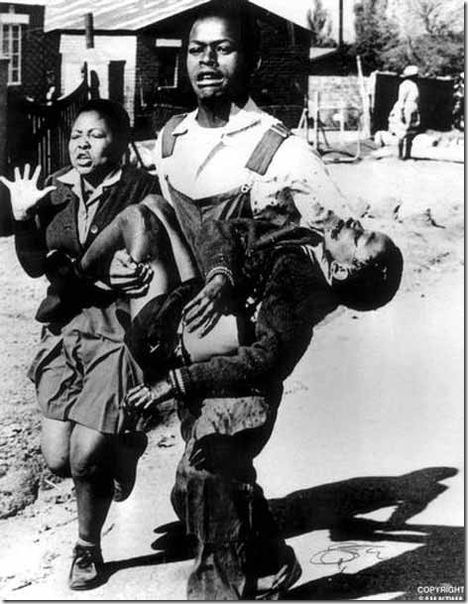
Hector Pieterson and Mbuyisa Makhubo

On 16 June 1976, thousands of black South African students staged a protest and walked from their schools to Orlando Stadium in Soweto.  They were protesting against the Afrikaans Medium Decree of 1974 which forced tuition to be given in a 50/50 split between English and Afrikaans in schools.  Not only was Afrikaans the language of their oppressors, it was also a language that many black South Africans did not understand as they primarily spoke one of the black African languages such as Zulu, Northern or Southern Sotho or Xhosa.  Part of the Apartheid policy was to allocate fewer resources to black schools as well and to make them purchase their own textbooks and exercise books whereas these were freely distributed in white schools.  The effects of teaching in Afrikaans in already disadvantaged and inferior schools was devastating.

On the morning of 16 June 1976, protesting children found that their route to the stadium was blocked by a police barricade.  There are conflicting reports as to how the first shot was fired and whether it was provoked.  Some say that the children began throwing stones, other simply say that the policemen got spooked.  Once that first shot had been fired though, children ran screaming in different directions, terrified and panicked.  More shots were fired and by the end of the day, 23 people were dead (two of them were white people).

Soweto uprising - Hector Pieterson Hector Pieterson is the little boy being carried in the photograph above.  He was one of the first children to be killed that day.  Perhaps even more heartbreaking is that the boy carrying him was 18-year-old Mbuyisa Makhubo.  He was harassed so much by the police that he went into hiding after the event and his mother has not heard from him since 1978.   I imagine he is but one of the thousands of victims that “disappeared” in the Apartheid years.

The resulting violence after the shootings that day became known as The Soweto Uprising or Soweto Riots.  Between 200 and 600 people died in the violence and thousands were injured.  June 16 is commemorated each year as Youth Day and services and events are held across South Africa to honour their youth and to remember all that was lost during the Apartheid struggle.

Images © Sam Nzima

SHARE:

Tuesday, 27 April 2010

This Day In History: 27 April 1994

This is the article I posted for Freedom Day last year. I was going to do a brand new one and then realised that this basically says it all. I am still so proud of South Africa.

27 April is Freedom Day in South Africa and it is a public holiday held to commemorate 27 April 1994 when the first democratic general election was held in the country. This election marked the end of Apartheid where the National Party government was replaced by the government of the African National Congress and Nelson Mandela became president.

It was the first ever election in South Africa in which there was universal suffrage which means that all adult South Africans, regardless of race or gender, were allowed to vote.

election
Photo: AP

Apartheid
Most people today have heard about Apartheid but I wonder if everyone knows what it was like? Apartheid officially began in 1948 but certain laws dated to before that time and were vital parts of Apartheid legislation. The 1913 Native's Land Act prevented non-white people from owning land. Not only could they never own the land they lived on, they could be forcibly removed from any land that was deemed attractive for white settlement (see District 6). This law was enhanced in 1950 by the Group Areas Act which assigned different racial groups to different residential and business areas in urban areas. Hence, blacks, whites, coloureds and Indians in South Africa could not live together, could not own businesses in the same areas and only whites could own land.

The second piece of important pre-Apartheid legislation was released under the Jan Smuts government. It was called the Native Urban Areas Act of 1923 and it deemed urban areas to be "white" areas and all black adult men had to carry passes at all times if they were in cities or urban areas. A statue of the lovely Jan Smuts now stands in parliament Square in London and he looks out over the square to where Nelson Mandela's statue now also stands. This law was also enhanced by the 1952 Pass Laws Act which made it compulsory for all blacks South Africans over the age of 16 to carry a pass book at all times. The book would stipulate where, when and for how long a person could remain in a specific urban area and it greatly restricted where black people could move or visit.

The final bit of despicable legislation I will talk about today was the 1949 Prohibition of Mixed Marriages Act which prohibited interracial marriage in South Africa and the 1950 Immorality Act which prohibited all sexual relations between whites and non-whites. These laws were repealed by PJ Botha in 1985 but up to that time, people could be arrested and prosecuted if they were caught having sexual relations with a person of another race and black people often got stronger sentences than white people.

The Beginning of the End
In the early 1980's, international economic sanctions had begun to take their toll on Apartheid and that was the beginning of the end. Little by little President PJ Botha began to repeal laws and offer greater freedoms to the Indian population and to blacks and coloureds too. The separate and completely unequal policies and privileges offered to the different population groups under PJ Botha are quite complex and the topic of another post, but in 1989 PJ Botha had a stroke and FW de Klerk became president. He began a process of reform which culminated in the unbanning of the South African Communist Party and the African National Congress on 2 February 1990 and the release of Mandela on 11 February 1990.

A national referendum was held on 17 March 1992 in which white people voted whether they wanted to continue the process of reform started by FW de Klerk two years earlier. We knew what the stakes were and the basic question was really, "will this be the last whites-only election before universal suffrage is awarded and national elections are held"? 2.8 million people voted and the result was 68.73% "Yes".

The Road to the Elections
The next two years were emotional and tumultuous for our emerging rainbow nation. There was so much intimidation and violence going on around the elections that people were advised never to divulge who they were voting for. It was our right to keep our vote private. Many of the young, black females that I worked with were too scared to vote, even though we offered to drive them to the election stations and hide them in our cars. This was worrying - we needed every single vote. I still won't divulge who I voted for or what my preference was, but the important thing was to vote!

The Day
As the photo above shows, South Africans stood for hours and hours in queues that day to vote. I myself stood for four hours in a queue that ran the whole way around the northern Johannesburg suburb of Craighall. I got to the front of the queue and stood for several minutes in the booth. My hand was shaking so much that I was scared to try to write in case I spoiled my ballot. I cast my "x" on the regional and national papers, posted my ballots in the box and burst out crying. I was so overwhelmed and so acutely aware of the importance of what had come to pass that day. I was one of the 19,533,498 people who changed the course of world history that day.

The rest, as they say, is history. The ANC won 62.65% of the vote and Nelson Mandela became the first president of the New South Africa. At some stage I hope to elaborate on what it was like to live in Apartheid South Africa.

SHARE:

Tuesday, 2 February 2010

This day in history: Apartheid Dismantled

ANC unbanned
Photo: Independent Newspapers Archive

“There are moments in history that become icons of their era, symbols of a shift in the world order. The liberation of Auschwitz, the fall of the Berlin Wall, the assassination of John F Kennedy, the liberation of Saigon, FW de Klerk's address to parliament 20 years ago this coming week” - IOL

I can barely believe that it was twenty years ago today that the then-President of South Africa gave the speech which effectively dismantled Apartheid. I was sixteen and in my last year of school and I can remember that huge feeling inside as we witnessed the end of an era. On February 2, 1990 FW de Klerk unbanned the African National Congress and 9 days later Nelson Mandela was released from prison after being incarcerated for 27 years.

South Africa is just one small country amongst many that had right-wing totalitarian regimes in the past but the specific oppression of people of colour in favour of a white conservative government meant that South Africa's struggle became a global symbol for the fight against racism, oppression and domination.

Mr de Klerk, I cannot thank you enough for changing my world and for making me proud to say that I am South African. I cannot even begin to explain how your bravery and your actions, together with those of Nelson Mandela, shaped my mind and made me realise that we need to carry the struggle worldwide and fight against evil in this world.  Thank you.

You can find out more about this momentous day by clicking the links below:

IOL photo gallery on the events of February 1990

FW de Klerk reflects on reaching the decision to release Mandela on this day 20 years ago

The day De Klerk changed course of history

De Klerk's speech changed our lives forever

SHARE:

Monday, 27 April 2009

South Africa: Freedom Day – 27 April

27 April is Freedom Day in South Africa and it is a public holiday held to commemorate 27 April 1994 when the first democratic general election was held in the country. This election marked the end of Apartheid where the National Party government was replaced by the government of the African National Congress and Nelson Mandela became president.

It was the first ever election in South Africa in which there was universal suffrage which means that all adult South Africans, regardless of race or gender, were allowed to vote.

election
Photo: AP

Apartheid
Most people today have heard about Apartheid but I wonder if everyone knows what it was like? Apartheid officially began in 1948 but certain laws dated to before that time and were vital parts of Apartheid legislation. The 1913 Native's Land Act prevented non-white people from owning land. Not only could they never own the land they lived on, they could be forcibly removed from any land that was deemed attractive for white settlement (see District 6). This law was enhanced in 1950 by the Group Areas Act which assigned different racial groups to different residential and business areas in urban areas. Hence, blacks, whites, coloureds and Indians in South Africa could not live together, could not own businesses in the same areas and only whites could own land.

The second piece of important pre-Apartheid legislation was released under the Jan Smuts government. It was called the Native Urban Areas Act of 1923 and it deemed urban areas to be "white" areas and all black adult men had to carry passes at all times if they were in cities or urban areas. A statue of the lovely Jan Smuts now stands in parliament Square in London and he looks out over the square to where Nelson Mandela's statue now also stands. This law was also enhanced by the 1952 Pass Laws Act which made it compulsory for all blacks South Africans over the age of 16 to carry a pass book at all times. The book would stipulate where, when and for how long a person could remain in a specific urban area and it greatly restricted where black people could move or visit.

The final bit of despicable legislation I will talk about today was the 1949 Prohibition of Mixed Marriages Act which prohibited interracial marriage in South Africa and the 1950 Immorality Act which prohibited all sexual relations between whites and non-whites. These laws were repealed by PJ Botha in 1985 but up to that time, people could be arrested and prosecuted if they were caught having sexual relations with a person of another race and black people often got stronger sentences than white people.

The Beginning of the End
In the early 1980's, international economic sanctions had begun to take their toll on Apartheid and that was the beginning of the end. Little by little President PJ Botha began to repeal laws and offer greater freedoms to the Indian population and to blacks and coloureds too. The separate and completely unequal policies and privileges offered to the different population groups under PJ Botha are quite complex and the topic of another post, but in 1989 PJ Botha had a stroke and FW de Klerk became president. He began a process of reform which culminated in the unbanning of the South African Communist Party and the African National Congress on 2 February 1990 and the release of Mandela on 11 February 1990.

A national referendum was held on 17 March 1992 in which white people voted whether they wanted to continue the process of reform started by FW de Klerk two years earlier. We knew what the stakes were and the basic question was really, "will this be the last whites-only election before universal suffrage is awarded and national elections are held"? 2.8 million people voted and the result was 68.73% "Yes".

The Road to the Elections
The next two years were emotional and tumultuous for our emerging rainbow nation. There was so much intimidation and violence going on around the elections that people were advised never to divulge who they were voting for. It was our right to keep our vote private. Many of the young, black females that I worked with were too scared to vote, even though we offered to drive them to the election stations and hide them in our cars. This was worrying - we needed every single vote. I still won't divulge who I voted for or what my preference was, but the important thing was to vote!

The Day
As the photo above shows, South Africans stood for hours and hours in queues that day to vote. I myself stood for four hours in a queue that ran the whole way around the northern Johannesburg suburb of Craighall. I got to the front of the queue and stood for several minutes in the booth. My hand was shaking so much that I was scared to try to write in case I spoiled my ballot. I cast my "x" on the regional and national papers, posted my ballots in the box and burst out crying. I was so overwhelmed and so acutely aware of the importance of what had come to pass that day. I was one of the 19,533,498 people who changed the course of world history that day.

The rest, as they say, is history. The ANC won 62.65% of the vote and Nelson Mandela became the first president of the New South Africa. At some stage I hope to elaborate on what it was like to live in Apartheid South Africa.

SHARE:
© A Passion to Understand

This site uses cookies from Google to deliver its services - Click here for information.

Blogger Template Created by pipdig