Tuesday, 21 May 2024

Could South Africa’s ANC Lose Parliamentary Majority for the First Time Since 1994?

Thirty years ago, on 27 April 1994, South Africans voted in the first demographic general election in the country’s history. The National Party of the Apartheid regime was replaced by the government of the African National Congress and Nelson Mandela became president.

Next week, South Africans return to the polls. This is the seventh post-apartheid election in South Africa, including the inaugural democratic election in 1994. For 25 years, the African National Congress (ANC) government dominated polls, obtaining a parliamentary majority in each election, but that majority has been waning since its high of 2004.

1994

1999

2004

2009

2014

2019

62.65%

66.35%

69.69%

65.90%

62.15%

57.50%

In 2024, there is such uncertainty regarding the ability of the ruling party to obtain a majority that conversations are starting to revolve around President Cyril Ramaphosa not receiving 50% of the votes and what that means:

The ANC is still expected to win the largest share of votes, but if it receives less than 50% as predicted, it will need the help of coalition partners to reelect the 71-year-old Ramaphosa

- South Africa braces for what may be a milestone election. Here is a guide to the main players [AP News]

Why Is the ANC’s Popularity Waning?

For many South Africans, the ANC and Nelson Mandela represent those who fought for and won freedom for the majority of the population. Given the damning legacy of Apartheid, that emotional connection to the ruling party has been difficult to break.

Poverty, Inequality & Unemployment

Yet South Africa repeatedly draws attention for being the most inequal country in the world in terms of income and wealth. A 2022 report by the World Bank stated:

The Southern African Customs Union (SACU), comprising Botswana, Eswatini, Lesotho, Namibia, and South Africa, is the world’s most unequal region. Based on Gini coefficients of consumption (or income) per capita, South Africa, the largest country in SACU, is the most unequal country in the world, ranking first among 164 countries in the World Bank’s global poverty database

- Inequality in Southern Africa : An Assessment of the Southern African Customs Union [World Bank]

For every gated suburb in South Africa, there are areas of extreme poverty and deprivation. This is compounded by an unemployment rate of 32.9% in Q1 2024, currently the highest in the world.

According to StatsSA, the number of unemployed South Africans surged by 330,000 to a record 8.2 million in the first quarter of 2024… In Q1 2024, the official unemployment rate rose to a dismal 32.9%…

The situation is much worse for young South Africans, with unemployment rising to 59.7% in Q1 2024. Therefore, for jobseekers aged 15-24 who are not enrolled at educational institutions and are actively looking for work, only four of every ten have jobs…

- South Africa has the Highest Unemployment Rate in the World [ActionSA]

Failure to Invest in Infrastructure

South Africa’s infrastructure can most accurately be described as crumbling. Potholes are scattered across roads in such volume that it is often a case of more sand than tarmac on roads. Clean tap water has still not been extended to the full population, with people in rural communities being most disadvantaged. Waste collection can be described as poor at best with residents in informal settlements being especially effected by non-existent or unreliable services.

Perhaps the most significant of the infrastructure challenges is the South African energy crisis, now entering its seventeenth year.

South Africa is in the middle of a deep electricity crisis. In 2023 the public, many of whom are voters, experienced the worst loadshedding to date, losing power for an average of five hours a day

- South Africa’s electricity crisis: what political parties say in their election manifestos about solving it [The Conversation]

In a sign of the increasing importance of the electricity crisis to South African voters, the ANC, Democratic Alliance and Economic Freedom Fighters now dedicate 10% of their election manifesto to the crisis, up from 2% in 2019. Indeed, Thabo Mbeki’s 2008 admission that the ANC did not listen to Eskom’s warnings is doing the rounds again, further eroding ANC confidence in an increasingly impatient population.

"When Eskom said to the government: 'We think we must invest more in terms of electricity generation', we said no, but all you will be doing is just to build excess capacity," he said in a speech.

"We said not now, later. We were wrong. Eskom was right. We were wrong."

- Thabo Mbeki, 2008; Mbeki: Eskom was right [News24]

Further reading: this is an exceptional article on many of the issues discussed above by S'thembile Cele: "Africa’s Richest City Is Crumbling Under Chaos and Corruption" [Bloomberg]
Corruption

State capture is usually a concept reserved for Gerard Butler films yet it happened in South Africa. The Zondo Commission of Inquiry Into Allegations of State Capture demonstrated that Jacob Zuma and the Gupta family began a process of state capture immediately on Zuma’s election in 2009 which resulted in widespread corruption and economic disaster for South Africa.

The evidence before the Zondo Commission demonstrates that the state capturers were able to: (i) appoint willing collaborators in all kinds of key positions; (ii) hobble the law enforcement agencies, even making some of them complicit in corruption; (iii) weaken parliamentary oversight; and (iv) capture parts of the independent media

- How and Why Did State Capture and Massive Corruption Occur in South Africa? [PFM]

The Zondo Commission resulted in the resignation of President Jacob Zuma and the promotion of Cyril Ramaphosa to the position. Ramaphosa won the election in 2019 but it was already clear then that confidence in the ANC was waning.

Contenders in the South African 2024 Elections

Jacob Zuma and the MK Party

It’s a sign of the rapid change in South Africa at present that AP News published an article, "South Africa braces for what may be a milestone election. Here is a guide to the main players" on 19 May 2024 and it is already outdated by 20 May 2024. In the article, Gerald Imray listed Former President Jacob Zuma’s MK Party as one of four main contenders in the election but yesterday the Constitutional Court of South Africa (the highest court in the country) ruled that Zuma’s 15-month prison sentence for contempt of court disqualifies him from serving in parliament.

The BBC reported that "MK secretary general Sihle Ngubane said the party was disappointed with the ruling, but it would not affect the party's campaign for the 29 May election". Given the infighting rampant in the party, it is possibly unlikely that they will do anything but dilute the ANC’s votes.

Economic Freedom Fighters

Julius Malema was a former member of the ANC Youth League and formed the EFF in 2013 following his expulsion from the ANC. The party has risen to become the third biggest party in South Africa and are inspired by Marxist ideology. They focus on workers’ rights, the nationalisation of mines and redistribution of land, noting the lasting impact of Apartheid on the economic well-being of Black South Africans.

The Democratic Alliance

Since obtaining a 22% share of the vote in 2019, the Democratic Alliance has been rocked by several scandals including pro-colonialism tweets by former leader Helen Zille and racist remarks from the increasingly conservative current leader John Steenhuisen.

The DA harps on about its track record in keeping Cape Town clean and tidy, but does so at the expense of the city’s townships and informal settlements. Now seen as the party of the privileged classes, most of which are white, the DA has entered into into the Multi-Party Charter for South Africa to try reduce support for the ANC, EFF and MK parties. The founders of the Charter represent centre, centre-right and right-wing parties including the DA, Inkatha Freedom Party, Freedom Front Plus, ActionSA and African Christian Democratic Party.


This post will serve as a time capsule, both preserving the situation in 2024 and listing the possibilities for the years ahead. Public pressure has so far not made an impact on the rampant inequality and poverty in South Africa and it may be that the only way to effect change will be for voters to make their mark. Will the ANC lose their majority? Will the next government, no matter its composition, effect real change in South Africa? Only time will tell.

SHARE:

Sunday, 14 June 2020

Survivors Speak: RLTM and the Role of the Media in the Tutsi Genocide

The media played a critical role in the Tutsi genocide in Rwanda in 1994. There is still debate about the nature of that role; while it is unlikely that the media played a direct role in influencing Hutus to kill, it certainly played a secondary role in inciting and prolonging the genocide.

Almost four years before the genocide began, the pro-Hutu, anti-Tutsi newspaper Kangura published the Hutu Ten Commandments which explicitly called for an end to inter-ethnic relationships and business partnerships between Tutsis and Hutus; an exclusion of Tutsis from public office,  the military and education sector; and an end to so-called Hutu ‘mercy’ on Tutsis.

The Rwandan radio station Radio Télévision Libre des Mille Collines (RTLM, translates as “Thousand Hills Free Radio and Television”) specifically targeted the younger Hutu generation, playing popular music from neighbouring countries and referring to Tutsis as ‘cockroaches’ during anti-Tutsi, pro-Hutu broadcasts. During the genocide, government forces used RTLM to promote violence, going so far as to broadcast specific instructions for carrying out the killings (including the names and whereabouts of Tutsis).

Link: ICTR ‘Media Case’: sentencing of Jean-Bosco Barayagwiza, Ferdinand Nahimana and Hassan Ngeze

The Hutu Ten Commandments were attributed to the editor of Kangura, Hassan Ngeze. In 2003, in a judgement pertaining to the ICTR ‘Media Case’, Ngeze was convicted of genocide and crimes against humanity along with RTLM co-founder Ferdinand Nahimana and RTLM executive Jean-Bosco Barayagwiza.


Genocide Survivors' Recollections of RTLM

Link: 'Music to kill to': Rwandan genocide survivors remember RTLM (Al Jazeera, June 2020)

RTLM office Rwanda
The office from which RTLM was broadcast during the genocide against the Tutsi [Source: Kigali Wire/Flickr]

84-year-old Félicien Kabuga was a former businessman in Rwanda and was arrested in Paris, France on 16 May in relation to his role as founder and financier of both RTLM and Kangura magazine.

"[In 2011] Kabuga was charged before the ICTR with genocide, complicity in genocide, direct and public incitement to commit genocide, attempt to commit genocide, conspiracy to commit genocide and crimes against humanity, committed in Rwanda between 6 April and 17 July 1994"

- Case File: Félicien Kabuga [IRMCT.org]

Following the arrest of Kabuga, Al Jazeera have published an excellent in-depth report on the recollections of three genocide survivors about RTLM. Read the full report by Mia Swart on Al Jazeera.

Claver Irakoze

"I remember RTLM broadcasting songs conveying hatred and demonising the Tutsi. The songs would openly call for our extermination. Political slogans were translated into song and young people were mobilised into youth movements. These youth movements were key to executing the genocide"

- 'Music to kill to': Rwandan genocide survivors remember RTLM [Al Jazeera, June 2020]

Honore Gatera

"Before April 1994, RTLM sent messages about how the Hutus must protect themselves against the "snakes" and the "cockroaches", meaning the Tutsis. There were already some killings taking place. People my family knew in another region of Rwanda were killed. "

- 'Music to kill to': Rwandan genocide survivors remember RTLM [Al Jazeera, June 2020]

Beatrice Uwera

"More than 200 people in my own family had been killed. In my mother's family, there were eight siblings. Only one survived. We had to begin again from zero. . "

- 'Music to kill to': Rwandan genocide survivors remember RTLM [Al Jazeera, June 2020]

SHARE:

Sunday, 19 April 2020

COVID-19: State of Disaster in South Africa

I was very impressed with the South Africa response to the COVID-19 situation and the choice of President Cyril Ramaphosa to declare of a State of Disaster, not a State of Emergency as early as 15 March 2020 when there had not yet been any fatalities in South Africa. This article, written by Melodie Labuschaigne and Ciara Staunton, addresses this decision and the Constitutional ramifications thereof.

This article was first published on Verfassungsblog and is reproduced here under the Creative Commons license (CC BY NC ND) with due credit given to the original authors, Melodie Labuschaigne and Ciara Staunton.


As COVID-19 spread across the world, the first reported case in Africa was not until 27 February 2020 in Nigeria; six days later the South African National Institute of Communicable Diseases (NICD) confirmed the first case in South Africa. Since then, cases have increased steadily and the first death in South Africa was recorded on 27 March 2020. COVID-19 has shown its potential devastating impact elsewhere, but it is a particular cause for concern in South Africa.

First, while public health strategies such as social distancing and regular hand washing are encouraged, such strategies are a privilege many cannot afford in the crowded informal settlements that accounted for 13% of all households in 2016, many of which may not have access to running water. Second, the high rate of TB and HIV among the population, in addition to the number of those not on treatment for HIV, have led to concerns that this could impact the severity of COVID-19 in South Africa and make its population more susceptible to the virus. Third, while health systems in high income countries (HICs) are being stretched, most South Africans rely on the public health care system that is under-resourced and will struggle to meet the demand of the epidemic. While the virus does not discriminate on the basis of race, sex or borders, it is likely that it will disproportionately affect the poor and those suffering from other co-morbidities. Although the number of cases as of 15 March 2020 in South Africa remained relatively low in comparison to the rest of the world (61 confirmed cases; 0 deaths) President Cyril Ramaphosa stated that ‘urgent and drastic’ measures were necessary to limit the spread of the virus and address this ‘medical emergency’. As such, a State of Disaster was declared by the President on 15 March thereby giving Dr Nkosazana Dlamini Zuma, the Minister of Cooperative Governance and Traditional Affairs power to limit certain rights and freedoms within South Africa.

State of Disaster

A “State of Disaster” is distinct from a “State of Emergency” that can be declared by the President section 37 of the Constitution of South Africa and in terms of the State of Emergency Act 1997. In a State of Emergency, derogations from civil liberties protections under the Bill of Rights such as freedom of assembly are permitted, with some exceptions that include the rights to dignity, life and the right to a fair trial. The courts and parliament retain a supervisory role as the courts have the power to declare a State of Emergency invalid, and any extension of a State of Emergency beyond 21 days must be approved by parliament. A State of Disaster is a temporary measure in which certain rights (such as the rights discussed below) are limited and it may be declared invalid if the requirements for a declaration in s 27(1) of the Constitution are not met. The declaration of a State of Emergency must be necessary to restore peace and order, and as such, may not be the first step in addressing a health emergency, such as the spreading of a virus. Should the emergency escalate and lead to civil unrest, declaring a State of Emergency may be justified and it has not been ruled out.

The CEO of the South African Human Rights Commission, Tseliso Thipanyane, has argued that the measures introduced in fact amounts to a State of Emergency (a point echoed by others), but President Ramaphosa did not want to use that term due to its association with the days of apartheid. The Disaster Management Act 2002 also specifically includes a natural or human occurrence that causes or threatens to cause “death, injury or disease” within its definition of disaster, which would clearly apply to COVID-19, and this may also be why the President opted for a State of Disaster. Whatever the reason, for now the current situation has been designated a National State of Disaster.

Unlike a State of Emergency, the power to declare a State of Disaster is not expressly derived from the Constitution but rather under the Disaster Management Act 2002. Under the Act a National Disaster Management Centre must be established (in this case within the Department of Cooperative Governance and Traditional Affairs) which, amongst other duties, makes recommendations on draft legislation. The exercise of its powers and duties is subject to the direction of the Minister. It is however the national executive (i.e. the Cabinet) that is primarily responsible for coordination and management of the disaster. Regulations can only be made that assist and protect the public, provide relief to the public, protect property, prevent or combat disruption, or deal with disruptive or other effects of the disaster. Under this Act, a series of regulations restricting, amongst other things, the movement of persons, goods and the dissemination of information, were promulgated. These regulations include prohibiting foreign nationals from high risk countries (as defined by the WHO) from entering South Africa from 18 March 2020 and restricting gatherings to 100 individuals. A further series of restrictions, including a “lockdown” on the movement of its citizens from midnight on 26 March were announced on 23 March 2020.

In announcing these further restrictions, President Ramaphosa noted that COVID-19 is particularly dangerous for South Africa in light of the high levels of poverty, malnutrition and high rates of HIV and TB. At the time of the announcements South Africa had the highest number of cases in Africa albeit a low number relative to countries worldwide. The restrictions introduced were at that time the most stringent in Africa, as South Africa was then the only country on the African continent to require all of its citizens to remain at home. The measures announced on 15 March and 26 March represent the most comprehensive limitation on the freedom of movement and assembly of all South Africans since apartheid. A failure to adhere to these measures may result in a fine (unspecified), imprisonment of up to 6 months or both.

A State of Disaster lasts for 3 months (unless terminated by the Minister) and can be extended by the Minister one month at a time. There is, thus, no role for Parliament in the declaration, extension or termination of a State of Disaster. However, the Constitutional Court can set aside the declaration of a State of Disaster and it was challenged (and subsequently dismissed) on the grounds that the regulations are violating the rights of South Africans to human dignity, freedom of movement, freedom of trade, occupation and profession, and access to healthcare, food and water. Furthermore, unlike a State of Emergency, the regulations must conform to the Bill of Rights and a court can set aside any regulations that are considered to be an unjustified limitation on these rights under section 36(1) of the Constitution. Under the 2002 Act, parliament is not prohibited from meeting, but the COVID-19 regulations restricting gatherings in effect prevent parliament from meeting.

The COVID-19 regulations cover any array of measures considered to be necessary to prevent the spread of the virus, but the following are main limitations on the rights and freedoms:

1. Freedom of movement and assembly

The initial restrictions on movement pertained to entry into South Africa and the limitation of gatherings. Initially gatherings of no more than 100 individuals were permitted, but as of midnight 26 March, all gatherings including congregating for prayer is prohibited, with the exception of funerals that are restricted to 50 people. Foreign nationals from high risk countries were prevented from entering South Africa from 18 March. As of midnight on 26 March, all but essential movement is prohibited. The leaving of a residence is only permitted to buy essential goods, seek medical attention, buy medical products, collect social grants, attend a funeral of no more than 50 people, or access public transport for essential services during specified times. Leaving a house for exercise or to walk a dog is not permitted. Movement between provinces and districts is prohibited. Cumulatively, these measures go further than any restrictions on movement under the apartheid government.

Any individual who is suspected of having COVID-19 or has been in contact with a person who has tested positive for COVID-19 cannot refuse to consent to be tested. If the test is confirmed positive, they cannot refuse to submit to treatment, isolation or quarantine. Arguably, such measures are unnecessary as the Regulations Relating to the Surveillance and the Control of Notifiable Medical Conditionsgazetted in June 2017 under the National Health Act 2003 already make provision for the mandatory examination, treatment, isolation and quarantine. Under the 2017 regulations, such an application must be made to the High Court by the Head of a provincial department. The COVID-19 regulations, however, go further as a person who refuses to consent to testing or isolation can be quarantined for 48 hours while a warrant is sought. Section 36(1) of the Constitution requires a limitation of rights to be proportionate. The powers granted under the 2017 regulations appear to be suitable for COVID 19 and it is unclear why an extension of the powers was deemed necessary. Considering there have been no reported cases or indication that people will refuse testing, it is questionable whether this extension of powers is indeed a proportionate response.

2. Restrictions on movement of goods

As of midnight on 26 March, only essential goods may be sold. This includes any food and animal food products; cleaning and hygiene products; medical and hospital supplies; fuel, coal and gas, and basic goods, including airtime and electricity. The selling of alcohol and cigarettes are expressly prohibited. Price controls on certain goods have also been introduced, including toilet paper, hand sanitiser and some food products. Failure to comply can result in a fine, imprisonment of up to 6 months, or both.

3. Censorship

The South African Constitution guarantees freedom of expression and this includes “freedom of the press and other media” and “freedom to receive or impart information or ideas”, which are derogable rights. The COVID-19 regulations criminalise the intentional misrepresentation or publishing of a statement that a person or persons has/have COVID-19. The regulations also criminalise the publishing of a statement (including via social media) that intends to deceive another person about any measure taken by the government to address COVID-19. The focus is on disinformation and is aimed at preventing the spread of false cures that have been seen in the context of HIV. However, concerns have been expressed by the Committee to Protect Journalists that this may prompt other jurisdictions to adopt more oppressive press censorship. The risk of censorship that does not observe standards of necessity and proportionality in this time is that it may have the opposite effect and limit access to valuable and reliable information for public health. There is evidence within South Africa that this has already occurred as the Ministry of Health has stated that the dissemination of information is centralised to government, information requests by the press should be directed to the NICD and has it instructed other experts in South Africa not to talk to the press. Considering the NICD is currently overwhelmed, this has led to concerns that access to information has already been limited.

Enforcement of regulations

Under the 2002 Act, financial, human and other resources may be released and during his 23 March address, President Ramaphosa announced that he had directed the South African National Defence Force (SANDF) to be deployed to support the South African Police Service (SAPS). The SANDF are now patrolling the streets enforcing the lockdown. Already there have been allegations of the use of rubber bullets, as well as abuse, that have already led to calls for investigation.

Conclusion

This is the first time since the post-apartheid “New South Africa” that these basic freedoms have been limited. The limitations on rights are considerable and while recourse to the courts remains open, there is no compensation for loss or damage suffered as a results of these regulations. While these regulations apply to the COVID-19 crisis only, it is unclear when this epidemic will be deemed to have passed, and whether they may be used as a template for other public health emergencies which include the current TB and HIV epidemics. While such restrictions, particularly restrictions on movement, are harsh and can be followed in other HICs, it remains to be seen whether these restrictions will ultimately be a near impossible balance between restricting the spread of COVID-19, and depriving many in South Africa of their access to food, water and basic hygiene

SUGGESTED CITATION Labuschaigne, Melodie; Staunton, Ciara: COVID-19: State of Disaster in South Africa, VerfBlog, 2020/4/11, https://verfassungsblog.de/covid-19-state-of-disaster-in-south-africa/.

SHARE:

Sunday, 11 December 2016

Book Review: The Chibok Girls by Helon Habila

Helon Habila author of Chibok Girls

On the evening of 14-15 April 2014, Boko Haram militants kidnapped 276 female students from the Government Secondary School in Chibok, Borno State, Nigeria. The girls became known the world over as the 'Chibok Girls' yet surprisingly little is known about who they are, what their families are going through or the context in which this crime occurred. To date, in December 2016, almost 200 of the original abductees remains missing and the little that we do know is that their lives with Boko Haram are ones of untold horror, violence and sexual slavery.

Helon Habila is a Nigerian born author and professor of creative writing at George Mason University, Washington, D.C. In early 2016, he returned to Nigeria to take a road trip to Maiduguri and Chibok to speak to people not only about the events on that fateful evening in 2014, but about the long wait for the girls to return home and the present climate of war and strife in the region.

The Chibok Girls by Helon Habila - coverHabila has produced a chronicle of his time in Nigeria in the short but incredibly insightful The Chibok Girls: The Boko Haram Kidnappings and Islamist Militancy in Nigeria.

The book begins with accounts of the events of 14 April 2014 from parents and relatives of the girls who were taken and those that escaped. The residents of Chibok had received warnings that the town would be targeted that day and they had every reason to believe it. Massacres, assassinations and terrorist attacks have become ever more prevalent in what locals have begun to call the war with Boko Haram.

Just 9 months before the abduction of the girls from Chibok, Boko Haram militants entered a secondary school in Mamudo, Yobe State and killed 42 people, most of them students.

After spending time in Chibok, Habila moves on to Maiduguri and the heart of Boko Haram territory. He speaks of the effects of the civil war and how a divide was created between Christians and Muslims as successive governments misused state resources, culminating in the declaration of Sharia law in the area in 1999. Perhaps most chilling is the description of the rise of Boko Haram from a modest force to one to be reckoned with following the Boko Haram uprising in June / July 2009.

Moving back to Chibok, Habila collects yet more first-hand accounts of the fears and devastation of a community who have lost their daughters, sisters and friends.

Woven throughout the book is the story of the girls and the accounts of those who have escaped. Perhaps to be expected with the youth of the girls and the horrors that they experienced, there is very little in the book about their time with Boko Haram. Indeed, with so few escapees (and being that the book was in production at the time 21 girls were released in October 2016), we are but depending on the narratives of a handful of very traumatised girls.

Confronted with their reticence in the face on ongoing questions about their experiences, Habila notes the following:

Hauwa, Ladi, and Juliana were ordinary girls, young enough to be my daughter, who had been raised to almost mythic status by their extraordinary experience – Helon Habila, The Chibok Girls

Insightful, powerful and intimate, The Chibok Girls: The Boko Haram Kidnappings and Islamist Militancy in Nigeria is highly recommended for those interested in gaining a more in-depth perspective of the lives and people effected by Boko Haram activities.

The book is out in the States and will be released in the UK on 15 December 2016.

SHARE:

Wednesday, 16 December 2015

#ZumaMustFall, White Privilege and the South African Spring

The 16th of December is a public holiday in South Africa. It used to be a racist Apartheid holiday marking the Day of the Vow when Afrikaners swore to God that they would forever commemorate it if He allowed them victory over the Zulus at the Battle of Blood River in 1838.

Today the 16th of December is the Day of Reconciliation, a day dedicated to healing South Africa's fractured past. Or to sitting in the sun and drinking in the hot African summer. 

Today, the 16th of December was marked by protests around the country for the #ZumaMustFall movement. It was a day that made me proud to be South African and which I thought might finally be the start of South Africa's Spring. I don't expect the crime to suddenly end but I do live in hope of an end to the poverty and corruption (which I see linked). More on that later. 

There was a very good article in the RDM today.


This is an interesting article. In many ways he is right - we expats have all had awkward moments when we've had to explain to other South Africans that we don't share their racist views. You will not believe the racism amongst South African expats and the white middle classes. Or maybe you will. 

 And he's not wrong when he observes that "[i]n focusing singly on Zuma, white South Africans expediently ignore the role of unsurpassed privilege — and their refusal to relinquish those alienable components of it — in explicitly marginalising black South Africans". 

The problem is that he is ignoring that Zuma is hugely flawed, that he laughs in the faces of his corruption. And he is ignoring that something is seriously wrong in a country that hasn't begun to tackle abject poverty twenty years after the installation of 'democracy'. Compare Britain in 1965 and South Africa in 2015 and tell me again that it's impossible to put a roof over people's heads in the aftermath of devastation. 


Mzimhlophe Hostel, Front Door
Every day South Africans of all colours land up on the streets but a vast majority of black South Africans still live in shanty towns and slums with no running water, no sanitation and communal washing facilities (if they are lucky). In December 2014, I visited Mzimhlophe Hostel in Soweto where some of the worst violence took place in the 1990s. After all this time there was no running water or sewerage and one set of latrines and washing facilities for every six to eight families. There were also no plans to improve the lives of the residents there.

In October, a friend of mine died, leaving his wife and child in utter poverty. They have nothing now that the breadwinner has gone and there is no safety net, no social security and nothing to stop them landing up on the streets. There are so many South Africans in need that there is simply no charity that will take on their case. That falls to their friends and employers. 

Compare this to a R246b upgrade on the President's private residence. Move beyond the corruption, nepotism and cronyism to the wealthy elite who drive past homeless people in cars worth more than they will earn in a lifetime. Heck, some of those cars are worth more than I'll earn in a lifetime. 
Mzimhlophe Hostel Soweto
There is something very rotten in South Africa, a seemingly insurmountable discrepancy between rich and poor and I don't see anything being done about that. 

Apartheid caused what is happening in South Africa today but South Africa today is sustaining that legacy. 

So is the #ZumaMustFall movement solely the domain of white privilege and racism? Today I didn't witness my fear-mongering, often racist Facebook pals at the #ZumaMustFall marches, but the most liberal, forward-thinking and genuine of people. I know that smacks of "not all whites" but the truth is that South Africa cannot be free until all South Africans are free and if the movement does smack of privilege then it needs to move beyond that. 

Three years ago, I was reading The Battle for the Arab Spring by Lin Noueihed and Alex Warren and I was blown away by the similarities by the situation in Egypt prior to the Spring and that in South Africa. Massive youth unemployment and poverty were paired with massive state corruption, embezzlement, cronyism, nepotism and gerrymandering. I remember remarking to myself that the only factor that set Egypt apart from South Africa was that the latter had not moved electoral borders. Yet. 

Is the time right for a South African Spring? Yes, I think it is. I think that a massively popular movement needs to be played out across social media and in the streets and that South Africans need to demand housing, education, jobs, adequate healthcare and poverty alleviation. Those were the basic promises of the ANC in 1994 after all. It's one thing to support a party that liberated the country but if the ruling party has lost their way then the population needs to guide it back on track. 
SHARE:

Friday, 22 May 2015

Joanna Lipper interviewed in The Atlantic, "The Feminist Who Could Change Nigeria"

Filmmaker_JoannaLipper_Kudirat

Link: The Feminist Who Could Change Nigeria [The Atlantic, 8 October 2014]

In a discussion about her documentary The Supreme Price, director Joanna Lipper talks to Chris Heller about her relationship with Hafsat Abiola, daughter of late Nigerian president MKO Abiola, and the reasons for making her award-winning film.


When I set out to make the film, I had a very broad audience in mind. I wanted, first and foremost, to make a film that honored Nigerian history for Nigerians who knew the characters and knew their political history well. I also had in mind younger generations of Nigerians, who maybe had heard this story from their parents or grandparents, but did not know all the details. And then, a huge target was an international audience that did not know a lot about Nigeria. They needed some context to understand how a leader like M.K.O. Abiola emerged, what made him unique, what his objectives were, and what the opposition to his leadership was. How did a female leader like Kudirat Abiola emerge after her husband was incarcerated? How did she transition from being a wife and a mother to a leader?

Read the full interview in the Atlantic or read my review of The Supreme Price.

SHARE:

Sunday, 17 May 2015

Film Review: The Supreme Price (2014)

Hafsat Abiola-Lagos-Nigeria 01

The mourners are bewildered, suspicious and angry

It is a uniquely African situation: mourners gather at a funeral to commemorate yet another suspicious, unexpected and fathomless loss. The quote above describes the situation at the funeral of Chief Moshood Abiola, the democratically elected yet uninaugurated president of Nigeria who died in suspicious circumstances in 1998. Two decades later, the killings continue and it is estimated that there have been at least 160 political assassinations in Nigeria since the end of military rule in 1998.

Directed by Joanna Lipper, The Supreme Price is a film about the pro-democracy movement in Nigeria and the struggle to end military rule. It focuses primarily on Hafsat Abiola, the daughter of Chief Abiola (known as MKO Abiola) and his second wife Kudirat Abiola.

mko_abiola

Expertly combining historical footage and present-day interviews, the film follows the rise of MKO Abiola to power and his bid for the 1993 presidency of election. Though elected in a democratic election, the presidency was stolen from Abiola when the election was annulled. Following a successful campaign overseas, Abiola returned to Nigeria to fight for his mandate but was subsequently charged with treason and put into solitary detention. He later died in suspicious circumstances days after meeting with UN officials.

Kudirat for Web

During his detention, his wife Kudirat Abiola began to fight for his freedom and became a tireless campaigner for the pro-democracy movement in Nigeria. Once she realised that the West was not willing to sanction or boycott Nigerian oil, she convinced Nigerian oil workers to go on strike for 12 weeks. Kudirat was assassinated in 1996 and her killers were later acquitted of all charges.

Hafsat Abiola - Lagos - Nigeria 02

Any society that is silencing its women has no future

Hafsat Abiola was a student at Harvard when her mother was assassinated. In fact, Kudirat had been scheduled to fly to the US for Hafsat’s graduation on the day that she was killed. Hafsat realised that when confronted with a society that was silencing its women, there was no other option than for her to continue her mother’s work. And so from the exile, corruption and poverty in Nigeria, Hafsat works to unite women and give them a voice. Through her organisation KIND, she connects women across the numerous regional, religious and language barriers in Nigeria and teaches them the power of collaboration.

The Supreme Price is superb and Joanna Lipper has done an incredible job in weaving together a film that tells the modern history of Nigeria in 75 minutes. This is no dry documentary, the film has an almost feature film-like quality in its use of haunting music, dramatic editing and heart-rending reveals.

I would highly recommend The Supreme Price to anybody who would like to gain an understanding of the recent history in Nigeria and the effects of years of military rule and corruption. This is an important film and especially relevant today. It provides a vital backdrop to the recent Nigerian election and an understanding of the relief of a nation in finally voting out Goodluck Jonathan. It describes the poverty and injustice of a society that produced Boko Haram and how that society will struggle to overcome these extremists unless real social change is brought about.

The film was featured in several film festivals in 2014 including the Human Rights Watch film festival and the 2014 Raindance festival. The Supreme Price directed by Joanna Lipper is screening internationally and in cinemas from Friday 22 May 2015.


The Supreme Price - Extended Trailer from Joanna Lipper on Vimeo.


About the Director

Filmmaker_Joanna_Lipper_colorJoanna Lipper is an award-winning filmmaker and Lecturer at Harvard University where she teaches Using Film for Social Change in the Department of African and African-American Studies. Her work as a documentary filmmaker has been supported by the MacArthur Foundation, Ford Foundation, ITVS, Britdoc Foundation, the Gucci Tribeca Documentary Fund, Women Make Movies and Chicken & Egg Pictures. Her latest documentary, The Supreme Price, received the Gucci Tribeca Spotlighting Women Documentary Award and won Best Documentary at Africa International Film Festival.   An extended trailer from the film was commissioned to launch Gucci’s Chime for Change Women’s Empowerment Campaign at TED 2013. Previous films Lipper has produced and directed include Inside Out: Portraits of Children (1996), Growing Up Fast (1999) and Little Fugitive (2006). Lipper is the author of the nationally acclaimed book Growing Up Fast. Her photography has been published and exhibited in the US and overseas.

SHARE:

Tuesday, 29 April 2014

Rwanda, 20 Years On: Healing the Scars of Genocide

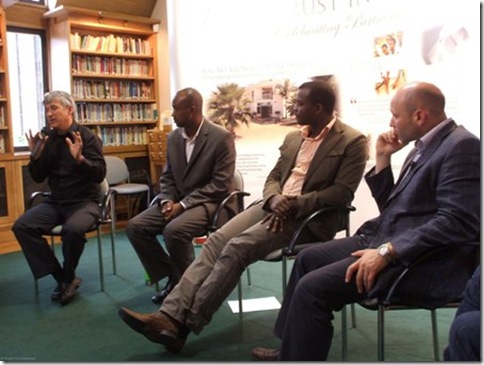
This year marks the 20th anniversary of the genocide in Rwanda and while it is ever important to remember the genocide in order to learn from it and prevent such an event from happening again, it is also important that we focus on how we move forward after such an event. Last night I attended Peace Talks, an event hosted by International Alert at The Geological Society in London. The topic for discussion was Rwanda, 20 Years On: Healing the Scars of Genocide.

The event was chaired by Dan Smith, Secretary General of International Alert. You might remember that he chaired the event War, Peace and Faith: The Ambiguous Role of Religion in 21st Century Conflict that I attended last year. Dan began by saying that while much has rightly been said about the genocide in Rwanda, the focus of the evening was on healing the scars of the genocide, to focus on what we can do to move forward.

The Way Things Appeared 20 Years Ago

Dan began asking His Excellency Williams Nkurunziza, High Commissioner of Rwanda to the UK, about what he saw 20 years ago as the road that lay ahead. He replied that by the end of the genocide, out of 8 million Rwandans, up to 1 million were dead, 3 million displaced and out of the country and the remaining 4 million were traumatised.

The emphasis of the Rwandan government had to be in reversing the forces that made genocide possible in the first place. The Rwandan constitution now stresses that Rwanda belongs to all Rwandese, and the focus is on reconciliation and belonging.

Nkurunziza notes that attitudes take time to change but that Rwandans have shown a readiness to learn from mistakes, a willingness to forgive and an ability to move on.

The same question was posed of Gloriosa Bazigaga, Rwanda Country Manager for International Alert. While Nkurunziza had touched on the Gacaca courts, Bazigaga continued saying that the courts were the start: they highlighted the events of the past but healing was slow to begin because people feared speaking out in fear of punishment.

Starting in 2007, International Alert began their work in healing psychological wounds and helping economic recovery through micro finance and the teaching of skills. Specifically, the organisation works with former prisoners and combatants, survivors and young people and they provide dialogue groups, trauma counselling and micro-finance to corporations of five people consisting of both survivors and perpetrators.

The Issues Involved in Recovery

Dan then asked Dr Ian Palmer, professor of military psychiatry to discuss the issues involved in healing from the scars of genocide. Dr Palmer began by saying that he believes psychiatry (that is the treatment of psychiatric conditions primarily through the use of medication) has only a small role to play and that the focus must be on healing individuals. Healing cannot begin until individuals feel safe, both from death and from the elements. Dr Palmer stressed social support in terms of safety, schooling, structure and food.

On forgiveness and reconciliation, Dr Palmer said that Rwandans (along with other post-conflict societies) had shown incredible resilience but that reconciliation is a choice. If we do not forgive, we cannot move on and while punishment is important, justice is more important. He finished by saying that we cannot have justice without resilience, forgiveness and reconciliation.

I found Dr Palmer's thoughts especially interesting given that I did my post-grad in Psychology.

Burundi and the DRC: The Political Context of Rwanda

Next up, the Rt Hon Lord Jack McConnell of Glenscorrodale PC spoke in his capacity as Chair of the All-Party Parliamentary Group on the African Great Lakes Region. He began by saying that it is remarkable that Rwanda has achieved what they did but there remain two different but continuing issues.

The first is that the exodus of Rwandans had an undeniable effect on the DRC and contributed to the inability of the DRC to move forward. The difficulty is that the government of the DRC relies too heavily on this explanation for their all of progress and they do move forward or take action.

The second issue is the impact of the genocide on the international community. 1994 was a disgrace: the international community knew it was going to happen, knew when it was happening and even exacerbated the events. Changes have been made to the way the international community responds to crises but a consistent international response is difficult given the continuing difficulties in the region. The DRC, Burundi and Central African Republic remain volatile.

The Road Ahead: New Avenues or More of the Same?

This is an interesting issue and the crux of this question was whether we continue in the current path of reconciliation, construction and coming together or whether our focus needs to be slightly different in the future.

HE Nkurunziza began by saying the Rwandan government are pleased with the progress made so far and are optimistic about the future. Reconciliation has been a deliberate decision and it is possible because the leadership is driving it. We must ensure that people do no succumb to the temptation to exact revenge, he said and without committed leadership, we cannot heal a fractured society.

When pressed, HE Nkurunziza went on to say that the process is driven by the politics of coexistence and systems and institutions to ensure that all Rwandese are views equally under the eyes of the law. Rwanda chose a path of restorative justice applied by the people themselves.

Specifically, programmes are underway to put all orphans into family homes rather than group homes; equal opportunities legislation provide equal access to jobs and education; there is universal primary education with 98% of primary school children in school; equal access to healthcare; and work to elevate people above the poverty line.

Gloriosa Bazigaga responded to the same question by stating that in the past, the focus has been on the legacy of genocide and reconciliation is still needed because people heal progressively but not at the same pace.

Bazigaga raised the issues of youth unemployment and land issues and Nkurunziza confirmed that the focus of the government is on the growth of the SME sector instead of a reliance on agriculture. According to the goals of the Rwandan government's Vision 2020 [PDF] policies, due to limited land capacity, the country aims to switch to a knowledge based economy by 2020.

Dan then asked Dr Ian Palmer, based on his experience of being in Rwanda and Bosnia, whether he could compare the two countries and comment on the timescale of healing (given that Bosnia is volatile again). Dr Palmer remarked that we take a lot for granted in the UK in terms of the structures needed for healing. He stated that if you don't have that structure, you can't do the rest and he commented again on the need for whole system change. He stated that mental illness is a combination of predisposition, a person's upbringing, trauma and the current environment. If you don't heal society, you're waiting for unscrupulous people who will pick on vulnerable people and start the whole process over again. Safety, structure, systems and the environment are most important.

In Closing

Finally, Dan asked Jack McConnell to comment on a type of leadership that would be conducive to supporting Rwanda and other post-conflict societies. McConnell observed that we have a generation of political leaders with little history or passion and that there is a lack of strong leadership in the EU as a whole (with the possible exception of Germany). The difference between Bosnia and Rwanda, he said, was in the leadership but it is not really correct to draw comparisons between Rwanda and Bosnia (given what had previously been discussed on different paces and rates of change). It was perhaps most accurate to look at post-war Germany and the steps that were taken to suppress right-wing ideologies.

In closing, McConnell warned that we should not forget the facts and we should not let people minimise the genocides in Rwanda and Bosnia. We require education and witness participation so that change can be made but also to prevent it happening elsewhere. Dr Palmer closed by saying there is no perfect fix. We must be ever vigilant and aware of the risks and the cost of not getting it right. He stressed that we must not forget.

Gloriosa Bazigaga closed by saying that the work of International Alert in the communities should be a lesson for other institutions. The Catholic Church, for example, has not reflecting on the role of their priests in the genocide. Finally, HE Nkurunziza stated that we must get involved, that it is important to be an ambassador in the global campaign against genocide.

The debate was followed by a lively discussion on Apartheid and the possible application of the TRC model to Rwanda instead of the Gacaca courts and a comment on whether people should forgive and forget (as opposed to remembering what happened). The event was then following by drinks and canapés and an exhibition of the work of photojournalist Carole Allen Storey.

SHARE:

Sunday, 30 March 2014

Film Review: Fire in the Blood

Fire in the Blood DVD packshot

In the summer of 1991, at the end of my first year in university, I went on a course on HIV / AIDS so that I could learn to educate young children about the disease. We talked about prevention, transmission and the lack of a cure. It never fails to confound me that 20 years later we were still preaching the same lessons when ARVs were found to be successful in the treatment of the disease in 1996.

Narrated by Academy Award-winner William Hurt and an official selection in the 2013 Sundance Festival, documentary Fire in the Blood is the story of how Western pharmaceutical companies and governments aggressively blocked access to low-cost AIDS drugs and generics across the developing world at a cost of an estimated ten million deaths.

Shot on four continents and featuring archived footage, Fire in the Blood exposes the fight for people in developing countries to access HIV / AIDS treatment which cost $15,000 a year or an average of $40 per dose. As a point of perspective, the average weekly wage in South Africa, the richest country on the African continent, is $68.

The film covers the patents which prevent the sale, production or import of generic drugs; the pressure on governments to uphold such patents at the threat of trade sanctions; and the propaganda machine that cultivated fear of counterfeit drugs, viral mutations and non-conformity to treatment should drugs be made available in the developing world.

Fire in the Blood still

All of this is discussed against the backdrop of the profiteering of pharmaceutical companies and the actual cost of the active ingredients in anti-retroviral drugs and the cost of producing them.

The film discusses the eventual victory that resulted in the President's Emergency Plan For AIDS Relief (PEPFAR/Emergency Plan) and the resulting backlash and extension of the TRIPS agreement which will make it very difficult for such victories in the future.

Pharmaceutical companies might have lost the battle with respect to the treatment of HIV and AIDS but Fire in the Blood concludes that everyday people might lose the war. With more and more Americans reporting an inability to afford medications, will we be able to sweep drug company monopolies under the carpet like we did when it was just third-worlders?

Fire in the Blood DVD packshotFire in the Blood is directed by Dylan Mohan Gray and is feature-length at 84 minutes. The pace is fast and the narrative features contributions from Zackie Achmat, co-founder of the Treatment Action Campaign in South Africa, Bill Clinton, Desmond Tutu, Joseph Stiglitz and Yusuf Hamied, chairman of Cipla, an Indian socially conscious generic pharmaceuticals company. The film includes powerful scenes showing the improvements in the lives of individuals in Uganda, India and South Africa once access to anti-retroviral drugs was improved.

Fire in the Blood is a powerful, important film that will be released on DVD in the UK on 24 March 2014. I highly recommend the film and give it five out of five stars. The film has only seen a limited release in the USA despite being prominent in film festivals in 2013.

You can purchase Fire in the Blood from Amazon.co.uk.

SHARE:

Saturday, 18 August 2012

South Africa: Where Life Is Cheap and Death Even More So

One of the top search terms on this blog is “crime in South Africa”, followed by “personal stories of crime in South Africa”.  I don’t know why people are searching those terms, but in my mind there are two main categories of searchers:

1.  Those wanting to visit South Africa and wanting to know if the horror stories are really true.

2.  Those who are still living in South Africa and have begun to wonder if there isn’t something wrong with this picture.

I once belonged to the latter category of people.  I knew many people who were raped, murdered, gang-raped, robbed, burgled, held up at gun point or hijacked.  I was held up at gunpoint in a bank robbery, my home was broken into while I was at home and my dog saved my life, I was attacked in my car. 

Life is cheap in South Africa and death is even more so.  I finally comprehended just how extreme the situation is there following a dinner party two years ago.  We were 7 women having dinner in a flat in London.  I was pressed to talk about the crime in South Africa and as always, I hesitated.  Talking about it leaves me feeling raw and vulnerable and it always, without fail, ushers in nightmares, panic attacks and generalised anxiety in the weeks following it.

But on that evening, I felt safe amongst 6 other women and I talked.  At one point, one of the women left the table and soon after made her excuses and left.  It turns out that my story filled her with such terror that she felt quite traumatised.  In her world, she didn’t know anyone who had died from unnatural causes, no victims of violent crime, barely any victims of crime at all.  Sure, she reads the newspapers, listens to the news.  But her inner circle had never been touched by violence, crime and inhumanity and that is entirely possible in countries other than South Africa. 

All of this has been in the forefront of my mind for the past ten days.  I want to talk about it and raise awareness because I believe that every South African, regardless of age, race, gender, sexual orientation, religion or class has the right to safety, security and dignity.  Four opinion pieces caught my attention over the past 10 days.

“Take your Women’s Day and shove it” [Helen Moffett, 8 August 2012, Books Live]

Helen discussed the parades and money spent on Women’s Day celebrations in South Africa and the laughing stock they had become in the face of a situation where women are raped, murdered, beaten and violated each and every day in South Africa.

Helen was a little bit angry and in light of the situation, I have to ask why we aren’t all more than a little bit angry:

Our rape stats are a global disgrace (Goddess, how many times do I have to FUCKING say this, the WORST in the world for a country not at war – the scale is unimaginable, the suffering ditto), black lesbians have “carve me up and smash my brains in” signs stamped on their backs, rural women and children live in relentless, grinding misery and poverty HUGELY exacerbated by patriarchal strictures, which are of course absolutely sacred (and the fact that the Traditional Courts Bill, which would render these women even more helpless and wretched, is actually allowed to pollute national airtime is a bloody disgrace)

[Read more about South Africa’s Women’s Day]

“Women don't deserve a day” [David Moseley, 14 August 2012, News 24]

Last weekend, violent protests erupted in Lonmin mine and David Moseley remarked that: “There is always something terrible happening in South Africa”.

He referenced Helen’s post and then went on to talk about his greatest fear, that someone he knows and loves will be raped.  It is a valid concern in South Africa where “women are getting raped (almost every 17 seconds in South Africa)” and “a survey … conducted amongst 1 500 Soweto school children … discovered that a quarter of all boys said that "jackrolling" (their lingo for gang rape) was "fun"”.

He closes by saying that:

Women don't deserve a day at all.

They deserve every day, every week, every month, every year. They deserve our undying attention. They deserve a country where they can live without fear.

They deserve life.

It can be really frustrating speaking to South Africans sometimes as their need to defend their country and all of its faults battles with their need to talk about the horrors that they face.  Ultimately it seems that they fail to grasp one small point.  Each South African has a fundamental human right to live safe from physical, bodily, emotional or psychological harm.  Especially where it is being dished out to them in such an aggressive, continuous and gratuitous manner.  While the government wraps itself up in corruption, nepotism, cronyism and negligence, the citizens of South Africa are dying.

“Where is the Outrage?” [Camilla Bath, 16 August 2012, Eye Witness New]

On Thursday morning, Camilla Bath EWN Deputy Editor in Johannesburg asked the following question:

Have we become so insensitive in Gauteng, in South Africa, that we all but disregard the unspeakable violence that’s unfolding on our own doorstep? Are we too callous to care, too inundated with tragedy and violence on a daily basis to truly take stock of what’s happening around us? Have our ideas of what qualifies as shocking been warped to such an extent that we no longer see people being burnt and hacked to death as utterly unacceptable and appalling?

Her words are especially chilling and especially relevant in light of the tragic events that took place at Lonmin mine just hours later.  Bath spoke of the disturbing violence taking place at the mine and the murders of miners, police officers and security guards and yet she wondered why this was not even reaching South Africa’s newspapers.  The sad fact is that South Africans are so jaded, so used to violence and crime that I found more reporting on the violence in Lonmin on international news sites than on South African sites.

Bath concluded by stating that, “This type of brutality is never deserving of anything other than outrage and disgust. Why the violence really started and who is really behind it are, for now, irrelevant. Right now, it simply needs to be stopped”. 

It was stopped, in the most violent, traumatic manner.  By the end of the day, 34 miners had been shot dead by police in what the police vehemently deny constitutes a massacre.

“Dear black person” [Ferial Haffajee, 16 August 2012, News 24]

It seems strange to close this piece on crime with mention of an opinion piece on politics, poverty and racism.  But it is very important and absolutely relevant in the South African context.

South Africa has one of the highest GINI coefficients worldwide which means that the gap between richest and poorest is wider than any other country, including Brazil.  The government is absolutely corrupt and citizens suffer without electricity, water, education, healthcare and housing.  There was some progress in the 1990s towards housing, jobs, education and healthcare but in the second decade of the 21st century we see a country torn apart by poverty, corruption, inequality and racism. 

It is clear that South Africa is a country on the brink and in the midst of all of this chaos, police opened fire on striking miners, killing 34 human beings.  I’d like to say that it feels like a return to the Apartheid era but back then we lived in a police state under a permanent State of Emergency.  I’m not going to even try predict the effect of adding state-sanctioned extreme violence to the mix of lawlessness and chaos but I can guess that it can’t be good.  How much more has to go wrong in South Africa before a true leader steps in and cleans up both on the streets and in the government?

SHARE:

Sunday, 29 April 2012

Southern Kordofan: Unfinished Business

When asked why there is so little coverage of the situation in Sudan, correspondent Peter Greste admits that Southern Kordofan is almost impossible to gain access to.  The Sudanese government in Khartoum will not allow entry to journalists and it remains for them to travel from South Sudan and into the area on long, treacherous roads. 

Peter Greste and Al Jazeera travelled to the Nuba Mountains in the remote state of Southern Kordofan in Sudan and discovered, in Greste’s words, “a humanitarian disaster”. 

“This is what a scorched earth policy looks like”.

This exclusive report by Al Jazeera exposes the hidden war in the Nuba Mountains.  It shows that the Sudanese government is targeting civilians, that they are being forced to live in caves, and that the government is embarking on a campaign of genocide.  Most importantly, it shows Sudanese government footage whereby troops are ordered to “clear out the area” and not to leave any survivors as this would lead to administrative costs for the Sudanese government.

In this report, Dr Mukesh Kapila, former UN head in Sudan and Mustafa Osman Ismail, senior adviser to Sudanese president Omar al-Bashir are interviewed.  Mustafa Osman Ismail claims that civilian casualties are incidental, that civilians are not being targeted, and that food, water and medical supplies are being sent to the people.

“I’m very disappointed in my good old friend Mr Osman, it must be very, very difficult to be advisor to a genocidal head of state.  What I saw in Southern Kordofan, and it’s not just me, is that what he’s saying is an absolute pack of lies. 

If that was the case, we would not be seeing a deserted countryside, we would not be seeing black, charred fields, we would be seeing seeds being planted as the rains come, yet that is not happening.  We would not be seeing thousands and thousands of women and children living in caves, as I saw for myself, and as refugees, as I saw for myself. 

And we would not be seeing anti-personnel landmines and Antonov bombers as I saw for myself.  And if Mr Osman is right, then why doesn’t he allow independent and impartial access to the region, which he will not do?

SHARE:

Sunday, 19 February 2012

Book Review: I’m Not Leaving by Carl Wilkens

Carl Wilkens, Jean-Francois Gisimba, Freddy Mutanguha and James Smith

In 2011, I had the privilege of watching Carl Wilkens speak at the event "Rwanda: Strengthening Society Through Genocide Education” in London. It was a privilege not because Carl Wilkens was the only American to remain in Rwanda during the 1994 genocide and we got to hear about his experiences, but because his story was one of hope, inspiration and near-miracles in the face of incredible horror.

Carl Wilkens has written a book about his experiences in Kigali during the genocide and the decision he made to stay behind when most foreign nationals left. I’m Not Leaving is based on Wilkens’s recollections and almost 8 hours of cassette recordings that he made during that fateful time but he is keen to stress that this is not another book about genocide:

“While the stories written here happened during the genocide, this book is not really about genocide. It is more about the choices people made, actions people took, courage people showed, and sacrifices people gave in the face of genocide”.

In 1994, Carl Wilkens was director of the Adventist Development Relief Agency. On April 6, 1994, the presidential airplane was shot down as it prepared to land at Kigali airport, killing all on board including Presidents Juvénal Habyarimana and Cyprien Ntaryamira of Rwanda and Burundi respectively. The assassination was a catalyst that set off the genocide against local Tutsis and moderate Hutus.

I'm Not Leaving Carl Wilkens book coverIt was a catalyst, but not the cause. The genocide had been in preparation for months, if not years before, as lists were compiled and weapons stockpiled. In fact, it was on January 11, 1994 that the UN Force Commander in Rwanda, Canadian Lieutenant General Roméo Dallaire, warned his superiors of plans to exterminate Tutsis.

Carl Wilkens knew this and when his wife and three young children were evacuated on the morning of April 10, 1994, he made the decision to stay behind to ensure the safety of his Tutsi employees Anitha and Janvier. All of the foreign nationals were leaving Rwanda and the American embassy was closing for good. Not surprisingly, his decision to remain behind was not well received by his superiors at ADRA or the United States embassy and he had to stand up to both of them.

"I took one of Mindy's school notebooks, found a blank page, and wrote with a pencil: "I have refused the help of the United States government to leave Rwanda"

As an eyewitness account I’m Not Leaving gives a valuable insight into the situation in Kigali before and during the genocide. Wilkens reminds us that at the beginning of 1994, there were over a million refugees in Kigali due to the 1990-1993 Rwandan civil war and the October 1993 assassination of Burundi President Melchior Ndadaye. There was already a widespread humanitarian relief effort in Kigali at that time and Wilkens notes that their food stocks are what kept Kigali going during the genocide.

Wilkens also provides insight into the role of the UN peacekeeping soldiers that had been in Rwanda since August 1993. While acknowledging the work that they did do and the lives that they saved, Wilkens questions whether their presence gave Rwandans a false sense of security. He believes that their presence might have contributed to people not fleeing or protecting themselves in face of RTLM propaganda and hate speech.  

It seems incredible that there was so much inaction in the face of the genocide and that, as Wilkens notes in the final pages of the book, it was solely the actions of the Rwandan Patriotic Front that brought an end to the slaughter. This is especially notable as Wilkens transcribes a BBC report from April 24, 1994 (18 days after the start of the genocide) in which the term ‘genocide’ was already being used to describe the events in Rwanda.

It was in the second week of the genocide that Wilkens thought of recording his ideas and thoughts on a cassette recorder. He then dedicates the majority of the book to chronicle his incredible actions over the next three months. Nearly every day, Wilkens and other ADRA associates braved snipers and mortars to drive around the streets of Kigali bringing food and water to various orphanages around the city. He achieved this despite the ADRA headquarters being completely sacked.

"Soon you stop diving for cover each time you hear an explosion, realizing that you will never hear the one that kills you".  

There are times in I’m Not Leaving when my heart felt as though t might stop and the book is uncomfortable to read at times. This is an intimate account of service, faith and courage and I almost felt like a worthless bystander watching as people risked their lives to save others. Wilkens talks about real fear and I got that. I could feel it as I read the book and my chest began to tighten. 

In his ADRA vehicles and borrowed UN flak jacket, Wilkens achieved what no one else could achieve during the genocide. This man got into a neighbourhood like Nyamirambo to get food and water to two orphanages when the UN couldn't even get in. He talks about negotiating and pleading with genocidaires to save the life of Tutsis, how he got one Major Emmanuel to rescue 12 Tutsis. They were rescued as they knelt in prayer, with the killers standing with machetes raised above their heads, poised to strike.

He tells of the events at Gisimba orphanage where his intervention led to the rescue of hundreds of people as they were moved to the safety of Saint Michel church. He was then helped by government soldiers to pack up the orphans’ belongings and take them through to the church (you can read more about Carl Wilkens and Jean-Francois Gisimba talking about their recollections of that day here).

No matter how many lives were spared, Wilkens reminds us of the incredible loss of life:

"Such staggering losses, so enormous that it seems wrong for me to keep on writing without some sort of respectful pause". 

Indeed, there were times when I had to pause myself to respect the gravity of what I was reading. Since the end of the genocide, Carl Wilkens has dedicated his life to educating people about prejudice, genocide and entering the world of “the other”. I would really recommend that you check out his speaking schedule and take the time to see him speak when he is next in your town or city.  I’m Not Leaving was self-published and all proceeds go towards the educational efforts of his organisation WorldOutsideMyShoes.org (click to go straight to the purchase page). 

I’m Not Leaving is essential reading for anybody wanting to know more about the genocide in Rwanda.  If you are new to this topic, you might find it useful to read Jean Hatzfeld’s Life Laid Bare: The Survivors in Rwanda Speak, Roméo Dallaire's Shake Hands with the Devil: The Failure of Humanity in Rwanda or Philip Gourevitch's We Wish to Inform You That Tomorrow We Will be Killed With Our Families: Stories from Rwanda first to gain some insight into what happened during the 100 days of the genocide, how the genocide occurred, and the failure of the international community to stop it.

This is a self-published book without the benefit of professional editors or proof readers and as such, there are inevitable grammatical and spelling errors.  These are minor though and don’t detract from the unique and inspirational perspective provided by Wilkens in the book.

SHARE:

Wednesday, 25 January 2012

Interview With Dr Ajaz Khan of Lendwithcare.org

It is one of the great paradoxes of the developing world. Those individuals in most need of banking services and credit are the most likely to lack sufficient collateral to support it.  In the past decade, there has been increasing focus on microfinance as a tool to alleviate poverty and sustain business models.

Microfinance is not charity.  There is an increasing perception that charity perpetuates poverty whereas it is believed that microfinance can enable an individual to build on their skills and provide a sustainable method of improvement.

AAKhan photoLendwithcare.org recently launched in the United Kingdom.  It is an initiative from Care International UK in association with The Co-operative.  We speak to Dr. Ajaz Khan, CARE’s Microfinance Advisor, about microfinance, Lendwithcare.org and what you can do to get involved.

You lived and worked in Bosnia-Herzegovina between 2000 and 2006. Could you please tell us about the work that you did there? What motivated you to make the move to BiH?

Although I spent most of my time in Bosnia & Herzegovina, I was also working in Kosovo from 2002 onwards. Initially, much of the work involved the physical reconstruction of homes, schools, health facilities and water supply systems, that is the infrastructure that had been damaged or destroyed during the conflicts. However, after the reconstruction phase most of my work revolved around creating employment and income earning opportunities. My particular area of expertise is microfinance and I helped to create two microfinance institutions, one in each country that provided thousands of loans to microentrepreneurs, mainly women, to develop their businesses.

Prior to working in the Balkans I had spent around nine years working in Latin America, largely with small scale farmers, and was looking for a new challenge. I had during the 1990s followed the Balkans conflicts very closely. There was a particular resonance for Muslims such as myself who had been born and brought up in Europe – at the back of our minds there was always a feeling that if this could happen in Eastern Europe could it happen in Western Europe as well? I was grateful when the opportunity arose for me to work in the Balkans and make a small difference to improving the lives of those affected by the conflicts. I left the Balkans to go on to work in Pakistan following the Kashmir Earthquake and then Sudan.

SrebrenicaPhoto credit: CARE/Jon Spaull

Microfinance is a relatively new concept but one that uniquely puts members of the public in a position where they can achieve a great social good. It is different from and more sustainable than giving charity. Could you please describe microfinance in simple terms?

Microfinance is the provision of financial services to those who traditionally have been socially or economically excluded from the formal financial sector. Microfinance includes a number of different financial services such as savings, remittances and insurance but has become synonymous with the provision of small loans or microcredit. The concept of microfinance has in fact been around for a long time but it is really only in the last 30-40 years that it has started to be seen by the international community as an effective tool in alleviating poverty amongst the working poor.

Improving access to financial services allows poor and low-income people to finance income-generating activities, build assets, stabilise consumption and protect against risks. It is in this regard that microfinance can be seen as a dignified and sustainable approach to the fight against poverty.

Lend With Care logo

Can you tell us a bit about Lendwithcare.org?

Lendwithcare.org is a micro-lending initiative from CARE International UK and in association with The co-operative. Lendwithcare allows people in the UK to lend from as little as £15 to an entrepreneur in the developing world. We work with local MFIs (microfinance institutions) from a number of developing countries to provide small loans to entrepreneurs working to lift themselves, and their families, out of poverty. By providing a platform through which entrepreneurs seeking microloans can be linked to people in the developed world who can provide capital, Lendwithcare not only enables low-income and poor families from around the world to work their way out of poverty but also gives lenders the satisfaction of seeing the direct impact their money can have on the lives of those they are helping. The money that is lent through Lendwithcare.org goes directly, and interest free, to the MFIs who administer the loans locally and once the entrepreneur starts repaying their loan this money goes back to the lenders who supported the loan request, where they can decide to re-lend their money to another entrepreneur or withdraw it.

Which countries does Lendwithcare.org currently operate in? Why were those countries chosen?

Lendwithcare currently works in five countries. It began in Togo and Benin in West Africa and then expanded to the Philippines, Cambodia and since late 2011 Bosnia & Herzegovina. There are several reasons why we selected these particular countries. Firstly, they are all countries where CARE has worked in the past in the field of microfinance - indeed some of the MFIs we now work with were established and developed by CARE in the past, although all are now independent entities so they are somewhat of a known quantity to us. Secondly, we feel we have identified the ‘right’ MFI partners, that is organisations that have a strong social development mission. There are also other factors which we need to consider such as the ease of transferring funds back and forth and whether we can develop links with the fair trade supply chains of our sponsor The co-operative.

Yawa Dotse, 49, grains food stall,  ApaktamE, Togo. Care International trip 13/02/11 to 16/02/11
Photo credit: CARE/Emilie Bailey

Is there a plan to expand into further countries this year?

Yes, from February 2012 we hope to include Ecuador and we are also currently exploring the feasibility of working with MFIs in South Africa, Indonesia and Pakistan.

Do you have any statistics on the numbers of individuals that Lendwithcare.org has assisted in the past?

Since Lendwithcare’s launch in September 2010, 1,249 entrepreneurs have been fully funded and just under half a million pounds lent. December 2011 has been our most successful month with over £109,000 being lent and 229 entrepreneurs fully funded.

Is there a single case or success story that stands out for you amongst the people that Lendwithcare.org has assisted?

Yes, a recent one actually from Bosnia & Herzegovina. Mrs Djerdji Merdjanovic and her husband both lost their jobs as the company where they were working ceased to operate after the Bosnian War. They decided to start raising livestock, growing vegetables and raising and selling earthworms to specialist fishing shops in the capital Sarajevo. Djerdji applied for a loan to buy a second hand van and was featured on Lendwithcare. One of our lenders who incidentally manages a business called Worms Direct UK and is a major supplier of worms for fishing bait saw her story. Because the particular type of worm she raises is quite rare he contacted us to see whether it is possible for Djerdji or indeed other suppliers in Bosnia and Herzegovina to export and sell the worms through his company in the UK.

What are the biggest hurdles that entrepreneurs face and what can be learned from mistakes made in the past?

Lack of affordable, accessible and timely capital is certainly one of the major hurdles that small businessmen and women the world over face. We feel that Lendwithcare, in a very small way, is helping microentrepreneurs overcome this hurdle. However, lack of markets, physical infrastructure such as roads and crop storage facilities, information, technical assistance and support and women’s mobility are all hurdles and their importance varies from one context to the next.

If you could give a message to prospective lenders out there, ones that might be hesitant or apprehensive about lending money through your organisation, what would that message be?

Not only can you help someone but you can also see where your money goes, we do not take anything from your loan to cover our costs, and you invariably get your money back!

I believe that borrowers are in fact charged interest on their loans. Is this consistent with Islamic finance or are special arrangements made for those borrowers (for example, those within BiH)?

Although Lendwithcare provides interest free capital to our MFI partners, the MFIs do charge interest (or other fees in the case of Shari’ah compliant institutions) to entrepreneurs. However, we do check to ensure that their interest rates are ‘reasonable and fair’ according to the local context.

If they are to survive then MFIs must of course cover their operational costs. And the costs associated with providing very small loans, on occasions supported with training and other services, to often geographically isolated borrowers, especially when they visit them at their homes to disburse loans and also collect repayments, can be considerable. Indeed if they wish to grow and develop MFIs will need to make a profit.

However, while there is an obvious need to ensure financial security for themselves so that they can continue operations, they are rarely under pressure from shareholders so do not need nor desire to make ‘excessive’ profits. What the interest free capital allows the MFIs to do is extend their operations and lend to poorer clients than they might otherwise, or to move into more remote areas - this has been the case with our MFI partner in Togo for example which is now lending in more isolated rural areas.  In other cases, such as the Philippines and Bosnia & Herzegovina the MFIs have actually passed on the benefits of receiving interest free capital from Lendwithcare to their clients through much lower interest rates. At present we do not have any Shari’ah compliant MFI partners, but this is likely to change during 2012 with potential partners in both Indonesia and Pakistan.

Care International trip to Cambodia with Deborah Meaden 14/03/11 to 20/03/11
Photo credit: CARE/Emilie Bailey

There are other microfinance organisations out there. What differentiates Lendwithcare.org from those others and who is your target market?

There are a number of government bodies, NGOs and development agencies working in the field of microfinance. However, Lendwithcare.org is the first person-to-person platform to be backed by a leading international aid and development organisation. Moreover, Lendwithcare is able to combine CARE International’s decades of expertise and innovation in the field of microfinance with this revolutionary initiative to provide the highest quality products and services to the working poor.

Do you have advice on what young people can study if they would like to become involved in international agencies such as yourselves?

I think more important than what they study is that they must have a passion to work in international development. It is useful though to have formal qualifications in technical subjects such as agriculture, health, and engineering as the first job is often at the grassroots level working directly in the field. Also, foreign languages are always useful.

Apart from becoming a lender, what can people do to support your organisation?

Since 100% of the loans made through Lendwithcare go to the entrepreneurs we have very little marketing budget and therefore need to find a way of telling people about Lendwithcare.org through word of mouth. We encourage all of our lenders to talk about Lendwithcare with friends and family and if they use Facebook or Twitter to visit and like our Facebook page www.facebook.com/lendwithcare or tweet using our @lendwithcare address.

As an organisation, CARE International UK has a number of ‘How you can help’ options, which can be found on our website http://www.careinternational.org.uk/how-you-can-help and regular Challenge activities that raise funds and awareness through enjoyable and often exhilarating events. In March this year for example, the CARE team are challenging people to walk 10,000 steps a day for one week as part of their Walk in her Shoes campaign for more information.


Thank you very much to Dr Khan for taking the time to speak to me and to answer my questions. I feel like I have a much wider appreciation and understanding of microfinance and feel confident in becoming involved in this great initiative..

SHARE:
© A Passion to Understand

This site uses cookies from Google to deliver its services - Click here for information.

Blogger Template Created by pipdig