Tuesday, 21 May 2024

Could South Africa’s ANC Lose Parliamentary Majority for the First Time Since 1994?

Thirty years ago, on 27 April 1994, South Africans voted in the first demographic general election in the country’s history. The National Party of the Apartheid regime was replaced by the government of the African National Congress and Nelson Mandela became president.

Next week, South Africans return to the polls. This is the seventh post-apartheid election in South Africa, including the inaugural democratic election in 1994. For 25 years, the African National Congress (ANC) government dominated polls, obtaining a parliamentary majority in each election, but that majority has been waning since its high of 2004.

1994

1999

2004

2009

2014

2019

62.65%

66.35%

69.69%

65.90%

62.15%

57.50%

In 2024, there is such uncertainty regarding the ability of the ruling party to obtain a majority that conversations are starting to revolve around President Cyril Ramaphosa not receiving 50% of the votes and what that means:

The ANC is still expected to win the largest share of votes, but if it receives less than 50% as predicted, it will need the help of coalition partners to reelect the 71-year-old Ramaphosa

- South Africa braces for what may be a milestone election. Here is a guide to the main players [AP News]

Why Is the ANC’s Popularity Waning?

For many South Africans, the ANC and Nelson Mandela represent those who fought for and won freedom for the majority of the population. Given the damning legacy of Apartheid, that emotional connection to the ruling party has been difficult to break.

Poverty, Inequality & Unemployment

Yet South Africa repeatedly draws attention for being the most inequal country in the world in terms of income and wealth. A 2022 report by the World Bank stated:

The Southern African Customs Union (SACU), comprising Botswana, Eswatini, Lesotho, Namibia, and South Africa, is the world’s most unequal region. Based on Gini coefficients of consumption (or income) per capita, South Africa, the largest country in SACU, is the most unequal country in the world, ranking first among 164 countries in the World Bank’s global poverty database

- Inequality in Southern Africa : An Assessment of the Southern African Customs Union [World Bank]

For every gated suburb in South Africa, there are areas of extreme poverty and deprivation. This is compounded by an unemployment rate of 32.9% in Q1 2024, currently the highest in the world.

According to StatsSA, the number of unemployed South Africans surged by 330,000 to a record 8.2 million in the first quarter of 2024… In Q1 2024, the official unemployment rate rose to a dismal 32.9%…

The situation is much worse for young South Africans, with unemployment rising to 59.7% in Q1 2024. Therefore, for jobseekers aged 15-24 who are not enrolled at educational institutions and are actively looking for work, only four of every ten have jobs…

- South Africa has the Highest Unemployment Rate in the World [ActionSA]

Failure to Invest in Infrastructure

South Africa’s infrastructure can most accurately be described as crumbling. Potholes are scattered across roads in such volume that it is often a case of more sand than tarmac on roads. Clean tap water has still not been extended to the full population, with people in rural communities being most disadvantaged. Waste collection can be described as poor at best with residents in informal settlements being especially effected by non-existent or unreliable services.

Perhaps the most significant of the infrastructure challenges is the South African energy crisis, now entering its seventeenth year.

South Africa is in the middle of a deep electricity crisis. In 2023 the public, many of whom are voters, experienced the worst loadshedding to date, losing power for an average of five hours a day

- South Africa’s electricity crisis: what political parties say in their election manifestos about solving it [The Conversation]

In a sign of the increasing importance of the electricity crisis to South African voters, the ANC, Democratic Alliance and Economic Freedom Fighters now dedicate 10% of their election manifesto to the crisis, up from 2% in 2019. Indeed, Thabo Mbeki’s 2008 admission that the ANC did not listen to Eskom’s warnings is doing the rounds again, further eroding ANC confidence in an increasingly impatient population.

"When Eskom said to the government: 'We think we must invest more in terms of electricity generation', we said no, but all you will be doing is just to build excess capacity," he said in a speech.

"We said not now, later. We were wrong. Eskom was right. We were wrong."

- Thabo Mbeki, 2008; Mbeki: Eskom was right [News24]

Further reading: this is an exceptional article on many of the issues discussed above by S'thembile Cele: "Africa’s Richest City Is Crumbling Under Chaos and Corruption" [Bloomberg]
Corruption

State capture is usually a concept reserved for Gerard Butler films yet it happened in South Africa. The Zondo Commission of Inquiry Into Allegations of State Capture demonstrated that Jacob Zuma and the Gupta family began a process of state capture immediately on Zuma’s election in 2009 which resulted in widespread corruption and economic disaster for South Africa.

The evidence before the Zondo Commission demonstrates that the state capturers were able to: (i) appoint willing collaborators in all kinds of key positions; (ii) hobble the law enforcement agencies, even making some of them complicit in corruption; (iii) weaken parliamentary oversight; and (iv) capture parts of the independent media

- How and Why Did State Capture and Massive Corruption Occur in South Africa? [PFM]

The Zondo Commission resulted in the resignation of President Jacob Zuma and the promotion of Cyril Ramaphosa to the position. Ramaphosa won the election in 2019 but it was already clear then that confidence in the ANC was waning.

Contenders in the South African 2024 Elections

Jacob Zuma and the MK Party

It’s a sign of the rapid change in South Africa at present that AP News published an article, "South Africa braces for what may be a milestone election. Here is a guide to the main players" on 19 May 2024 and it is already outdated by 20 May 2024. In the article, Gerald Imray listed Former President Jacob Zuma’s MK Party as one of four main contenders in the election but yesterday the Constitutional Court of South Africa (the highest court in the country) ruled that Zuma’s 15-month prison sentence for contempt of court disqualifies him from serving in parliament.

The BBC reported that "MK secretary general Sihle Ngubane said the party was disappointed with the ruling, but it would not affect the party's campaign for the 29 May election". Given the infighting rampant in the party, it is possibly unlikely that they will do anything but dilute the ANC’s votes.

Economic Freedom Fighters

Julius Malema was a former member of the ANC Youth League and formed the EFF in 2013 following his expulsion from the ANC. The party has risen to become the third biggest party in South Africa and are inspired by Marxist ideology. They focus on workers’ rights, the nationalisation of mines and redistribution of land, noting the lasting impact of Apartheid on the economic well-being of Black South Africans.

The Democratic Alliance

Since obtaining a 22% share of the vote in 2019, the Democratic Alliance has been rocked by several scandals including pro-colonialism tweets by former leader Helen Zille and racist remarks from the increasingly conservative current leader John Steenhuisen.

The DA harps on about its track record in keeping Cape Town clean and tidy, but does so at the expense of the city’s townships and informal settlements. Now seen as the party of the privileged classes, most of which are white, the DA has entered into into the Multi-Party Charter for South Africa to try reduce support for the ANC, EFF and MK parties. The founders of the Charter represent centre, centre-right and right-wing parties including the DA, Inkatha Freedom Party, Freedom Front Plus, ActionSA and African Christian Democratic Party.


This post will serve as a time capsule, both preserving the situation in 2024 and listing the possibilities for the years ahead. Public pressure has so far not made an impact on the rampant inequality and poverty in South Africa and it may be that the only way to effect change will be for voters to make their mark. Will the ANC lose their majority? Will the next government, no matter its composition, effect real change in South Africa? Only time will tell.

SHARE:

Sunday, 19 April 2020

COVID-19: State of Disaster in South Africa

I was very impressed with the South Africa response to the COVID-19 situation and the choice of President Cyril Ramaphosa to declare of a State of Disaster, not a State of Emergency as early as 15 March 2020 when there had not yet been any fatalities in South Africa. This article, written by Melodie Labuschaigne and Ciara Staunton, addresses this decision and the Constitutional ramifications thereof.

This article was first published on Verfassungsblog and is reproduced here under the Creative Commons license (CC BY NC ND) with due credit given to the original authors, Melodie Labuschaigne and Ciara Staunton.


As COVID-19 spread across the world, the first reported case in Africa was not until 27 February 2020 in Nigeria; six days later the South African National Institute of Communicable Diseases (NICD) confirmed the first case in South Africa. Since then, cases have increased steadily and the first death in South Africa was recorded on 27 March 2020. COVID-19 has shown its potential devastating impact elsewhere, but it is a particular cause for concern in South Africa.

First, while public health strategies such as social distancing and regular hand washing are encouraged, such strategies are a privilege many cannot afford in the crowded informal settlements that accounted for 13% of all households in 2016, many of which may not have access to running water. Second, the high rate of TB and HIV among the population, in addition to the number of those not on treatment for HIV, have led to concerns that this could impact the severity of COVID-19 in South Africa and make its population more susceptible to the virus. Third, while health systems in high income countries (HICs) are being stretched, most South Africans rely on the public health care system that is under-resourced and will struggle to meet the demand of the epidemic. While the virus does not discriminate on the basis of race, sex or borders, it is likely that it will disproportionately affect the poor and those suffering from other co-morbidities. Although the number of cases as of 15 March 2020 in South Africa remained relatively low in comparison to the rest of the world (61 confirmed cases; 0 deaths) President Cyril Ramaphosa stated that ‘urgent and drastic’ measures were necessary to limit the spread of the virus and address this ‘medical emergency’. As such, a State of Disaster was declared by the President on 15 March thereby giving Dr Nkosazana Dlamini Zuma, the Minister of Cooperative Governance and Traditional Affairs power to limit certain rights and freedoms within South Africa.

State of Disaster

A “State of Disaster” is distinct from a “State of Emergency” that can be declared by the President section 37 of the Constitution of South Africa and in terms of the State of Emergency Act 1997. In a State of Emergency, derogations from civil liberties protections under the Bill of Rights such as freedom of assembly are permitted, with some exceptions that include the rights to dignity, life and the right to a fair trial. The courts and parliament retain a supervisory role as the courts have the power to declare a State of Emergency invalid, and any extension of a State of Emergency beyond 21 days must be approved by parliament. A State of Disaster is a temporary measure in which certain rights (such as the rights discussed below) are limited and it may be declared invalid if the requirements for a declaration in s 27(1) of the Constitution are not met. The declaration of a State of Emergency must be necessary to restore peace and order, and as such, may not be the first step in addressing a health emergency, such as the spreading of a virus. Should the emergency escalate and lead to civil unrest, declaring a State of Emergency may be justified and it has not been ruled out.

The CEO of the South African Human Rights Commission, Tseliso Thipanyane, has argued that the measures introduced in fact amounts to a State of Emergency (a point echoed by others), but President Ramaphosa did not want to use that term due to its association with the days of apartheid. The Disaster Management Act 2002 also specifically includes a natural or human occurrence that causes or threatens to cause “death, injury or disease” within its definition of disaster, which would clearly apply to COVID-19, and this may also be why the President opted for a State of Disaster. Whatever the reason, for now the current situation has been designated a National State of Disaster.

Unlike a State of Emergency, the power to declare a State of Disaster is not expressly derived from the Constitution but rather under the Disaster Management Act 2002. Under the Act a National Disaster Management Centre must be established (in this case within the Department of Cooperative Governance and Traditional Affairs) which, amongst other duties, makes recommendations on draft legislation. The exercise of its powers and duties is subject to the direction of the Minister. It is however the national executive (i.e. the Cabinet) that is primarily responsible for coordination and management of the disaster. Regulations can only be made that assist and protect the public, provide relief to the public, protect property, prevent or combat disruption, or deal with disruptive or other effects of the disaster. Under this Act, a series of regulations restricting, amongst other things, the movement of persons, goods and the dissemination of information, were promulgated. These regulations include prohibiting foreign nationals from high risk countries (as defined by the WHO) from entering South Africa from 18 March 2020 and restricting gatherings to 100 individuals. A further series of restrictions, including a “lockdown” on the movement of its citizens from midnight on 26 March were announced on 23 March 2020.

In announcing these further restrictions, President Ramaphosa noted that COVID-19 is particularly dangerous for South Africa in light of the high levels of poverty, malnutrition and high rates of HIV and TB. At the time of the announcements South Africa had the highest number of cases in Africa albeit a low number relative to countries worldwide. The restrictions introduced were at that time the most stringent in Africa, as South Africa was then the only country on the African continent to require all of its citizens to remain at home. The measures announced on 15 March and 26 March represent the most comprehensive limitation on the freedom of movement and assembly of all South Africans since apartheid. A failure to adhere to these measures may result in a fine (unspecified), imprisonment of up to 6 months or both.

A State of Disaster lasts for 3 months (unless terminated by the Minister) and can be extended by the Minister one month at a time. There is, thus, no role for Parliament in the declaration, extension or termination of a State of Disaster. However, the Constitutional Court can set aside the declaration of a State of Disaster and it was challenged (and subsequently dismissed) on the grounds that the regulations are violating the rights of South Africans to human dignity, freedom of movement, freedom of trade, occupation and profession, and access to healthcare, food and water. Furthermore, unlike a State of Emergency, the regulations must conform to the Bill of Rights and a court can set aside any regulations that are considered to be an unjustified limitation on these rights under section 36(1) of the Constitution. Under the 2002 Act, parliament is not prohibited from meeting, but the COVID-19 regulations restricting gatherings in effect prevent parliament from meeting.

The COVID-19 regulations cover any array of measures considered to be necessary to prevent the spread of the virus, but the following are main limitations on the rights and freedoms:

1. Freedom of movement and assembly

The initial restrictions on movement pertained to entry into South Africa and the limitation of gatherings. Initially gatherings of no more than 100 individuals were permitted, but as of midnight 26 March, all gatherings including congregating for prayer is prohibited, with the exception of funerals that are restricted to 50 people. Foreign nationals from high risk countries were prevented from entering South Africa from 18 March. As of midnight on 26 March, all but essential movement is prohibited. The leaving of a residence is only permitted to buy essential goods, seek medical attention, buy medical products, collect social grants, attend a funeral of no more than 50 people, or access public transport for essential services during specified times. Leaving a house for exercise or to walk a dog is not permitted. Movement between provinces and districts is prohibited. Cumulatively, these measures go further than any restrictions on movement under the apartheid government.

Any individual who is suspected of having COVID-19 or has been in contact with a person who has tested positive for COVID-19 cannot refuse to consent to be tested. If the test is confirmed positive, they cannot refuse to submit to treatment, isolation or quarantine. Arguably, such measures are unnecessary as the Regulations Relating to the Surveillance and the Control of Notifiable Medical Conditionsgazetted in June 2017 under the National Health Act 2003 already make provision for the mandatory examination, treatment, isolation and quarantine. Under the 2017 regulations, such an application must be made to the High Court by the Head of a provincial department. The COVID-19 regulations, however, go further as a person who refuses to consent to testing or isolation can be quarantined for 48 hours while a warrant is sought. Section 36(1) of the Constitution requires a limitation of rights to be proportionate. The powers granted under the 2017 regulations appear to be suitable for COVID 19 and it is unclear why an extension of the powers was deemed necessary. Considering there have been no reported cases or indication that people will refuse testing, it is questionable whether this extension of powers is indeed a proportionate response.

2. Restrictions on movement of goods

As of midnight on 26 March, only essential goods may be sold. This includes any food and animal food products; cleaning and hygiene products; medical and hospital supplies; fuel, coal and gas, and basic goods, including airtime and electricity. The selling of alcohol and cigarettes are expressly prohibited. Price controls on certain goods have also been introduced, including toilet paper, hand sanitiser and some food products. Failure to comply can result in a fine, imprisonment of up to 6 months, or both.

3. Censorship

The South African Constitution guarantees freedom of expression and this includes “freedom of the press and other media” and “freedom to receive or impart information or ideas”, which are derogable rights. The COVID-19 regulations criminalise the intentional misrepresentation or publishing of a statement that a person or persons has/have COVID-19. The regulations also criminalise the publishing of a statement (including via social media) that intends to deceive another person about any measure taken by the government to address COVID-19. The focus is on disinformation and is aimed at preventing the spread of false cures that have been seen in the context of HIV. However, concerns have been expressed by the Committee to Protect Journalists that this may prompt other jurisdictions to adopt more oppressive press censorship. The risk of censorship that does not observe standards of necessity and proportionality in this time is that it may have the opposite effect and limit access to valuable and reliable information for public health. There is evidence within South Africa that this has already occurred as the Ministry of Health has stated that the dissemination of information is centralised to government, information requests by the press should be directed to the NICD and has it instructed other experts in South Africa not to talk to the press. Considering the NICD is currently overwhelmed, this has led to concerns that access to information has already been limited.

Enforcement of regulations

Under the 2002 Act, financial, human and other resources may be released and during his 23 March address, President Ramaphosa announced that he had directed the South African National Defence Force (SANDF) to be deployed to support the South African Police Service (SAPS). The SANDF are now patrolling the streets enforcing the lockdown. Already there have been allegations of the use of rubber bullets, as well as abuse, that have already led to calls for investigation.

Conclusion

This is the first time since the post-apartheid “New South Africa” that these basic freedoms have been limited. The limitations on rights are considerable and while recourse to the courts remains open, there is no compensation for loss or damage suffered as a results of these regulations. While these regulations apply to the COVID-19 crisis only, it is unclear when this epidemic will be deemed to have passed, and whether they may be used as a template for other public health emergencies which include the current TB and HIV epidemics. While such restrictions, particularly restrictions on movement, are harsh and can be followed in other HICs, it remains to be seen whether these restrictions will ultimately be a near impossible balance between restricting the spread of COVID-19, and depriving many in South Africa of their access to food, water and basic hygiene

SUGGESTED CITATION Labuschaigne, Melodie; Staunton, Ciara: COVID-19: State of Disaster in South Africa, VerfBlog, 2020/4/11, https://verfassungsblog.de/covid-19-state-of-disaster-in-south-africa/.

SHARE:

Wednesday, 16 December 2015

#ZumaMustFall, White Privilege and the South African Spring

The 16th of December is a public holiday in South Africa. It used to be a racist Apartheid holiday marking the Day of the Vow when Afrikaners swore to God that they would forever commemorate it if He allowed them victory over the Zulus at the Battle of Blood River in 1838.

Today the 16th of December is the Day of Reconciliation, a day dedicated to healing South Africa's fractured past. Or to sitting in the sun and drinking in the hot African summer. 

Today, the 16th of December was marked by protests around the country for the #ZumaMustFall movement. It was a day that made me proud to be South African and which I thought might finally be the start of South Africa's Spring. I don't expect the crime to suddenly end but I do live in hope of an end to the poverty and corruption (which I see linked). More on that later. 

There was a very good article in the RDM today.


This is an interesting article. In many ways he is right - we expats have all had awkward moments when we've had to explain to other South Africans that we don't share their racist views. You will not believe the racism amongst South African expats and the white middle classes. Or maybe you will. 

 And he's not wrong when he observes that "[i]n focusing singly on Zuma, white South Africans expediently ignore the role of unsurpassed privilege — and their refusal to relinquish those alienable components of it — in explicitly marginalising black South Africans". 

The problem is that he is ignoring that Zuma is hugely flawed, that he laughs in the faces of his corruption. And he is ignoring that something is seriously wrong in a country that hasn't begun to tackle abject poverty twenty years after the installation of 'democracy'. Compare Britain in 1965 and South Africa in 2015 and tell me again that it's impossible to put a roof over people's heads in the aftermath of devastation. 


Mzimhlophe Hostel, Front Door
Every day South Africans of all colours land up on the streets but a vast majority of black South Africans still live in shanty towns and slums with no running water, no sanitation and communal washing facilities (if they are lucky). In December 2014, I visited Mzimhlophe Hostel in Soweto where some of the worst violence took place in the 1990s. After all this time there was no running water or sewerage and one set of latrines and washing facilities for every six to eight families. There were also no plans to improve the lives of the residents there.

In October, a friend of mine died, leaving his wife and child in utter poverty. They have nothing now that the breadwinner has gone and there is no safety net, no social security and nothing to stop them landing up on the streets. There are so many South Africans in need that there is simply no charity that will take on their case. That falls to their friends and employers. 

Compare this to a R246b upgrade on the President's private residence. Move beyond the corruption, nepotism and cronyism to the wealthy elite who drive past homeless people in cars worth more than they will earn in a lifetime. Heck, some of those cars are worth more than I'll earn in a lifetime. 
Mzimhlophe Hostel Soweto
There is something very rotten in South Africa, a seemingly insurmountable discrepancy between rich and poor and I don't see anything being done about that. 

Apartheid caused what is happening in South Africa today but South Africa today is sustaining that legacy. 

So is the #ZumaMustFall movement solely the domain of white privilege and racism? Today I didn't witness my fear-mongering, often racist Facebook pals at the #ZumaMustFall marches, but the most liberal, forward-thinking and genuine of people. I know that smacks of "not all whites" but the truth is that South Africa cannot be free until all South Africans are free and if the movement does smack of privilege then it needs to move beyond that. 

Three years ago, I was reading The Battle for the Arab Spring by Lin Noueihed and Alex Warren and I was blown away by the similarities by the situation in Egypt prior to the Spring and that in South Africa. Massive youth unemployment and poverty were paired with massive state corruption, embezzlement, cronyism, nepotism and gerrymandering. I remember remarking to myself that the only factor that set Egypt apart from South Africa was that the latter had not moved electoral borders. Yet. 

Is the time right for a South African Spring? Yes, I think it is. I think that a massively popular movement needs to be played out across social media and in the streets and that South Africans need to demand housing, education, jobs, adequate healthcare and poverty alleviation. Those were the basic promises of the ANC in 1994 after all. It's one thing to support a party that liberated the country but if the ruling party has lost their way then the population needs to guide it back on track. 
SHARE:

Saturday, 18 August 2012

South Africa: Where Life Is Cheap and Death Even More So

One of the top search terms on this blog is “crime in South Africa”, followed by “personal stories of crime in South Africa”.  I don’t know why people are searching those terms, but in my mind there are two main categories of searchers:

1.  Those wanting to visit South Africa and wanting to know if the horror stories are really true.

2.  Those who are still living in South Africa and have begun to wonder if there isn’t something wrong with this picture.

I once belonged to the latter category of people.  I knew many people who were raped, murdered, gang-raped, robbed, burgled, held up at gun point or hijacked.  I was held up at gunpoint in a bank robbery, my home was broken into while I was at home and my dog saved my life, I was attacked in my car. 

Life is cheap in South Africa and death is even more so.  I finally comprehended just how extreme the situation is there following a dinner party two years ago.  We were 7 women having dinner in a flat in London.  I was pressed to talk about the crime in South Africa and as always, I hesitated.  Talking about it leaves me feeling raw and vulnerable and it always, without fail, ushers in nightmares, panic attacks and generalised anxiety in the weeks following it.

But on that evening, I felt safe amongst 6 other women and I talked.  At one point, one of the women left the table and soon after made her excuses and left.  It turns out that my story filled her with such terror that she felt quite traumatised.  In her world, she didn’t know anyone who had died from unnatural causes, no victims of violent crime, barely any victims of crime at all.  Sure, she reads the newspapers, listens to the news.  But her inner circle had never been touched by violence, crime and inhumanity and that is entirely possible in countries other than South Africa. 

All of this has been in the forefront of my mind for the past ten days.  I want to talk about it and raise awareness because I believe that every South African, regardless of age, race, gender, sexual orientation, religion or class has the right to safety, security and dignity.  Four opinion pieces caught my attention over the past 10 days.

“Take your Women’s Day and shove it” [Helen Moffett, 8 August 2012, Books Live]

Helen discussed the parades and money spent on Women’s Day celebrations in South Africa and the laughing stock they had become in the face of a situation where women are raped, murdered, beaten and violated each and every day in South Africa.

Helen was a little bit angry and in light of the situation, I have to ask why we aren’t all more than a little bit angry:

Our rape stats are a global disgrace (Goddess, how many times do I have to FUCKING say this, the WORST in the world for a country not at war – the scale is unimaginable, the suffering ditto), black lesbians have “carve me up and smash my brains in” signs stamped on their backs, rural women and children live in relentless, grinding misery and poverty HUGELY exacerbated by patriarchal strictures, which are of course absolutely sacred (and the fact that the Traditional Courts Bill, which would render these women even more helpless and wretched, is actually allowed to pollute national airtime is a bloody disgrace)

[Read more about South Africa’s Women’s Day]

“Women don't deserve a day” [David Moseley, 14 August 2012, News 24]

Last weekend, violent protests erupted in Lonmin mine and David Moseley remarked that: “There is always something terrible happening in South Africa”.

He referenced Helen’s post and then went on to talk about his greatest fear, that someone he knows and loves will be raped.  It is a valid concern in South Africa where “women are getting raped (almost every 17 seconds in South Africa)” and “a survey … conducted amongst 1 500 Soweto school children … discovered that a quarter of all boys said that "jackrolling" (their lingo for gang rape) was "fun"”.

He closes by saying that:

Women don't deserve a day at all.

They deserve every day, every week, every month, every year. They deserve our undying attention. They deserve a country where they can live without fear.

They deserve life.

It can be really frustrating speaking to South Africans sometimes as their need to defend their country and all of its faults battles with their need to talk about the horrors that they face.  Ultimately it seems that they fail to grasp one small point.  Each South African has a fundamental human right to live safe from physical, bodily, emotional or psychological harm.  Especially where it is being dished out to them in such an aggressive, continuous and gratuitous manner.  While the government wraps itself up in corruption, nepotism, cronyism and negligence, the citizens of South Africa are dying.

“Where is the Outrage?” [Camilla Bath, 16 August 2012, Eye Witness New]

On Thursday morning, Camilla Bath EWN Deputy Editor in Johannesburg asked the following question:

Have we become so insensitive in Gauteng, in South Africa, that we all but disregard the unspeakable violence that’s unfolding on our own doorstep? Are we too callous to care, too inundated with tragedy and violence on a daily basis to truly take stock of what’s happening around us? Have our ideas of what qualifies as shocking been warped to such an extent that we no longer see people being burnt and hacked to death as utterly unacceptable and appalling?

Her words are especially chilling and especially relevant in light of the tragic events that took place at Lonmin mine just hours later.  Bath spoke of the disturbing violence taking place at the mine and the murders of miners, police officers and security guards and yet she wondered why this was not even reaching South Africa’s newspapers.  The sad fact is that South Africans are so jaded, so used to violence and crime that I found more reporting on the violence in Lonmin on international news sites than on South African sites.

Bath concluded by stating that, “This type of brutality is never deserving of anything other than outrage and disgust. Why the violence really started and who is really behind it are, for now, irrelevant. Right now, it simply needs to be stopped”. 

It was stopped, in the most violent, traumatic manner.  By the end of the day, 34 miners had been shot dead by police in what the police vehemently deny constitutes a massacre.

“Dear black person” [Ferial Haffajee, 16 August 2012, News 24]

It seems strange to close this piece on crime with mention of an opinion piece on politics, poverty and racism.  But it is very important and absolutely relevant in the South African context.

South Africa has one of the highest GINI coefficients worldwide which means that the gap between richest and poorest is wider than any other country, including Brazil.  The government is absolutely corrupt and citizens suffer without electricity, water, education, healthcare and housing.  There was some progress in the 1990s towards housing, jobs, education and healthcare but in the second decade of the 21st century we see a country torn apart by poverty, corruption, inequality and racism. 

It is clear that South Africa is a country on the brink and in the midst of all of this chaos, police opened fire on striking miners, killing 34 human beings.  I’d like to say that it feels like a return to the Apartheid era but back then we lived in a police state under a permanent State of Emergency.  I’m not going to even try predict the effect of adding state-sanctioned extreme violence to the mix of lawlessness and chaos but I can guess that it can’t be good.  How much more has to go wrong in South Africa before a true leader steps in and cleans up both on the streets and in the government?

SHARE:

Saturday, 7 January 2012

Improvement slow in South Africa as ANC Turns 100

This is a balanced but shocking report by Al Jazeera English into the continuing poverty and inequality in South Africa.  The ANC is turning 100 tomorrow amidst allegations of corruption and the misuse of public funds.

The ANC swept to power in 1994 on a platform promising jobs, education, housing and healthcare for all.  There were great successes –2 million houses were built in 18 years, for example.

The political analyst in this piece, David Monyae, notes the growth of the black middle class and the perception that the ANC are pandering to that middle class.  The gap might be closing between the black and white middle classes but the unemployment, poverty and homelessness is growing too.

I don’t know who the best party for South Africa is but I wouldn’t mind an honest party who rides again on the platform of jobs, education, housing and healthcare for all.

SHARE:

Tuesday, 1 November 2011

On Rehabilitation and Punishment

Window of the "Starkville City Jail"

Johannesburg, South Africa
6.45pm. Monday 17 April 2006.  I logged onto a local news site and was thrilled to see a photo of Brett Goldin, my colleague Peter’s son.  Brett was an up-and-coming actor and we’d been closely following his successes over the years, sharing in Peter’s pride and excitement as Brett appeared in plays, on television and landed his first film roles.

6.47pm. Monday 17 April 2006. Oh no.  No, no, no, no, no.  Brett Goldin and his friend Richard Bloom were carjacked around midnight on 15/16 April 2006, stripped naked, shot in the back of the head and left to die beside the highway outside of Cape Town.  Murder.

Link: Five held after murder of Crazy Monkey actor [IOL]
Link: Double Murder Leaves Arts Community in Tears [IOL]

The next six months passed in a blur as we struggled to come to terms with the murder that broke the hearts of Peter and his family.  Nothing felt right or safe in the world anymore.

On a personal level, I suffered from nightmares and insomnia and was overcome by images of somebody turning towards me, pulling out a gun and pointing it at my head.  This had in fact happened to me in January 1998 when I was in a bank robbery.  It was difficult to see it at the time (and these intrusive images and nightmares lasted for two years until early 2008) but the murder of these two people was a trigger and finally forced me to confront the unresolved issues stemming from that bank robbery.

29 May 2006: Nurshad Davids and Jayde Wyngaard turn state witnesses.  They admitted to robbing and carjacking Brett and Richard and agreed to testify against the alleged killers Shavaan Marlie and Clinton Davids.  They were convicted of robbery, kidnapping and possession of an unlicensed firearm and ammunition and sentenced to 12 years in prison.

Link: Secrecy surrounds Goldin, Bloom witnesses [IOL]

9 January 2007: Peter Goldin passed away, most of us believed of a broken heart.

In February 2007 we made the decision to leave South Africa.  We try to tell people it wasn’t because of the crime but of course it was.  It just wasn’t because of these crimes.  It was because I knew two other people who had been murdered, shot in the back of the head execution style and because I had been attacked in my car and in my home.  These murders were just the final straw.

21 May 2007: The murderers of Brett Goldin and Richard Bloom confessed to their crimes, thus avoiding a long, drawn-out trial.  They were sentenced to 28 years each.

Link: Goldin, Bloom: Plea spells out executions [IOL]


At the time Brett Goldin and Richard Bloom were murdered, I not only believed in the death penalty, I wanted to pick up a gun and mete out justice myself.  (The death penalty was abolished in South Africa in 1995, with the last execution carried out in 1989). 

I wrote this in May 2006:

Hello anger (a love poem for Nurshad Davids)

    Were I to come upon you face to face
    In a dark time and isolated place
    And were I to have a gun or even a knife
    Then I would not hesitate to take your life
    I would not hesitate to tear out your eyes
    To take you under, to drown you in your lies

    But could I really use a gun?
    A bullet is over before its begun
    No, anger takes me to a blacker place
    I plot and plan a more appalling fate
    I would want to make you beg and plead
    Make you see the horror of your sickening deed
    I want to rip the heart out of your mother's chest
    Devastate her with grief, make her beat her breast

    And when you think my calm has come
    Mercy is here, forgiveness is done
    You will see in my eye a terrifying resolve
    See me step out of my moral and upright mould
    For I do not purport to be Judge or Jury
    But in a second you'll know my name is Fury

    Somewhere along the way, perhaps it was when the killers confessed their crimes, I began to believe that death penalty is never the answer, that it can only ever amount to an act of revenge. I came to stand by rehabilitation and due process. Of course, that is my privilege. Had it been my brother or son that had been murdered, I have no doubt that I would never have reached that conclusion.


    All of this is swimming around in my head at the moment.  I’m feeling raw and vulnerable, emotions I imagine must pale in comparison to how the family and close friends of Brett Goldin are feeling today.  Nurshad Davids has applied for parole after serving just 5 years and 5 months of his effective 12 year sentence (he received 15 years with 3 years suspended).

    Link: Outrage at Goldin killer’s parole bid [IOL]

    An online petition has been set up to protest against this parole bid: SAY NO! to parole for Brett Goldin/Richard Bloom convicts.  The petition has received over 2,000 signatures so far and Richard’s father Tony is quoted as saying, “[w]e will be submitting an affidavit, objecting, and are also going to appear.”

    I am absolutely torn by all of this.  Firstly, Nurshad Davids was not charged or convicted of murder.  I don’t believe there exists, in South African law, a concept of ‘felony murder’ and even if the concept does exist, Nurshad was not charged or convicted of such a crime. He was convicted of robbery, kidnapping and possession of an unlicensed firearm and ammunition.  I believe there is a line between violent crime and murder, a line that speaks to the increased possibility of rehabilitation for the former.

    I firmly believe that if Nurshad Davids has been rehabilitated, if he has learned a trade, shown remorse, come clean off drugs and completed a recovery programme, then theoretically, it should be up to the parole board to decide whether or not to release him into society.

    The problem is that it doesn’t quite work like that in South Africa.  Nurshad Davids was shown to have gang ties to alleged Americans gang boss Igshaan "Sanie American" Davids.  It is entirely possible that he either began or continued gang activity in Drakenstein prison.  Indeed, prison time is often seen as an essential step in moving up in gangs in South Africa.

    South African prisons are notorious for a lack of resources, conditions of overcrowding, massive levels of violence and gang activity.  This leads to catastrophically low levels of rehabilitation as inmates are denied the opportunity to work, study or learn a trade.  This is a problem seen around the world but one that contributes to a 94% recidivism rate in South Africa. (See: T S Thinane thesis)

    I want to believe that at some level, we have to have faith in the legal system, otherwise what is the point? If we can’t trust the police, the courts, prisons or parole boards, then we are one step away from vigilantism and chaos. Which, incidentally, is a state many South Africans believe has already been reached.

    Most importantly, perhaps, is the general lack of faith that South Africans have in the justice system.  The perception is that the parole board is more likely to approve parole in order to relieve conditions of overcrowding in prisons than they are to ensure that Nurshad Davids is indeed rehabilitated. 

    As this struggle looks to be played out in the public sphere and more members of the public sign the petition, perhaps it is time for Davids’s lawyers to release details regarding his time in prison and the work he has done to improve his life and atone for his part in these crimes?  Emotionally, this will not convince anyone that he deserves to be paroled, but surely there are conditions that must be met from a legal point of view?

    For once, I hope that the South African justice system makes the right decision.

    Photo credit: Window of the "Starkville City Jail" uploaded by tderego on Flickr.

    SHARE:

    Tuesday, 9 August 2011

    This Day in History: 9 August 1956

    1948: The National Party Victory

    South Africa, 1948: the United Party (led by incumbent Prime Minister Jan Smuts) and the Herenigde Nasionale Party (Reunited National Party) (led by DF Malan), competed against each other in the national elections.  This was an election where only white South Africans could vote, and realising that many of the electorate felt threatened by black political and economic aspirations, Malan promised a system of grand Apartheid if he was victorious.

    The HNP was victorious and when they came into power in 1948, they implemented Apartheid.  The HNP was eventually renamed the National Party and thus, the same party was in power from 1948 to 1994, when the African National Congress took power in the first democratic elections in South Africa that featured universal franchise.

    Apartheid Whites Only
    Source

    1950: The Group Areas Act

    One of the first acts to be enacted following the implementation of Apartheid was the 1950 Group Areas Act.  The Group Areas Act divided up urban areas and assigned different racial groups to different residential and business areas. This meant that the black, white, Indian and coloured populations could not live together or own businesses in the same areas.  The 1913 Native’s Land Act had already ruled that only white people could become landowners in South Africa.

    1952: The Pass Laws

    The 1923 Native Urban Areas Act had made it compulsory for black men in cities to carry passes on them.  Any man found without a pass would be arrested and sent to a rural areas.  In 1952, the Native Laws Amendment Act and the Natives (Abolition of Passes and Coordination of Documents) Act were enacted to assist in policing the 1950 Group Areas Act.  The Native Laws Amendment Act required that no black South African could remain in an urban areas for longer than 72 without the necessary documentation.  The Natives (Abolition of Passes and Coordination of Documents) Act required that all black South African men over the age of 16 had to carry a single reference book.  It also noted that women would be required to carry such reference books at some time in the future.

    Dompas
    Source

    The Injustice of the Dompas

    The reference book (enduringly referred to as the dompas in Afrikaans) would stipulate where and for how long a person could remain and it included photographs, fingerprints and employer details.  It was a horrifically limiting document because black South Africans were subject to persecution if they were found to be outside of their stipulated area.  That meant that a man could not visit his brother who was working in the next neighbourhood, for instance.  If he lost his job, his right to remain in an urban area could be rescinded by any government employee and he could be made to return to rural areas immediately. 

    Blacks in urban areas were often forced to leave their families behind in rural areas.  The consequence of this is that they could be subject to arrest, punishment and persecution if they were discovered to be travelling to or from those rural areas too.  Basically, each time a black person wanted to move within the country, they had to seek permission and that permission was recorded in their pass book.

    Life in the Homelands

    In the decades leading up to the 1950s, the majority of black South Africans in urban areas had been men.  They were often migrant workers, employed on mines and in factories and women were often left behind to look after the family.  The problem with the rural areas (and Homelands) allocated to black people is that they were specifically chosen on the basis of their dry, arid and unsustainable nature.  The very worst pockets of land in South Africa were allocated to rural black populations. 

    A combination of factors lead to more and more women moving to urban areas in the early days of Apartheid.  Some scenarios include the death of income earners in precarious conditions in mines and factories; neglect from partners who took up with mistresses in town; and severe poverty caused by the high cost of living in urban areas, the inability to send enough money home, and the inability to sustain families in the arid conditions of the Homelands and rural areas.  Women were also permitted to join their spouses in urban areas if he had been born in that area or had laboured continuously in an area for over ten years.

    (Incidentally, many of these factors continue today and many children are brought up in rural areas by grandparents and the extended family as poverty and economic needs continues to drive families apart).

    1955: Plan to Issue Pass Books to Women

    In response to the growing number of black women in urban areas, the government announced in September 1955 that all black women would be issued reference books with effect from January 1956.

    9 August 1956
    15BAHA-Women's-March-4
    ©Baileys Archives [Source]

    The protest on 9 August 1956 was not the first protest against the Pass Laws and it was one action among one of the most colourful and successful liberation struggles in history.

    What was outstanding about this protest is that it surprised many parties, the government and liberation movement included and it showed that women were active, organised and militant.


    On 9 August 1956, 20,000 women marched to the Union Buildings in Pretoria in protest of the pass laws and the roll out of reference books for women.  The march was organised by the Federation of South African Women in conjunction with the ANC Women’s League and was attended by such great women as Helen Joseph and Albertina Sisulu.

    Women came from all over the country to attend the protest, from as far afield as Durban and Cape Town, and black, white, coloured and Indian women attended the march.

    The crowd left bundles of petitions filled with 100,000 signatures at Prime Minister JG Strijdom’s doors as he was not at the Union Buildings that day. 

    In a masterpiece of peaceful protest, the women stood for a full half an hours’ silence, many with children on their backs, as they protested the assault on their freedom and integrity that the pass laws represented.

    9 August 1994

    Apartheid ended in 1994 when the African National Congress came to power.  Since 9 August 1994, the day has been commemorated as National Women’s Day in South Africa.  It is a public holiday and that is why South Africans celebrate women’s day on a different day to the rest of the international community.

    SHARE:

    Thursday, 5 August 2010

    South African Journalist “Disappeared”

    Mzilikazi_wa_Afrika_894833b
    Photo: Sunday Times

    I thought that the disappearances ended with the end of Apartheid?  The last person I know that “disappeared” was one of my friends at university in 1991.  We were very lucky, he was returned after four month.  I am posting the entire post below as it appeared on the blog I Wrote This For You.  I’m posting the whole thing, word for word, because it is an “editor’s note” on the aforementioned blog and they tend to remove them to uphold the blog’s original form as a photo and poetry blog.  This post, however, is perfect for this blog and certainly belongs here.

    Before I continue, I can confirm that the case was thrown out of court today after the “Kwa Bokweni court prosecutor … declined to prosecute Sunday Times journalist Mzilikazi wa Afrika, saying he has no case to answer”.  It seems that the Hawks (South Africa’s new elite crime fighting unit that replaced the Scorpions) will pursue a case of fraud against the journalist.

    Mzilikazi wa Afrika arrest
    Photo: Kevin Sutherland, Sunday Times

    In the letter to the President of South Africa below, it says “Does this not remind you of the actions of the Apartheid government?”  My answer to this is: why yes.  It does remind me of a time where journalists and activists disappeared; where they were beaten, tortured and murdered; where we were so very scared to support change and freedom in South Africa because it could mean jail time or worse for you and your friends.  It reminds me of a South Africa where so many people were happy to remain separate and unequal because to do anything else was either too much trouble or it was dangerous.


    I do not write this easily.
    I have tried my best to live my life according to my beliefs and principals, to do what I know, somewhere at the back of my mind, is the right thing to do.
    Some would say that my responsibility, as an artist or as a writer, ends at creating art.
    To write pretty things about love.
    But none of us are only one thing. I am an artist, a writer, a lover, a brother and most importantly, a human being.
    As a human being, I ask you, a fellow human being, for your help.
    Yesterday, in South Africa, where I live, a journalist, who had recently written an article on corruption within the government, was picked up off the street by 6 police cars. He was whisked away, in an unmarked car, to an unknown location. His “questioning” started at 2:30am this morning. I re-post this article from the www.thedailymaverick.com for more details.
    ___________

    As we write this, the exact whereabouts of Mzilikazi wa Afrika are still unknown. Erik van den Berg, lawyer for the Sunday Times, says they know he was booked into the Watervalboven police station at 5:30pm on Wednesday. Then he was booked out. He has not been booked in anywhere else in Mpumalanga. Needless to say, this uncertainty really gives this story the fear factor. No lawyer has yet been to see Wa Afrika. Is that what the country ruled by the “greatest liberation movement” in the world has come to? This is behaviour reminiscent of one of the worst kinds of government - the one we thought we had relegated to history in 1994.

    Strangely, the spin side of “Operation Arrest Wa Afrika” has been much quicker. The Hawks' Musa Zondi (you ask why the Hawks were involved here - so do we) was on the radio, talking about Wa Afrika's arrest, claiming it was a normal operation and that the arrest had nothing to do with Wa Afrika's work as a journalist. Which then turned out not to be the case. In fact, he was arrested for receiving a fax that was supposedly Mpumalanga Premier David Mabuza's resignation letter to SA President Jacob Zuma. After the Sunday Times checked with the Presidency and they claimed never to have received it, editor Ray Hartley decided not to run the story and it was spiked.

    Perhaps someone realised that public perception matters when you arrest a journalist in the same way you would a serial killer armed with automatic weapons and on the run. But the awareness of public perceptions didn't go far enough to arrange for Wa Afrika's appearance in court or to let him see a lawyer immediately. If they needed to ask him a few questions, couldn't they just have followed due process? No spin doctor in the world can fix such crude conduct.

    Of course, none of that happened, and it is no surprise that the media is so concerned here. It took nearly 24 hours for police to even tell us where and if he would appear in court. And, according to Hartley, Wa Afrika’s interrogation began at 2:30 this morning - hardly a standard time to sit down for a chat with a journalist.

    Of course, political reaction has been fascinating. Mabuza released a statement last night, at the witching hour, saying he welcomed the arrest which, he claimed, was further proof of a political conspiracy against him, and that Wa Afrika was a journalist who had ignored the gains being made in the province.

    Mabuza's midnight statement told you all you needed to know about the province, and about how it’s governed.

    It is clear that there is bad blood between Mabuza and Wa Afrika, and now it would appear that Mabuza has the journalist in his power. That may not be technically correct, as the police are run as a national “competence”, and officially premiers have no say and no power over them. But this leads us to the real issue.

    The entire arrest, the outrage and anger that followed it and the giddy response from Mabuza all point to the same problem. The fact is that in this country the same people make decisions about who to arrest, which officers to use to do it, what to charge them with, and sometimes, it seems, who will do the judging. The checks and balances that are marks of a functioning democracy are simply not there.

    In this country, Luthuli House decides how and who gets the power jobs in the civil service. The ANC decides who will head the police that will arrest a reporter and who will prosecute him. And we do know the nature of relationship between media on one side, and Bheki Cele and Menzi Simelane on the other.

    The reaction also tells us another sad fact about our country. Your reaction to Wa Afrika's arrest will pretty much depend on your identity and whether you belong to the ANC or not. If you voted ANC, you’re probably pretty pleased that this rabble-rouser journalist who dissed your peeps is getting what he’s had coming to him. If you’re middle-class, educated and would consider voting for someone else, you’re bloody worried.

    The reaction of the media is, naturally, more than just one of shared concern. For reporters and editors the sight of one of their own being bundled into a van by police officers with overwhelming force because of a story that is not even going to be run certainly looks like a sign of very bad times to come. The fact that it happened outside a building hosting a meeting of the SA National Editors’ Forum about defending media freedom can justifiably be seen as a crude attempt at intimidation.

    To the older and greyer journalists' the developments of late, with the ANC hell-bent on railroading a raft of the laws through Parliament that will effectively muzzle the media and shield politicians behind even darker windows to keep them from public scrutiny, the Hollywood-style spectacular arrest of a journalist sounds way too familiar.

    And we all thought it would never happen again.

    By Stephen Grootes

    _________________
    I was 14 years old when Apartheid ended in this country. Had I been older, had I the ability to reach people that I do today, I like to think and to hope that I would have the moral backbone to do everything in my power to bring attention to the horrors that were being committed on a daily basis in this country.
    Today, I am here.
    You may not live here. In fact, you probably don’t live here. I have very few readers in my home country, compared to other countries. That is why you are important. It was people from other countries that provided the pressure, externally, through sanctions, that helped end Apartheid.
    You can help end this before it becomes something more.
    I beg you to repost this to your own blogs and media platforms, and to either copy and paste the letter below or draft your own, and send it on to the newspapers in my country, so that our leaders know that they are being watched. Not just by South Africans, but by the world.
    I implore you.
    Sincerely,
    Me.
    ______________
    To: tellus@sundaytimes.co.za
    Dear President Jacob Zuma,
    Firstly, I would like to congratulate you and your countrymen on hosting an incredibly successful World Cup. When the world’s eyes were upon you, you rose to the challenge.
    Unfortunately, my attention has recently been bought to the detention of a reporter named Mzilikazi wa Afrika. I have several questions for you in this regard.
    Why were 6 police vehicles required to arrest one journalist?
    Why were photographers prevented from taking pictures, by police?
    Why was he arrested for a story that was never published?
    Why was he not allowed to see a lawyer?
    Why did you only begin to question him at 2:30am in the morning?
    Does this not remind you of the actions of the Apartheid government?
    I sincerely urge you to look into this matter and to provide answers at the earliest possible opportunity. Because, as they were during Apartheid, as they were during the World Cup, and as they are now:
    The eyes of the world are upon you.
    Sincerely,
    (Name)
    (Country Of Origin)
    __________

    SHARE:

    Wednesday, 16 June 2010

    This Day in History: 16 June 1976

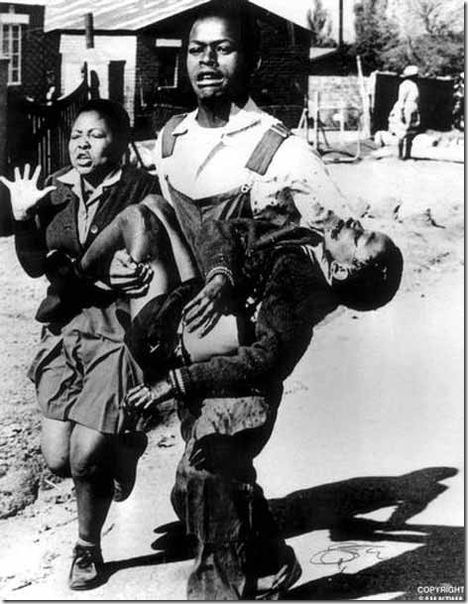
    Hector Pieterson and Mbuyisa Makhubo

    On 16 June 1976, thousands of black South African students staged a protest and walked from their schools to Orlando Stadium in Soweto.  They were protesting against the Afrikaans Medium Decree of 1974 which forced tuition to be given in a 50/50 split between English and Afrikaans in schools.  Not only was Afrikaans the language of their oppressors, it was also a language that many black South Africans did not understand as they primarily spoke one of the black African languages such as Zulu, Northern or Southern Sotho or Xhosa.  Part of the Apartheid policy was to allocate fewer resources to black schools as well and to make them purchase their own textbooks and exercise books whereas these were freely distributed in white schools.  The effects of teaching in Afrikaans in already disadvantaged and inferior schools was devastating.

    On the morning of 16 June 1976, protesting children found that their route to the stadium was blocked by a police barricade.  There are conflicting reports as to how the first shot was fired and whether it was provoked.  Some say that the children began throwing stones, other simply say that the policemen got spooked.  Once that first shot had been fired though, children ran screaming in different directions, terrified and panicked.  More shots were fired and by the end of the day, 23 people were dead (two of them were white people).

    Soweto uprising - Hector Pieterson Hector Pieterson is the little boy being carried in the photograph above.  He was one of the first children to be killed that day.  Perhaps even more heartbreaking is that the boy carrying him was 18-year-old Mbuyisa Makhubo.  He was harassed so much by the police that he went into hiding after the event and his mother has not heard from him since 1978.   I imagine he is but one of the thousands of victims that “disappeared” in the Apartheid years.

    The resulting violence after the shootings that day became known as The Soweto Uprising or Soweto Riots.  Between 200 and 600 people died in the violence and thousands were injured.  June 16 is commemorated each year as Youth Day and services and events are held across South Africa to honour their youth and to remember all that was lost during the Apartheid struggle.

    Images © Sam Nzima

    SHARE:

    Tuesday, 27 April 2010

    This Day In History: 27 April 1994

    This is the article I posted for Freedom Day last year. I was going to do a brand new one and then realised that this basically says it all. I am still so proud of South Africa.

    27 April is Freedom Day in South Africa and it is a public holiday held to commemorate 27 April 1994 when the first democratic general election was held in the country. This election marked the end of Apartheid where the National Party government was replaced by the government of the African National Congress and Nelson Mandela became president.

    It was the first ever election in South Africa in which there was universal suffrage which means that all adult South Africans, regardless of race or gender, were allowed to vote.

    election
    Photo: AP

    Apartheid
    Most people today have heard about Apartheid but I wonder if everyone knows what it was like? Apartheid officially began in 1948 but certain laws dated to before that time and were vital parts of Apartheid legislation. The 1913 Native's Land Act prevented non-white people from owning land. Not only could they never own the land they lived on, they could be forcibly removed from any land that was deemed attractive for white settlement (see District 6). This law was enhanced in 1950 by the Group Areas Act which assigned different racial groups to different residential and business areas in urban areas. Hence, blacks, whites, coloureds and Indians in South Africa could not live together, could not own businesses in the same areas and only whites could own land.

    The second piece of important pre-Apartheid legislation was released under the Jan Smuts government. It was called the Native Urban Areas Act of 1923 and it deemed urban areas to be "white" areas and all black adult men had to carry passes at all times if they were in cities or urban areas. A statue of the lovely Jan Smuts now stands in parliament Square in London and he looks out over the square to where Nelson Mandela's statue now also stands. This law was also enhanced by the 1952 Pass Laws Act which made it compulsory for all blacks South Africans over the age of 16 to carry a pass book at all times. The book would stipulate where, when and for how long a person could remain in a specific urban area and it greatly restricted where black people could move or visit.

    The final bit of despicable legislation I will talk about today was the 1949 Prohibition of Mixed Marriages Act which prohibited interracial marriage in South Africa and the 1950 Immorality Act which prohibited all sexual relations between whites and non-whites. These laws were repealed by PJ Botha in 1985 but up to that time, people could be arrested and prosecuted if they were caught having sexual relations with a person of another race and black people often got stronger sentences than white people.

    The Beginning of the End
    In the early 1980's, international economic sanctions had begun to take their toll on Apartheid and that was the beginning of the end. Little by little President PJ Botha began to repeal laws and offer greater freedoms to the Indian population and to blacks and coloureds too. The separate and completely unequal policies and privileges offered to the different population groups under PJ Botha are quite complex and the topic of another post, but in 1989 PJ Botha had a stroke and FW de Klerk became president. He began a process of reform which culminated in the unbanning of the South African Communist Party and the African National Congress on 2 February 1990 and the release of Mandela on 11 February 1990.

    A national referendum was held on 17 March 1992 in which white people voted whether they wanted to continue the process of reform started by FW de Klerk two years earlier. We knew what the stakes were and the basic question was really, "will this be the last whites-only election before universal suffrage is awarded and national elections are held"? 2.8 million people voted and the result was 68.73% "Yes".

    The Road to the Elections
    The next two years were emotional and tumultuous for our emerging rainbow nation. There was so much intimidation and violence going on around the elections that people were advised never to divulge who they were voting for. It was our right to keep our vote private. Many of the young, black females that I worked with were too scared to vote, even though we offered to drive them to the election stations and hide them in our cars. This was worrying - we needed every single vote. I still won't divulge who I voted for or what my preference was, but the important thing was to vote!

    The Day
    As the photo above shows, South Africans stood for hours and hours in queues that day to vote. I myself stood for four hours in a queue that ran the whole way around the northern Johannesburg suburb of Craighall. I got to the front of the queue and stood for several minutes in the booth. My hand was shaking so much that I was scared to try to write in case I spoiled my ballot. I cast my "x" on the regional and national papers, posted my ballots in the box and burst out crying. I was so overwhelmed and so acutely aware of the importance of what had come to pass that day. I was one of the 19,533,498 people who changed the course of world history that day.

    The rest, as they say, is history. The ANC won 62.65% of the vote and Nelson Mandela became the first president of the New South Africa. At some stage I hope to elaborate on what it was like to live in Apartheid South Africa.

    SHARE:

    Thursday, 8 April 2010

    Julius Malema Lashes Out At BBC Journalist

    This man really, really scares me in a way I can barely explain.  I believe that he is inciting racial tension, hatred and violence and agree with the Democratic Alliance that he is South Africa’s Mugabe. 

    Just this weekend he was in Zimbabwe and stated that the South African government would soon start reclaiming white-owned farms.  That went swimmingly well in Zimbabwe with state-of-the-art agricultural equipment being left to rust while crops failed and citizens starved.  He continued to sing his hateful song “Kill The Boer” in Zimbabwe over the weekend.

    This Guardian article is quite good and provides a partial transcript of the tirade above:  ANC's Julius Malema lashes out at 'misbehaving' BBC journalist. 

    Malema then erupted, asking for a security guard to eject Fisher and telling him: "If you're not going to behave, you're [sic] going to call security to take you out. This is not a newsroom, this is a revolutionary house and you don't come here with that tendency.

    "Don't come here with that white tendency. Not here. You can do it somewhere else. Not here. If you've got a tendency of undermining blacks, even where you work, you are in the wrong place. Here you are in the wrong place."

    Fisher responded: "That's rubbish. That's absolute rubbish."

    Malema continued: "You can go out. Rubbish is what you have covered in that trouser. That is rubbish. You are a small boy, you can't do anything."

    Collecting his dictaphone and walking out, Fisher said: "I didn't come here to be insulted."

    Malema bellowed after him: "Go out. Go out. Bastard! Go out. You bloody agent!" - guardian.co.uk

    I will tell you why I care about this and what it means to me.  As divorced as I am from South African because of living in the UK, I feel as if I am watching a massacre or disaster in the making.  I believe that Julius Malema is breeding hatred, fear and intolerance in South Africa and I believe that more South Africans, of all colours, are going to die because of it. 

    Life is cheap in South Africa.  South Africa has all the crimes and problems we have in “First World” countries but in South Africa, those crimes often turn lethal because the perpetrators are armed and they do not see their victims as human beings.  Yes, crimes are often committed along racial lines but it is the dehumanisation process that is the most problematic. 

    The crime situation was already hurtling out of control in South Africa and I believe that this man, this one man, is doing so much harm and that he is making it harder for South Africans to reconcile and come together as one nation.

    SHARE:

    Saturday, 3 April 2010

    Eugène Terre'Blanche murdered

    Eugene Terreblanche murdered

    Link: Eugene Terre'blanche murdered [News 24]

    One of the most hated men in South Africa has been murdered on his farm in Ventersdorp this evening.  Eugène Terre'Blanche founded the Afrikaner Weerstandsbeweging, a far right wing, paramilitary organisation in 1973.  Known as the AWB, the name means the ‘Afrikaner Resistance Movement’ but they are known in South Africa as racists and white supremacists.  The AWB has long since rallied for a separate state for white, Afrikaans Boers (farmers) and in fact, there is a town called Orania which is their attempt at a self-governing homeland.

    I find this murder extremely problematic in light of the events of the past couple of weeks*.  The hyper-summarised version of events is that the leader of the African National Congress Youth League (the youth league of the ruling party) is a man called Julius Malema.  He is extremely controversial and a convicted hate mongerer.  In March 2010, Julius Malema sang a variation of the hateful and extremely offensive song “Kill The Boer” at a rally at a university campus. 

    ANCYL president Julius Malema addressing the delegates during the conference held in Nasrec, Johannesburg. 29/06/08 Photo:Oupa Nkosi

    It is important to note that the ANC is the ruling party of South Africa but lines had never been drawn strictly according to colour or race.  Yes, the ANC furthered the cause of black liberation and consciousness in the Apartheid years but as the ruling party of South Africa, the ANC is to promote the interests of all citizens regardless of age, gender, colour, race or creed. 

    The fact that Julius Malema is singing such a song, a song that had previously been defined as hate speech by the South African Human Rights Commission, is beyond wrong.  The debacle that followed is even more wrong.  From Wikipedia: 

    “The Southern Gauteng High Court ruled on 26 March 2010 that Malema's song (which he had continued singing at public gatherings) was "unconstitutional and unlawful", and that any person singing it could face charges of incitement to murder, stating that the song called for the killing of the "farmer/white man", however, the ANC defended the song. 

    The ANC announced it would appeal the ruling. The Northern Gauteng High Court, on 1 April 2010 then granted an interdict preventing Malema from uttering the words "shoot the boer", or from "uttering any song of a similar nature which incites violence" until the matter was heard by the Equality Court, to which the case was referred by the presiding judge” - Wikipedia

    Some South Africans say that Malema has gone too far now and will begin to naturally lose supporters.  In other words, give him enough rope and he’ll hang himself.  I disagree.  In Rwanda, media outlets and radio stations called to people to “eliminate the cockroaches”; this man is calling on people to kill white South Africans, specifically farmers.  I categorically disagree with claims that the current crime wave in South Africa constitutes a genocide but I believe that this is a clear and unambiguous call to do just that.

    So.  Back to the murder of the leader of the far-right wing AWB movement Eugène Terre'Blanche.  Initial police reports state that it is not politically motivated and that Terre’Blanche simply got into an argument with two farm labourers aged 16 and 21 who have already been arrested.  Unfortunately, I don’t think it is all as easy as that.  I think this is extremely bad timing.  At worst, it is a politically and racially motivated murder.  If not, it is still another farm murder and too many farmers have been killed on their farms.

    Incidentally, the incident coincides with Julius Malema’s arrival in Harare, where he was given a heroes welcome by a Zanu-PF crowd singing “Kill The Boer” (see: Zanu-PF sings Malema song). 

    Cry, The Beloved Country indeed.

    *Admittedly, I have been trying my best to ignore those events as it can be difficult to follow homeland politics when you are an expat and living 5000 miles away.  In short, I find them too distressing to cover usually.

    SHARE:

    Wednesday, 24 March 2010

    Combating Human Trafficking and Illegal Immigration Africa Summit 2010

    Combating Human Trafficking

    There is a three day summit taking place in Johannesburg, South Africa this week on Combating Human Trafficking and Illegal Immigration. 

    The objectives of the summit are to:

    • Brainstorm on effective strategies, proactive and pragmatic approaches
    • To reduce and prevent human trafficking
    • To raise awareness on the harmful effects of human trafficking
    • Provide an opportunity to share information, ideas and experiences on best practices to combat and monitor human trafficking more especially with Africa now hosting World cup Soccer in 2010
    • To expose the antics of human traffickers and address the issues of victim support services
    • To sensitize the government on the need to devote sufficient resources and the political will to combat human trafficking

    Debbie Beadle from ECPAT UK has gone down this week to speak at the conference. 

    The topics for discussion are as follows:

    Wednesday 24 March 2010

    • Keynote Address: International Policy Priorities to Combat Human Trafficking;
    • Human Trafficking in Member Regions: Developing Integrated Action;
    • Harmonising means of combating illegal immigration and illegal employment and improving the relevant means of control;
    • The Human Trafficking Experience in the Great Lakes Region of East Africa;
    • Comparative Case Study: Regional vs. National Approach towards Human Trafficking in Africa

    Thursday 25 March 2010

    • Keynote Address: Protecting Victims of Human Trafficking: Raising Awareness of International and Cross-Border Issues;
    • Communicating Human Trafficking: From understanding to action;
    • Child Trafficking: Impacts and Safeguarding children trafficked to Europe;
    • Monitoring the implementation of instruments adopted by the Council concerning illegal immigration, readmission, the unlawful employment of the
      third-country nationals and cooperation in the implementation of expulsion orders;
    • The threat represented by the Soccer World Cup to Women and Children in South Africa;
    • Evaluation of anti-trafficking and victim rehabilitation programmes;
    • Panel Discussion: Discussion on the Economic Recession and its impact on illegal immigration

    Friday 26 March 2010

    Workshop: Human Trafficking: Enhancing Multi-Stakeholder Partnerships and International Cooperation


    I would love to go to one of these summits one day.  I guess I need to keep an eye open for when they are taking place in London.

    SHARE:
    © A Passion to Understand

    This site uses cookies from Google to deliver its services - Click here for information.

    Blogger Template Created by pipdig