Saturday, 19 August 2023

Graphic Novel Review: The Photographer of Mauthausen by Salva Rubio, Pedro J Colombo & Aintzane Landa ★★★★★

Most online accounts of Ernst Kaltenbrunner and Albert Speer mention that they were convicted at the Nuremberg trials but few accounts mention the testimony and evidence provided by Francisco Boix that enabled those convictions. Nor do they mention the bravery and sacrifices of the people involved in preserving and delivering that evidence to the outside world.

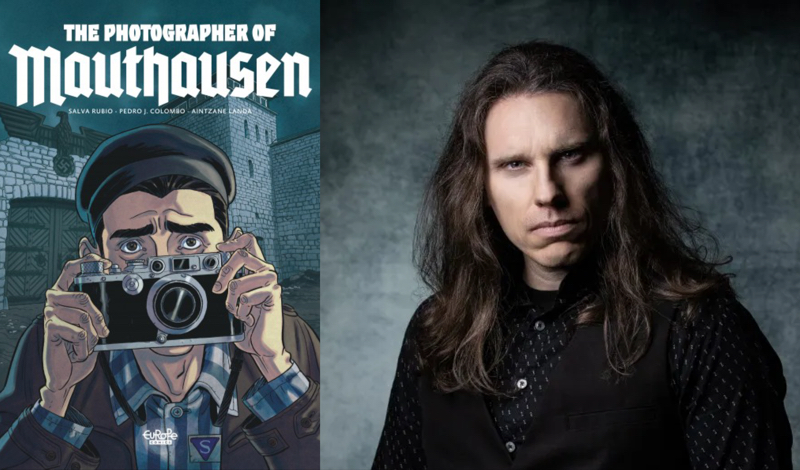
Graphic Novel Review | The Photographer of Mauthausen | cover and author photograph

The Photographer of Mauthausen by Salva Rubio (writer), Pedro J Colombo (illustrator) and Aintzane Landa (colourist) tells the story of Boix, a Spanish photographer and veteran of the Spanish Civil War. Following his part in the civil war, Boix was exiled to France and joined the French army before being captured by the Germans. The Photographer of Mauthausen starts with Boix's arrival at Mauthausen in 1941.

Boix starts off his internment as a translator but soon finds a position in the photography lab. Somehow, inexplicably, SS-Hauptscharführer Paul Ricken takes a liking to to Boix and recruits him as assistant to his macabre photography project. In this role, Boix is exposed to the many atrocities being committed at Mauthausen (in addition to the ones he had already witnessed).

Boix realises initially that this evidence needs to be preserved and several prisoners get involved in making this happen. However, as news reaches camp of an impending Russian victory, Boix realises that he needs to get proof of the atrocities to people on the outside of the camp.

Boix was successful and both his testimony and the photographic evidence proved that Nazis such as Kaltenbrunner and Speer were not only aware of what was happening at Mauthausen but they were complicit in the atrocities too.

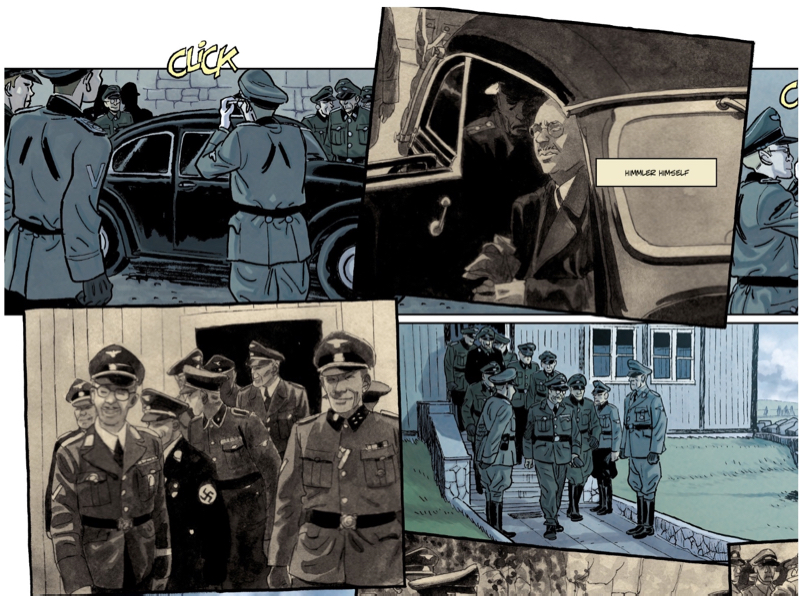
The value of The Photographer of Mauthausen is in the questions that it raises about justice and remembrance. At the time of the Nuremberg trials, the photos were used to obtain convictions but Boix expresses frustration on page in the graphic novel about why people weren't more concerned about what happened at Mauthausen and the atrocities committed.

Graphic Novel Review | The Photographer of Mauthausen | Page from graphic novel depicting the photographer capturing various Nazi officers

The Photographer of Mauthausen is an excellent graphic novel that tells, in an accessible format, an important story in the annals of Holocaust history while serving as an educational source on both Nazi atrocities and the trials following the war.

I give The Photographer of Mauthausen a superb five out of five stars. The graphic novel is extremely well illustrated and written and recommended for those interested in history, graphic novels and the Holocaust.

★★★★★

SHARE:

Friday, 28 May 2021

'Letters from Diaspora' by Arnesa Buljusmic-Kustura | Book Review

Letters from Diaspora by Arnesa Buljusmic-Kustura | Book Review

If you've ever contemplated how people 'get over' war and genocide, Arnesa Buljušmić-Kustura has the answer in her debut novel Letters from Diaspora: Stories of War and its Aftermath: they don't. The war follows them everywhere, their trauma never leaves them and it simply gets quieter.

Letters from Diaspora: Stories of War and its Aftermath reads like an oral history and it's written in a very similar voice to that used by Svetlana Alexievitch. Alexievitch's Voices From Chernobyl was one of the best non-fiction books I've ever read and I very much enjoyed both the style and content of the book, however grim.

Letters from Diaspora is not a book that is enjoyed. It's fiction, short at 98 pages and is twelve stories about twelve survivors of war and genocide in Bosnia. All of the subjects are living in the diaspora and speak about rage, loss, grief and being told to move on.

There is no moving on.

I finished Letters from Diaspora in one sitting; not surprising perhaps, given the length. It's an incredibly difficult subject matter to read but is a necessary and beautifully written book. I'd highly recommend this book, especially to teens. The short, accessible stories would be an ideal starting point for exploration and discussion.

SHARE:

Saturday, 30 January 2021

Unspeakable: The Tulsa Race Massacre by Carole Boston Weatherford and Floyd Cooper | Book Review

Greenwood District, Tulsa, Oklahoma was once home to a thriving African American community. On May 31st and June 1st 1921, a mob of armed white Tulsans attacked the community, killing as many as 300 African Americans and displacing 8,000 more. 2021 will mark the 100th anniversary of what became known as the Tulsa Race Massacre, the history of which was suppressed for seventy-five years.

Unspeakable The Tulsa Race Massacre by Carole Boston Weatherford and Floyd Cooper | Book Review

Unspeakable: The Tulsa Race Massacre is a picture book by author Carole Boston Weatherford and illustrator Floyd Cooper. It's short at 32 pages but aims to help young readers understand these terrible events so that "we can move toward a better future for all". It's aimed at the 8-12 years age group.

Reading Unspeakable: The Tulsa Race Massacre was physically painful. In the beginning, the book describes the thriving community of Greenwood District and the high street that became known as the "Black Wall Street". The descriptions of culture, fashion and community reminded me so much of what I've read about Sophiatown and District Six in South Africa, communities with vibrant cultures that were similarly razed to the ground.

Weatherford has done a fine job of simplifying the events for young readers, but presenting sufficient detail to draw older readers into healthy debate and discussion. It would be a good platform to stimulate further research and self-study too. The author's and illustrator's notes were particularly interesting, detailing their personal reasons for being involved in this work. Of particular note is the author's comment that the event was not even taught in Oklahoma schools until the twenty-first century.

Unspeakable The Tulsa Race Massacre by Carole Boston Weatherford and Floyd Cooper | Book Review

The illustrations by Floyd Cooper are exquisite, showcasing the fashions and vibrancy of Greenwood District, and ultimately the violence and devastation. The illustrations do a great job of bringing the events and people to life, ensuring that the reader relates to them and to the injustice of the events.

Unspeakable: The Tulsa Race Massacre is published by Carolrhoda Books, an imprint of Lerner Publishing Group

I would wholeheartedly recommend this book and am pleased to note that it's being released in both the US and UK (and presumably around the world).

An advance, electronic copy of this book was provided by Netgalley for the purposes of this review.

SHARE:

Sunday, 4 October 2020

Book Review: West of Jim Crow: The Fight Against California's Color Line by Lynn Hudson ★★★★☆

I know very little about American civil rights history from the late 19th to early 20th century. This is not surprising; my focus has primarily been on Africa (especially South Africa) and on genocides in the 20th century. It has been interesting to learn that anti-miscegenation laws and job-colour bars weren't the invention of Apartheid South Africa but originated in North America. Specifically, a set of so-called Jim Crow laws emerged in America from about 1880 that sought to enforce racial segregation and these laws would be a highly influential on laws adopted by South Africa.

West of Jim Crow: The Fight Against California's Color Line by Lynn M. Hudson | Book Review

In West of Jim Crow: The Fight Against California's Color Line, Lynn M Hudson focuses on the African Americans who moved to California to escape Jim Crow, expecting freedom and the benefits of full citizenship but instead realising that Jim Crow and racial segregation were all too present in the west.

This is not simply a recounting of the racism, fear-mongering and obsession with eugenics that featured so prominently in white society for the century after the Reconstruction Era (although these are mentioned in some detail throughout the book). West of Jim Crow is about the tireless efforts of Black Americans to assert their citizen rights, establish respectability, secure equal opportunities and protect their men and women from the scourge of lynching and the rise of the KKK.

It is also notably about the role of Black women, their agency and the significant roles they took in journalism, activism and other roles to secure their rights both as women and as human beings. As Lynn M Hudson remarks on many occasions, just because there is little in the written records about Black women's struggles for freedom and activism, does not mean there wasn't significant agency and activism present.

West of Jim Crow is structured around six chapters, each concentrating on a specific event in Californian history:

  • Reconstruction: the initial gains and setbacks in the period following the Civil War, with the rise of Jim Crow and associated Jim Crow entertainments and minstrelsy
  • The Panama Pacific International Exposition: a look at the systematic erasure of civil rights gains, the emergence of the NAACP, the popularity of Birth of a Nation and the rise of eugenics
  • The Rise and Fall of Allensworth: the town founded by and for African Americans, doomed to fail because of misrepresentation, geographical and environmental issues
  • On Lynching: an account of the events that divided a country into those who supported lynching and those who were appalled by it; eerily prescient of Trump, tiki-torch marches and the gun lobby
  • On the Ku Klux Klan: fighting arson and intimidation while the KKK infiltrated law enforcement and local government in California
  • The Fight to Desegregate Pasadena's Municipal Swimming Pools: how activists began to use the damages of Jim Crow to argue for civil rights, winning the Pasadena pool case and later the Brown v Board of Education case

West of Jim Crow: The Fight Against California's Color Line by Lynn M. Hudson | Book ReviewWest of Jim Crow covers an incredible wealth of information and provides an interesting, readable account of African American history in California. Initially I felt a bit exhausted by the repetitive, circular mode of writing, featuring titbits and breadcrumbs followed by elaboration and exposition. I've noticed that this form of writing is favoured by many historians and while it can be taxing to read, the truth is it is preferable to a dry, linear account and also aids significantly in the reader's retention and comprehension of historical information.

Despite this small reservation, I give West of Jim Crow an excellent four out of five stars and highly recommend to those wishing to know about this particular area of Black history.

★★★★☆

West of Jim Crow: The Fight Against California's Color Line is available to purchase from Amazon.com and Amazon.co.uk (disclosure: affiliate links. I will earn a small amount if you purchase using these links, at no additional cost to you).

My thanks to University of Illinois Press and Netgalley for advance, electronic copy of this book.

SHARE:

Sunday, 1 January 2017

Book Review: Islam and Democracy After the Arab Spring by John Esposito, Tamara Sonn & John Voll

Islam and Democracy - John Esposito

In the aftermath of the Arab Spring and the descent into war in Syria, one question that arises time and again is this: is Islam compatible with democracy? It is a question that John Esposito, Tamara Sonn and John Voll promise to answer in their book Islam and Democracy After the Arab Spring. 

It is difficult to review a book and to rate it when it clearly doesn't do what it promises to do on the cover and while this book has a lot to do with Islam and democracy, it has little to do with the Arab Spring (with the exception of the final two chapters). One of the questions that most interests me is the events leading up to the Arab Spring, some of which I attempted to explore in the series Before the Spring. 

Events such as the Iraq war and the Second Intifada were pivotal in the development of a shared Arab consciousness that transcended national borders as was the rise of Al Jazeera and social media. 

In focusing on countries such as Pakistan, Turkey, Iran and Senegal, I was hoping that Islam and Democracy After the Arab Spring would continue in a similar vein - picking up those similarities and exploring whether those countries were also ripe for a Spring-like uprising. Or at least exploring similar factors in the various countries that so emboldened the Arab Spring protestors to take action and topple governments. 

Islam and Democracy After the Arab SpringIt doesn't quite manage that but what this book does do is take an in-depth look at the rise of Islamic governments in seven countries and how issues such as equality, democratic participation and the economy were shaped by world events and the relationship of each country to outside forces. 

The book includes a fascinating profile of Iran and the lasting impacts of US interference, such as in the 1953 coup. Likewise, the chapter on Turkey provides an insight into current political events and gives some background to Erdogan's political motives. 

As a series of essays on the rise of Islamic governments, it would have been more accurate had the book been titled A Political History of Islam in the 20th Century. Judging it on that basis, it's quite interesting and the difference in writing styles between the various authors keeps it so. 

As a resource further exploring the roots and enduring consequences of the Arab Spring, there are better volumes, such as Lin Noueihed and Alex Warren's The Battle for the Arab Spring.

SHARE:

Sunday, 18 December 2016

Book Review: Voices from Chernobyl by Svetlana Alexievitch

Voices from Chernobyl by Svetlana Alexievitch

I was 12 years old when the Chernobyl disaster happened and I remember being quite aware of the dangers of nuclear events - I'd learned about Hiroshima and Nagasaki and the enduring impact of the atomic bomb. Chernobyl was something else. It was a catastrophic and unprecedented disaster; we didn’t immediately know what the lasting effect would be but we knew that they were in trouble.

It was little surprise then when the years passed and we learned that Pripyat and surrounding areas had become ghost towns, areas that would be unfit for human habitation for another 10,000 years (or so estimates go).

But people do live there. They cut through fences and snuck past military patrols to resettle in their homes or to make new homes, surrounded only by the ghosts of the tens of thousands of people that once lived in those towns and the ever-present spectre of radiation.

Svetlana Alexievitch, Belarusian investigative journalist and winner of the Nobel Prize in Literature in 2015, spoke to those people and indeed, to people from all walks of life who were effected by Chernobyl. She spoke to widows and survivors, liquidators, contractors and military reservists who were called to Chernobyl in the days after the disaster. She spoke to families who had been evacuated from Pripyat and surrounding areas, to those who returned and to those who fled the war in Tajikistan to settle there because they had nowhere else to go.

Voices from Chernobyl: The Oral History of a Nuclear Disaster reads like a dystopian novel, or perhaps a post-apocalyptic survival story. First published in Russian in 1997 and expertly translated by Keith Gessen, Voices from Chernobyl is the fruit of hundreds of interviews that Alexievitch obtained over a three year period. It is an incredible and page-turning volume with accounts as fascinating as they are obscene.

It’s difficult to put into words how much of an impact this book has on the reader and any attempt will be nowhere near as eloquent as the accounts themselves. The lack of understanding of the dangers that people faced, coupled with a massive campaign of disinformation is perhaps most notable. In the aftermath of Chernobyl, they sent cranes from East Germany and robots intended for the Russian Mars exploration. Even robots from Japan made it to the site but the radiation interfered with all their workings and so they resorted to sending human beings in rubber suits instead.

There were 340,000 personnel despatched to Chernobyl but those working on the roof of the reactor got it the worst. They were wearing lead vests but the radiation came through their boots.

Voices from Chernobyl - Svetlana AlexievitchDespite the massive loss of life and how many disaster personnel succumbed to radiation poisoning or ‘Chernobyl cancer’ that took years to emerge and yet more years to eventually kill them, many of the interviewees displayed a nostalgia for the Soviet era and for the heroism of a bygone era. Time after time, interviewees would explain that they did not know the danger but they would have responded in the same way even if they had. It was their duty and they would have fulfilled it.

And then, throughout the book is the ever-present reminder that the Chernobyl disaster happened to a population less than 50 years after the Second World War.

Gulag, Auschwitz, Chernobyl. One generation saw it all.

What impressed me the most is that many of these people survived the Leningrad blockade only to suffer devastation again in Chernobyl. They spoke of the terrible winters during the blockade where people froze to death on the streets and one man mentioned, perhaps in jest, burning his belt so that the smell could stay his hunger.

Voices of Chernobyl is a study in the various shades of trauma. Some interviewees expressed that they couldn’t talk about the blockade, it was too traumatic, but Chernobyl they could talk about. Despite the catastrophic loss of life and livelihood, the events of Chernobyl still felt less traumatic to many of them than the blockade.

I cannot recommend Voices from Chernobyl enough and was so impressed that I have ordered Alexievitch’s latest book Secondhand Time: The Last of the Soviets which was shortlisted for the 2016 Bailie Gifford prize for non-fiction.

SHARE:

Sunday, 11 December 2016

Book Review: The Chibok Girls by Helon Habila

Helon Habila author of Chibok Girls

On the evening of 14-15 April 2014, Boko Haram militants kidnapped 276 female students from the Government Secondary School in Chibok, Borno State, Nigeria. The girls became known the world over as the 'Chibok Girls' yet surprisingly little is known about who they are, what their families are going through or the context in which this crime occurred. To date, in December 2016, almost 200 of the original abductees remains missing and the little that we do know is that their lives with Boko Haram are ones of untold horror, violence and sexual slavery.

Helon Habila is a Nigerian born author and professor of creative writing at George Mason University, Washington, D.C. In early 2016, he returned to Nigeria to take a road trip to Maiduguri and Chibok to speak to people not only about the events on that fateful evening in 2014, but about the long wait for the girls to return home and the present climate of war and strife in the region.

The Chibok Girls by Helon Habila - coverHabila has produced a chronicle of his time in Nigeria in the short but incredibly insightful The Chibok Girls: The Boko Haram Kidnappings and Islamist Militancy in Nigeria.

The book begins with accounts of the events of 14 April 2014 from parents and relatives of the girls who were taken and those that escaped. The residents of Chibok had received warnings that the town would be targeted that day and they had every reason to believe it. Massacres, assassinations and terrorist attacks have become ever more prevalent in what locals have begun to call the war with Boko Haram.

Just 9 months before the abduction of the girls from Chibok, Boko Haram militants entered a secondary school in Mamudo, Yobe State and killed 42 people, most of them students.

After spending time in Chibok, Habila moves on to Maiduguri and the heart of Boko Haram territory. He speaks of the effects of the civil war and how a divide was created between Christians and Muslims as successive governments misused state resources, culminating in the declaration of Sharia law in the area in 1999. Perhaps most chilling is the description of the rise of Boko Haram from a modest force to one to be reckoned with following the Boko Haram uprising in June / July 2009.

Moving back to Chibok, Habila collects yet more first-hand accounts of the fears and devastation of a community who have lost their daughters, sisters and friends.

Woven throughout the book is the story of the girls and the accounts of those who have escaped. Perhaps to be expected with the youth of the girls and the horrors that they experienced, there is very little in the book about their time with Boko Haram. Indeed, with so few escapees (and being that the book was in production at the time 21 girls were released in October 2016), we are but depending on the narratives of a handful of very traumatised girls.

Confronted with their reticence in the face on ongoing questions about their experiences, Habila notes the following:

Hauwa, Ladi, and Juliana were ordinary girls, young enough to be my daughter, who had been raised to almost mythic status by their extraordinary experience – Helon Habila, The Chibok Girls

Insightful, powerful and intimate, The Chibok Girls: The Boko Haram Kidnappings and Islamist Militancy in Nigeria is highly recommended for those interested in gaining a more in-depth perspective of the lives and people effected by Boko Haram activities.

The book is out in the States and will be released in the UK on 15 December 2016.

SHARE:

Tuesday, 29 December 2015

Review: My War Gone By, I Miss It So by Anthony Loyd (2015 edition)

Sarajevo


During the war in Bosnia and Herzegovina in the 1990s, most press correspondents huddled in the safety of the distinctive yellow Holiday Inn in Sarajevo, sending out second-hand dispatches to news outlets back home. Anthony Loyd was never going to do that. In his memoir My War Gone By, I Miss It So Loyd travelled across Bosnia and Herzegovnia during the war of 1992-1995 and spent time in Grozny at the height of the First Chechen War. Now, to mark the 20th anniversary of the signing of the Dayton Agreement, a new edition of Loyd’s memoir has been released with an updated foreword.

The prologue of My War Gone By, I Miss It So begins at the end of the Bosnian war, in the hills near Srebrenica. Withdrawing from drugs and newly clean, Loyd stumbles through a landscape peppered with corpses, witness to the aftermath of the Srebrenica genocide. It is an interesting place to begin, at the very end of the war, but by the end of the memoir we will see that this was not the most disturbing thing that Loyd saw in his time there. Moreover, by the end of the war, we will see that Loyd has come full circle in his life.

Armed with just a camera and pen, Loyd travelled over to Bosnia during the war after a stint in the military. Landing first in Sarajevo, he befriended a local family and spent his days dodging sniper bullets and trying to overcome the relentless boredom of war. Eager to see the frontlines, Loyd later travelled to various towns and villages in central and northern Bosnia where he met up with other members of the press corps and began to eke out a living as a war correspondent.

Loyd’s writing is brutally honest and in many passages he describes scenes and photographs that many of us would look away from or avoid. That is not to say that I don’t want to know, I really do, but at times his descriptions were so intimate and graphic that I felt somehow wrong reading the passages, as if I had somehow violated someone’s privacy. Such is the power of Loyd’s writing.

At many times in the memoir, Loyd mentions his eagerness to support the Bosniak cause on a moral level, to view them as the underdogs, but even this explicit bias is tested from time to time by the atrocities he sees. The saying goes that all is fair in love and war but that is utter rubbish, and what Loyd witnesses proves that all is twisted and futile in war instead.

It was the scenes in Grozny that were perhaps the most shocking. I’ve read a fair amount about the wars in the former Yugoslavia and felt somehow familiar with the subject matter when Loyd described his time in Bosnia and Herzegovnia. The chapter on the conflict on the ground in Grozny was disturbing to say the least. Loyd travels to the Chechen capital days before the fall of Grozny in February 1995 and what he witnesses is the utter meaningless and futility of war. It is especially moving in light of the way that history ultimately played out for the Chechens.

Again, my view of events in Bosnia might be influenced by all that I have read about the war and history of the region in the past but the only aspect of Loyd’s memoir that concerned me was his tendency to takes sides in the conflict. It is true that history and the subsequent trials have pretty much confirmed what he wrote almost 20 years ago but throughout the memoir I couldn’t shake the feeling that it would have been preferable if he had maintained a slightly more objective position.

In the foreword to the new edition, Loyd remarks how young and angry he was at the time of writing. It is interesting because while I might fault his objectivity, I never would have faulted his perspective which was infinitely more nuanced than anything I would have written back in the mid-90s when I was roughly the same age as him.

Nevertheless, I was riveted by the book from cover to cover and would highly recommend it to those interested in accounts of war or in the conflict in Bosnia and Herzegovina in particular. Like the timeless photographs to which Loyd refers in his memoir, his book provides a unique glimpse into one of the most disturbing conflicts of the 20th century.

SHARE:

Saturday, 10 October 2015

Malala Retells Her Story in New Teen Edition

I Am Malala - Teen

It was a story that resonated around the world. In October 2012, 15-year-old Pakistani blogger and activist Malala Yousafzai was targeted for assassination by the Taliban for her work in re-opening local schools for girls. She was flown to Birmingham, England for treatment and on recovery, went on to work tirelessly for the rights of women and girls. She worked with Christina Lamb on her memoir I Am Malala: The Story of the Girl Who Stood Up for Education and was Shot by the Taliban, notable for its rich insight into the Taliban and Pakistani treatment of women and girls. In 2014, Malala was joint recipient of the Nobel Peace Prize for her work in defending the right of all children to an education.

What people often forget is that Malala is still just a teenager and now she has retold her story for her peers. I Am Malala: The Girl Who Stood Up for Education and Changed the World begins with those fateful words:

After 15 January, no girl, whether big or little, shall go to school. Otherwise, you know what we can do. And the parents and the school principal will be responsible. 

I Am Malala (Teen Edition)Working with National Book Award finalist Patricia McCormick, Malala takes us from the very first Taliban announcement regarding girls’ schooling, through to her activism, assassination attempt and recovery in the United Kingdom. Targeted at young people Malala’s own age, this retelling is less rich in detail and background but gives the reader more insight into the events as they unfolded, from the public’s initial disbelief at the Taliban’s pronouncement to the dawning realisation of their deadly intentions.

Malala talks about girls being banned from school, of seeing explosions, fear and repression in her homeland and she speaks about it in a format that will be more easily accessible by middle-graders and early teens. We learn that Malala is a teen just like any other. She loves cricket and gossiping with her friends. On the day of the shooting, Malala notes how normal everything seemed.

I was late, as usual, because I’d slept in, as usual. I’d stayed up extra late after talking to Moniba, studying for my year-end exam in Pakistani studies.

The last thing Malala remembered that was was thinking about her exams then darkness.

I Am Malala: The Girl Who Stood Up for Education and Changed the World is available to buy on paperback in the UK from Amazon.co.uk from October 2015. The book is currently available on hardcover in the US but will be released in paperback on Amazon.com in March 2016. i would highly recommend this edition to younger readers who might have found the initial memoir too advanced to read.

SHARE:

Saturday, 4 July 2015

A discussion with Stephanie Hepburn, author of Conversation With My Daughter About Human Trafficking

The reality of human trafficking is often so horrific that it remains one of the most difficult subjects to discuss with children.  How does one get into a conversation with children about how individuals are tricked, extorted and enslaved without exposing them to ideas that may be too mature for them, such as sexual exploitation, rape and the murder of their loved ones? How do we impress upon them that this is not just something that is happening in a far away country but something that is happening in our own city?

ConversationwithdaughterThese are questions that Stephanie Hepburn was confronted with. After a decade of working in the realm of human trafficking and releasing the book Human Trafficking Around the World: Hidden in Plain Sight, Stephanie had a conversation with her daughter about human trafficking and realised that other parents would no doubt have this conversation too.

In Conversation With My Daughter About Human Trafficking, beautifully illustrated by James Guthman, Stephanie takes us through some of the questions that her daughter asked and the answers that she gave. The book is an excellent starting point for discussions on this difficult topic and will be of great use in classrooms and homes to get children talking and thinking about human trafficking and how they can identify, understand and prevent this phenomenon in their own environments.

We caught up with Stephanie to discuss the book and her experience in the field of human trafficking.

How did you become interested in human trafficking?

The impetus was my move to New Orleans in February 2006, not long after Hurricane Katrina devastated the city and Gulf Coast region. The infrastructure was destroyed and there was a sudden demand for low cost labor, which allowed opportunity for unscrupulous people to step in. This was compounded by the decrease in law enforcement in the city and also federal under-enforcement of temporary work visas. 

I saw red flags of exploitation and human trafficking all over the city and it made me realize that it can happen anywhere, not just somewhere far away. I began digging deeper and adding more nations as I went along. I ended up compiling my findings in Human Trafficking Around the World: Hidden in Plain Sight, which was published by Columbia University Press in 2013. 

How did the idea for your book Conversation With My Daughter About Human Trafficking evolve?

After pulling my head out of the research world and talking to people about my book, I was able to learn what everyday people think about the issue of human trafficking. Adults are often wary of looking uninformed so these conversations, while useful, often seemed indirect. Eventually, I would figure out the piece (or pieces) of the puzzle they were missing and I could address it, but it took a while to get there. 

Children are the opposite. They are unabashed in their curiosity and they say what they think and aren't overly concerned about seeming informed, so misunderstandings and areas of confusion are easier to identify. Kids are also awesome little people who are our future, so figuring out how to talk to them is essential for the future of humanity. Getting them to understand what to look out for and what red flags to identify in traffickers and victims creates an entire generation of eyes and ears that are way ahead of where we are now. 

In your experience, which aspect of human trafficking is the most difficult for children to comprehend?

I think for my daughter the challenge is understanding why someone wouldn't just run away. Physical chains are something she can understand but the concept of psychological chains is more difficult. 

How do you envisage that the book should be used?

I hope that parents read it and, when they think it's right, share the topic with their children. It's a difficult topic and my objective was to create an easy how-to guide on how to talk about it. The language is written in a way that parents can read it to their children. The graphics were created for that reason as well. That way parents can use it in multiple ways, whether as a tool for ideas on how to approach the topic or as a book to read with their children. 

What feedback have you received so far?

The feedback has been overwhelming and positive. I have come to a point where preaching to the choir (advocates and others involved in the anti-trafficking realm) just isn't enough. Real impact will happen when your average person has a greater understanding on the topic. That said, reaching your audience is always the challenge. In this case it has worked and people are reading it and passing it along. I feel extremely happy about that. 

The book is beautifully illustrated by James Guthman. Can you tell us a little bit more about his illustrations and how you came to work with James?

A colleague recommended him and sent a few pictures of his paintings and illustrations. He's very versatile and was able to capture the look I wanted for the book. It was important to me that the book contains a universal feel to it since human trafficking happens everywhere. So often this issue is unintentionally represented as happening to people in only a few parts of the world, based on the visuals used in tandem when the issue is reported. As a result, we chose a color pallet that does not indicate a specific race or region of the world, and to create vignettes when people are depicted in the story. The color pallet also had to mirror the tone of the book without being too visually depressing. It's a hard subject, so striking the tonal balance was important, and he did a really great job with it. You can check him out on Instagram at www.instagram.com/jamesguthmanart

Are there plans to release the book in paperback or hardcover or will it remain an ebook?

For now it will just be an ebook. I don't know what the future holds. Paperback would be fantastic!

Together with Rita J. Simon, you've written another book about human trafficking Human Trafficking Around the World: Hidden in Plain Sight. Can you tell us a bit more about that?

I talked a bit about the impetus above. The book took exhaustive research and time. In many ways it was my education on how to get one-step closer to communicating with the mainstream population on this topic. It contains narratives, which I find essential because people relate to stories. It also contains meaty statistics, which help to create perspective on the prevalence of human trafficking. It really is a great book for those who have been introduced to the topic and want to know more. I would say it's step two in reading after Conversation With My Daughter About Human Trafficking. 

This was actually your second book with Rita, the first being Women's Roles and Statuses the World Over (Global Perspectives on Social Issues). That sounds really interesting. Can you tell us a bit about the issues you covered in that book?

This book was a turning point for me. I was in law school at the time and sick of my female peers having a negative knee-jerk reaction to the term feminism. Many of my friends would start off a conversation with "I'm not a feminist or anything but..." They worried they wouldn't be taken seriously if they were thought to be a feminist, which somehow has become synonymous with extremism. It isn't. It just means that the person believes women and men to be equal. That's it. Anyhow, I decided to write a paper, for one of my law school classes, that was just based on law and empirical data to illustrate where women actually stand in the U.S. My professor Rita J. Simon asked me if I wanted to turn it into a book. I did and I added on 25 other nations. It was eye-opening for me as I hope it was for readers. We have a long way to go. 

What are you up to next?

My objective to bring awareness on labor exploitation and human trafficking to the mainstream world triggered me to open Good Cloth, an online ethical clothing shop, this past October. During the media junket of Human Trafficking Around the World: Hidden in Plain Sight I quickly realized that people wanted to know how to purchase ethically and to ensure that no one was harmed in the process. They, in essence, wanted to vote with their dollars for ethical change and corporate responsibility. Fashion is an ideal arena for informing people about human exploitation and positive changes they can make. People don't like feeling helpless, which is easy to feel when you hear about the horrors of human trafficking. This is a way for people to make positive decisions in their day-to-day life that actually make an impact. It makes the customer feel great and does a great deal for starting the dialogue about corporate responsibility and spotlighting designers who are taking excellent measures to protect workers and the environment. 

Through the shop and my journalistic pursuits I will continue to try to reach the mainstream audience about this important topic. 

About Stephanie Hepburn

Stephanie HepburnStephanie Hepburn is an independent journalist whose work has been published in the Guardian, Huffington Post, Americas Quarterly and the journal Gender Issues. She is a weekly and monthly contributing writer for the New Orleans Times-Picayune. A graduate of the University of Michigan and the Washington College of Law at American University, she integrates her legal and journalism backgrounds to create pieces that are highly informative and have a human tone. Her book with Rita J. Simon, Women's Roles and Statuses the World Over, was named an Outstanding Academic Title by Choice. Her second book Human Trafficking Around The World: Hidden in Plain Sight was published by Columbia University Press in 2013.

Conversation With My Daughter About Human Trafficking is available on Amazon.co.uk and Amazon.com.

SHARE:

Sunday, 28 June 2015

Book Review: Letters to Palestine: Writers Respond to War and Occupation (edited by Vijay Prashad)

Letters to Palestine cover - Vijay Prashad - banner

Gaza, 2014. Following the kidnap and murder of three Israeli youths, the IDF embarked on a seven week campaign against Gaza. In that time, over 2,000 Gazans were killed, most of them civilians and most of them children, while tens of thousands were injured. Hospitals, schools and houses were demolished and half a million Gazans were displaced.

The Gazan conflict divided people like no other conflict. Across social media, timelines were filled with people trying to draw attention to the devastation and destruction in Gaza while pro-Zionists asked what else they could do in the face of continuing Hamas aggression. 

With access to Gaza notoriously controlled and restricted, there was limited reporting on the ground, scant consideration of everyday Palestinians who were living in a state of terror. 

Edited by Vijay Prashad and featuring a host of writers, poets, essayists and activists, Letters to Palestine: Writers Respond to War and Occupation attempts to give a human face to that struggle. 

Reading this collection with a desire to learn more about the conflict from a Palestinian point of view, one might expect little more than anti-Israeli propaganda and rhetoric. Letters to Palestine is nothing of the sort. It is an earnest collection of essays, poems and diary excerpts that seeks to understand both the conflict and history of Palestine. 

In his essay 'Bad Laws', Teju Cole talks about how what he terms 'cold violence' is exacted through a series of laws, by-laws and regulations that are all perfectly legal under Israeli law. Based as they are in restrictions on freedom and movement, he notes that these laws are in contravention with international standards and conventions. He mentions Sheikh Jarrah where Palestinians are slowly losing their permanent residency in East Jerusalem, where the right of return applies to Jews in East Jerusalem but not Palestinians. 

"The historical suffering of Jewish people is real, but is no less real than, and does not in any way justify, the present oppression of Palestinians by Israeli Jews" – Teju Cole, ‘Bad Laws’, Letters to Palestine

In an excerpt from her 'Travel Diary' Noura Erakat begins by describing her anger and anti-Israeli sentiment but over the course of her journey to Palestine begins to develop a more nuanced position. She brings up the subject of privileged Palestinians, those who have done very well out of occupation and observes that not all Palestinians are good-hearted, not all Israelis 'evil'. While capturing the atmosphere in Palestine during her visit, Erakat mentions the work of Zochrot, an Israeli non-profit organisation whose aim is to raise awareness of the Palestinian Nakba and of New Profit who work towards the demilitarisation of Israel. Spanning over eleven days in May 2013, the diaries give a unique snapshot of a moment in Palestinian time.

"Israeli settler colonialism, apartheid and occupation should not cease because Palestinians are good and Israelis are bad"- Noura Erakat, ‘Travel Diary’, Letters to Palestine

Nalja Said shares her 'Diary of a Gaza War, 2014' as a Palestinian living in America during the conflict. Intimate and painfully honest, Said's entries show her worry and despair for her loved ones in Gaza. 

"If you think that Palestinians all hate Jews and are rejoicing in the deaths of those three boys (Naftali Fraenkel, Gilad Shaer, Eyal Yifrah), then you are a racist. That's all I have to say. As my dad used to say, ‘No one has a monopoly on suffering’" – Nalja Said, 'Diary of a Gaza War, 2014', Letters to Palestine

"The boy who was killed was a cousin of my dear friends... You who are reading this are now two degrees from the murdered Palestinian - a child killed in revenge" – Nalja Said, 'Diary of a Gaza War, 2014', Letters to Palestine

In 'Below Zero: In Gaza Before the Latest War', Ben Ehrenreich reminds us of the appalling conditions of loss, devastation, poverty and wretchedness in Gaza even before the war. 

Interspersed throughout the collection is a series of heart-breaking, eye-opening poetry. Poems tell of Kafkaesque experiences of denied entry and the soul-destroying set up of the checkpoints. Notable entries include 'Until It Isn't' by Remi Kanazi, 'Afterwords' by Sinan Antoon and 'Running Orders' by Lena Khalaf Tuffaha. 

"Prove you're human/ prove you stand on two legs/ Run" - Lena Khalaf Tuffaha, 'Running Orders', Letters to Palestine

The last part of the collection is dedicated to an examination of the Palestinian liberation movement in America and its links to the civil rights movement. For the most part, this was too US-centric to be of specific interest to foreign readers but there were some interesting parallels to be drawn to the South African and worldwide anti-Apartheid movement. 

In 'Yes, I Said, "National Liberation"', Robin D G Kelly notes the intersection with Black rights and Ferguson, how the black civil rights movement moved from supporting Israel to recognising the injustices there. 

It would be impossible to capture the scope of this collection here.  Vijay Prashad has done an excellent job in curating a collection of short, powerful pieces that is each powerful in its own right. I would highly recommend this collection to anyone seeking to know more about the situation in Gaza both before and during the conflict last year.

Letters to Palestine: Writers Respond to War and Occupation is published by Verso Books who currently have a sale of 40% off on paperbacks and 50% off on eBooks. The book is also available to purchase from Amazon.co.uk and Amazon.com.

SHARE:

Sunday, 8 December 2013

Audiobook review: The War That Ended Peace by Margaret MacMillan

The War That Ended Peace UK cover

I believe that each generation thinks of the First and Second World Wars in a different way, depending on whether our peers, parents, grandparents or even great-grandparents fought in them. In my case, my great-grandfathers fought in the First World War and my grandfather in the Second. I have a living memory of my grandfather living with injuries sustained in the Second World War and I recall the stories he told me about his time in all of the major theatres of the war.

Yet somehow I have never quite been able to fathom how total war was possible. I saw the glory days of Europe at the turn of the century, with its world fairs and expositions, followed by the roaring twenties and the Great Depression. I knew about the First World War, of course I did, but I struggled to connect the culture of innovation, harmony and discovery with total war and absolute devastation.

This perception was not helped by the way in which the outbreak of the war was explained to us in school. Countless articles and books began with statements along the lines of, “when Gavrilo Princip assasinated Archduke Franz Ferdinand on the Latin Bridge in Sarajevo in 1914, he had no idea of what he was setting in motion”.

This never made sense to me. We were taught that the First World War was an inevitable consequence of this one act of assassination but I could never accept that, and rightly so.

The War That Ended Peace UK coverWith the centenary of the outbreak of the First World War taking place next year, I thought what better choice than Margaret MacMillan's The War That Ended Peace, narrated by Richard Burnip and released on audiobook format by Audible.

The War That Ended Peace begins with a description of The Exposition Universelle of 1900. This world fair was held in Paris to showcase the great achievements of the world in terms of innovation, technology and advancement. The proceedings were imbued with a general feeling of well-being and confidence, even in the presence of a healthy atmosphere of competition between the participating nations.

How then did the world descend into chaos? MacMillan warns in the very first chapter that Europeans were complacent, that they should have paid more attention to the American Civil War and Franco-Prussian Wars.

What follows is an extremely well-researched and in-depth look at the personalities behind the war. Each chapter looks at the motivations, insecurities and observations of the key political players in the context of rising distrust and rivalry between the nations. Meanwhile, alliances form in the most unexpected of places while old alliances fail. The detailed biographies focus not just on Britain’s King George V, Germany’s Kaiser Wilhelm II and Russia’s Czar Nicholas II but include Lord Salisbury, Admiral Jackie Fisher and Alfred von Tirpitz amongst others.

Ultimately, The War That Ended Peace appears to leave more questions than it provides answers. We’re provided with an important insight into the key payers but are we to believe that war was inevitable because of a simple comedy of errors, a clash of egos or a series of unfortunate diplomatic mistakes? Perhaps looking at the wars of the first decades of the 21st century, that is precisely what it was. MacMillan draws parallels between modern day terrorist organisations and the anarchists and activists of the previous century and concludes ominously that there are always choices.

The audiobook version of The War That Ended Peace is narrated by Richard Burnip, an actor and historian who previously narrated Frank Wynne’s I Was Veneer. After listening to several fictional works on audiobook, I decided to experiment and listen to a work of non-fiction in this format. I do like to read non-fiction works but progress can often be slow, especially with historical or political works which can tend to be a bit dry and heavy.

I won’t lie, The War That Ended Peace is long. The print version of the book is 784 pages long and progress through an audiobook is rather defined by the pace of the narration. While superbly enunciated and clearly understandable, Burnip’s narration was extremely slow and I increased the narration speed to 1.25x and even 1.5x to quicken the pace. Nevertheless, Burnip used just the right amount of solemnity and levity in his narration and made it much easier to progress through this lengthy tome than I fear I would have experienced had I tried to read the book. Despite this, it still took almost a month to work my way to the end of the audiobook.

The War That Ended Peace by Margaret MacMillan is available to purchase in audiobook format from Audible.co.uk, in paperback from Amazon.co.uk and in hardcover and Kindle format from Amazon.com.

SHARE:

Tuesday, 11 December 2012

Book Review: Syria: The Fall of the House of Assad by David W. Lesch

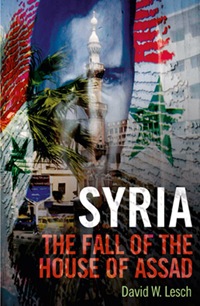
David Lesch - Syria - The Fall of the House of Assad - bannerWhen Bashar al-Assad became president of Syria upon his father's death in 2000, many people had high hopes for this young man who gave up his passion for ophthalmology to lead his country. Many expected al-Assad to embark on a series of reforms and lead Syria to a more progressive future.

A decade later and the oppressive and powerful Syrian security-military apparatus reacted with increasing brutality to the Syrian uprisings that were part of the region-wide Arab Spring. Almost two years later and the country remains in the grip of a devastating civil war.

What went wrong in Syria, the country that once held the highest hopes of progression and reform in the region? Author David W. Lesch enjoyed exclusive access to Assad as a leading Middle East scholar and consultant between 2004 and 2009 and in Syria: The Fall of the House of Assad, Lesch goes into detail about the rise and fall of the house of Assad.

Syria: The Fall of the House of Assad is by turns quite fascinating. It begins with a discussion of al-Assad's first years in office, the Damascus Spring and the increasing international pressure following 9/11 and the assassination of former Prime Minister of Lebanon, Rafic Hariri.

David Lesch - Syria - The Fall of the House of Assad - coverWith its secularism and the overwhelmingly positive perceptions of Syrians of Bashar al-Assad and his wife Asma, many thought that Syria would be immune to the effects of the Arab Spring. The next portion of the book discusses why many in the Syrian government, military and Assad's inner circle thought that Syria was different, including Assad himself. This is followed by a breakdown of precisely why Syria was no different to the rest of the countries in the region and the reasons behind the escalating protests.

The following two chapters are dedicated to the Syrian response to the uprisings compared to the mounting opposition and popular action that took place amid reports of increasing atrocities.

Of particular interest was the next section of the book dealing with the the often confounding international response. Lesch goes into some detail regarding the divisions within and between the member states in both the United Nations and the Arab League and their evolving affiliations to Syria during this time.

As the book draws to a close at the end of the summer of this year, what is particularly startling is that the government and president of Syria continue to give the same empty promises of reform and cooperation as they did two years ago.

Syria: The Fall of the House of Assad is an important book with valuable information covering both the background and current situation in Syria. The book does not go into much detail on the individual atrocities and massacres, other than to mention them and the consequences thereof, and the focus is on the background to the decisions made by key local, regional and international players.

It can be a little difficult to follow at times and the author does tend to jump back and forward in time, but I appreciate the layout of the book into clearly defined sections over the benefits that a strict chronological analysis would have brought.

I certainly recommend Syria: The Fall of the House of Assad to anyone interested in understanding the situation in Syria and would recommend it to academics and interested parties alike. Lesch makes a good attempt to present the book so that it will be accessible to non-academic readers.

Syria: The Fall of the House of Assad is available to purchase at  Amazon.co.uk and Amazon.com.

SHARE:

Sunday, 19 February 2012

Book Review: I’m Not Leaving by Carl Wilkens

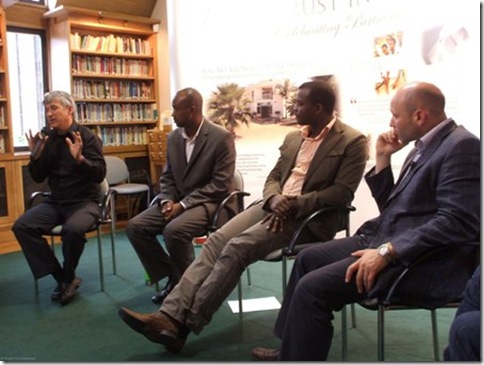
Carl Wilkens, Jean-Francois Gisimba, Freddy Mutanguha and James Smith

In 2011, I had the privilege of watching Carl Wilkens speak at the event "Rwanda: Strengthening Society Through Genocide Education” in London. It was a privilege not because Carl Wilkens was the only American to remain in Rwanda during the 1994 genocide and we got to hear about his experiences, but because his story was one of hope, inspiration and near-miracles in the face of incredible horror.

Carl Wilkens has written a book about his experiences in Kigali during the genocide and the decision he made to stay behind when most foreign nationals left. I’m Not Leaving is based on Wilkens’s recollections and almost 8 hours of cassette recordings that he made during that fateful time but he is keen to stress that this is not another book about genocide:

“While the stories written here happened during the genocide, this book is not really about genocide. It is more about the choices people made, actions people took, courage people showed, and sacrifices people gave in the face of genocide”.

In 1994, Carl Wilkens was director of the Adventist Development Relief Agency. On April 6, 1994, the presidential airplane was shot down as it prepared to land at Kigali airport, killing all on board including Presidents Juvénal Habyarimana and Cyprien Ntaryamira of Rwanda and Burundi respectively. The assassination was a catalyst that set off the genocide against local Tutsis and moderate Hutus.

I'm Not Leaving Carl Wilkens book coverIt was a catalyst, but not the cause. The genocide had been in preparation for months, if not years before, as lists were compiled and weapons stockpiled. In fact, it was on January 11, 1994 that the UN Force Commander in Rwanda, Canadian Lieutenant General Roméo Dallaire, warned his superiors of plans to exterminate Tutsis.

Carl Wilkens knew this and when his wife and three young children were evacuated on the morning of April 10, 1994, he made the decision to stay behind to ensure the safety of his Tutsi employees Anitha and Janvier. All of the foreign nationals were leaving Rwanda and the American embassy was closing for good. Not surprisingly, his decision to remain behind was not well received by his superiors at ADRA or the United States embassy and he had to stand up to both of them.

"I took one of Mindy's school notebooks, found a blank page, and wrote with a pencil: "I have refused the help of the United States government to leave Rwanda"

As an eyewitness account I’m Not Leaving gives a valuable insight into the situation in Kigali before and during the genocide. Wilkens reminds us that at the beginning of 1994, there were over a million refugees in Kigali due to the 1990-1993 Rwandan civil war and the October 1993 assassination of Burundi President Melchior Ndadaye. There was already a widespread humanitarian relief effort in Kigali at that time and Wilkens notes that their food stocks are what kept Kigali going during the genocide.

Wilkens also provides insight into the role of the UN peacekeeping soldiers that had been in Rwanda since August 1993. While acknowledging the work that they did do and the lives that they saved, Wilkens questions whether their presence gave Rwandans a false sense of security. He believes that their presence might have contributed to people not fleeing or protecting themselves in face of RTLM propaganda and hate speech.  

It seems incredible that there was so much inaction in the face of the genocide and that, as Wilkens notes in the final pages of the book, it was solely the actions of the Rwandan Patriotic Front that brought an end to the slaughter. This is especially notable as Wilkens transcribes a BBC report from April 24, 1994 (18 days after the start of the genocide) in which the term ‘genocide’ was already being used to describe the events in Rwanda.

It was in the second week of the genocide that Wilkens thought of recording his ideas and thoughts on a cassette recorder. He then dedicates the majority of the book to chronicle his incredible actions over the next three months. Nearly every day, Wilkens and other ADRA associates braved snipers and mortars to drive around the streets of Kigali bringing food and water to various orphanages around the city. He achieved this despite the ADRA headquarters being completely sacked.

"Soon you stop diving for cover each time you hear an explosion, realizing that you will never hear the one that kills you".  

There are times in I’m Not Leaving when my heart felt as though t might stop and the book is uncomfortable to read at times. This is an intimate account of service, faith and courage and I almost felt like a worthless bystander watching as people risked their lives to save others. Wilkens talks about real fear and I got that. I could feel it as I read the book and my chest began to tighten. 

In his ADRA vehicles and borrowed UN flak jacket, Wilkens achieved what no one else could achieve during the genocide. This man got into a neighbourhood like Nyamirambo to get food and water to two orphanages when the UN couldn't even get in. He talks about negotiating and pleading with genocidaires to save the life of Tutsis, how he got one Major Emmanuel to rescue 12 Tutsis. They were rescued as they knelt in prayer, with the killers standing with machetes raised above their heads, poised to strike.

He tells of the events at Gisimba orphanage where his intervention led to the rescue of hundreds of people as they were moved to the safety of Saint Michel church. He was then helped by government soldiers to pack up the orphans’ belongings and take them through to the church (you can read more about Carl Wilkens and Jean-Francois Gisimba talking about their recollections of that day here).

No matter how many lives were spared, Wilkens reminds us of the incredible loss of life:

"Such staggering losses, so enormous that it seems wrong for me to keep on writing without some sort of respectful pause". 

Indeed, there were times when I had to pause myself to respect the gravity of what I was reading. Since the end of the genocide, Carl Wilkens has dedicated his life to educating people about prejudice, genocide and entering the world of “the other”. I would really recommend that you check out his speaking schedule and take the time to see him speak when he is next in your town or city.  I’m Not Leaving was self-published and all proceeds go towards the educational efforts of his organisation WorldOutsideMyShoes.org (click to go straight to the purchase page). 

I’m Not Leaving is essential reading for anybody wanting to know more about the genocide in Rwanda.  If you are new to this topic, you might find it useful to read Jean Hatzfeld’s Life Laid Bare: The Survivors in Rwanda Speak, Roméo Dallaire's Shake Hands with the Devil: The Failure of Humanity in Rwanda or Philip Gourevitch's We Wish to Inform You That Tomorrow We Will be Killed With Our Families: Stories from Rwanda first to gain some insight into what happened during the 100 days of the genocide, how the genocide occurred, and the failure of the international community to stop it.

This is a self-published book without the benefit of professional editors or proof readers and as such, there are inevitable grammatical and spelling errors.  These are minor though and don’t detract from the unique and inspirational perspective provided by Wilkens in the book.

SHARE:

Sunday, 17 April 2011

Book Review: Treblinka Survivor: The Life and Death of Hershl Sperling by Mark S. Smith

Treblinka Survivor coverTreblinka was a Nazi extermination camp situated near the village of Treblinka in Poland.  Extermination or death camps were different to concentration camps in that they were never designed for the incarceration of prisoners but simply to expedite the efficient extermination of thousands of people at a time.  At a conservative estimate, over 850,000 people entered Treblinka Death Camp between July 1942 and October 1943 and less than seventy came out alive.

Hershl Sperling was one of the inmates who escaped during the Treblinka Uprising on Monday 2 August 1943.  Prisoners attacked the SS headquarters, destroyed petrol tankers, and set buildings alight.  They entered into the extermination portion of the camp, killing informants and attacking watchtowers before finally escaping through the perimeter fence and across the anti-tank defences.  Many of the survivors lost their lives within the camp, while crossing the anti-tank defences, or during the relentless pursuit through the surrounding woods and in fact, most of the escapees were caught and murdered within that first 24 hours.

Treblinka Concentration Camp Sign

Of the escapees that survived the woods and reached the surrounding houses, many were betrayed and handed over to the SS by local residents.  Yet a local family helped sixteen-year-old Hershl Sperling and two others by feeding them and helping them to escape to the south-west, towards Warsaw.  He made it to Warsaw but Sperling was eventually recaptured on a train and sent to Auschwitz via Radom, then on to Birkenau, Sachsenhausen, Kaufering and Dachau where he was liberated. 

By the time he was eighteen-years-old, Hershl Sperling had survived two Nazi death camps, five concentrations camps, the escape from Treblinka, a death march, starvation, malnutrition and slave labour.  What would cause a man who had survived the greatest horrors of the twentieth century to jump off a bridge in Scotland 44 years later?

Treblinka Survivor: The Life and Death of Hershl Sperling by Mark S. Smith is an attempt to understand what Hershl went through and the events that eventually lead up to his death.  Much of the book is based on Hershl’s own testimony (Treblinka by Hershl Sperling) which appeared in a journal published shortly after the war entitled From The Last Extermination: Journal for the History of the Jewish People During the Nazi Regime.  As an eyewitness testimony, this work is extremely valuable and is translated and published in full at the end of the book. 

WW2-Holocaust-Poland

Author Mark S. Smith was a childhood friend of Hershl’s son, Sam Sperling and the book follows four main storylines: Hershl’s life before and during the Holocaust, as related by him to his sons and through his written testimony; Hershl’s life and struggles after the Holocaust, as recalled by the author, his sons and others who knew him; the struggles and experiences of his sons Alan and Sam as they grew up in the house of Holocaust survivors; and finally, the experiences of the author as he travelled to Poland and America to research the book, with visits to the sites of Treblinka and Auschwitz.  

KZ Treblinka, Lageplan

Treblinka Survivor: The Life and Death of Hershl Sperling is an extremely well-written book.  It is an authentic historical account and not dry as one might imagine, but highly readable. Having said that, there were parts that I had to force my way through as the sense of horror builds and I realised that yet another mind-blowing revelation awaited me.

The book is especially powerful as the original testimony is interspersed with a huge body of research and the author's commentary.  It is also corroborated by the testimony of other camp survivors as well as the meticulous records kept by the Nazis. 

The accounts of life and death in Treblinka were shocking and may upset sensitive readers.  This is simply the most disturbing book I've ever read.  The accounts and descriptions were vivid and well-written and I found it hard to rid my mind of the images the book evoked.

Photo of Treblinka site from 1945, mass graves were disturbed, and bones and personal effects are visible

The sheer scale of the murder at Treblinka was astounding. Ten to fifteen thousand people were systematically murdered each day between July 1942 and October 1943.  This was no concentration camp, no internment or work camp: this was a death camp.  Hershl notes in his testimony that up to 24,000 were killed on one particularly ‘efficient’ day.

It is not surprising that I experienced nightmares and sleeplessness while reading this book and felt quite unable to think of anything else.

Treblinka - Rail tracks

This is a devastating and horrific book but an important one and one that I am glad to have read.  The account of how lost Hershl felt after the Holocaust and especially after the death of his wife, of his depression and struggles with alcoholism, seemed to highlight the depths of despair to which he sank.  Anyone who has ever suffered from acute depression might understand how Hershl could ever utter, "this is worse than Treblinka".

Caught in that twilight between death and dying for so long that his reactions were forevermore a manifestation of denial, bargaining, numbness and grief, it seems that Hershl Sperling never entirely escaped Treblinka.  The author explains that he was in a perpetual state of fight or flight, in the motion of the survival instinct.  Perhaps his suicide was one last stand to live or die at his own hands and not at the hands of the Nazis or the ghosts that haunted him.

Treblinka Memorial - each stone represented a community destroyed at Treblinka

Treblinka Survivor: The Life and Death of Hershl Sperling is a devastating book and it is certainly not for the faint of heart. It is, however, an important and authentic historical account of one of the great horrors of the Holocaust and I would certainly recommend it to anyone with a desire to know and understand what happened during that time.

I appreciated the author’s mentions of the genocides in Rwanda and Srebrenica as well as the on-going situation in Darfur.  It reminds us that genocide, mass murder and hatred did not end in 1945 but carried on with a destructive force right up to the present day.  It is important to know what happened during the Holocaust and even more so now as the last of the survivors begin to pass on. 

I cannot fault Treblinka Survivor: The Life and Death of Hershl Sperling and would wholeheartedly recommend this book in spite of the gruesome subject matter and the necessarily graphic descriptions that must accompany it.

I give Treblinka Survivor: The Life and Death of Hershl Sperling five out of five stars.

Purchase Treblinka Survivor: The Life and Death of Hershl Sperling at Amazon.co.uk ¦ Amazon.com.

Photo credits:

  1. Treblinka Concentration Camp sign at Yad Vashem (David Shankbone) (GNU Free Documentation License)
  2. Map of the Holocaust in Poland during World War II, 1939-1945 (Dennis Nilsson) (Creative Commons)
  3. KZ Treblinka, Lageplan (Commons:Bundesarchiv) (Creative Commons)
  4. Treblinka 1945 (Public Domain) (Wikimedia)
  5. The symbolic "remains" of the railroad in Treblinka (Little Savage) (Wikimedia Commons)
  6. Treblinka's Memorial in Winter (Little Savage) (Wikimedia Commons)
SHARE:
© A Passion to Understand

This site uses cookies from Google to deliver its services - Click here for information.

Blogger Template Created by pipdig