Saturday, 19 August 2023

Graphic Novel Review: The Photographer of Mauthausen by Salva Rubio, Pedro J Colombo & Aintzane Landa ★★★★★

Most online accounts of Ernst Kaltenbrunner and Albert Speer mention that they were convicted at the Nuremberg trials but few accounts mention the testimony and evidence provided by Francisco Boix that enabled those convictions. Nor do they mention the bravery and sacrifices of the people involved in preserving and delivering that evidence to the outside world.

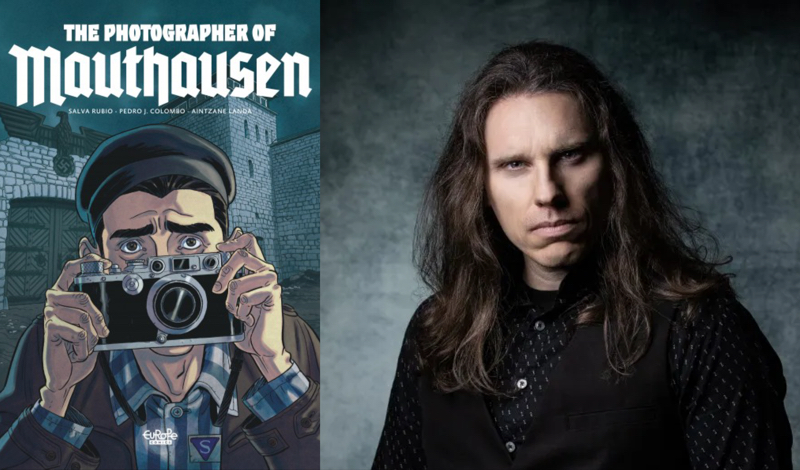
Graphic Novel Review | The Photographer of Mauthausen | cover and author photograph

The Photographer of Mauthausen by Salva Rubio (writer), Pedro J Colombo (illustrator) and Aintzane Landa (colourist) tells the story of Boix, a Spanish photographer and veteran of the Spanish Civil War. Following his part in the civil war, Boix was exiled to France and joined the French army before being captured by the Germans. The Photographer of Mauthausen starts with Boix's arrival at Mauthausen in 1941.

Boix starts off his internment as a translator but soon finds a position in the photography lab. Somehow, inexplicably, SS-Hauptscharführer Paul Ricken takes a liking to to Boix and recruits him as assistant to his macabre photography project. In this role, Boix is exposed to the many atrocities being committed at Mauthausen (in addition to the ones he had already witnessed).

Boix realises initially that this evidence needs to be preserved and several prisoners get involved in making this happen. However, as news reaches camp of an impending Russian victory, Boix realises that he needs to get proof of the atrocities to people on the outside of the camp.

Boix was successful and both his testimony and the photographic evidence proved that Nazis such as Kaltenbrunner and Speer were not only aware of what was happening at Mauthausen but they were complicit in the atrocities too.

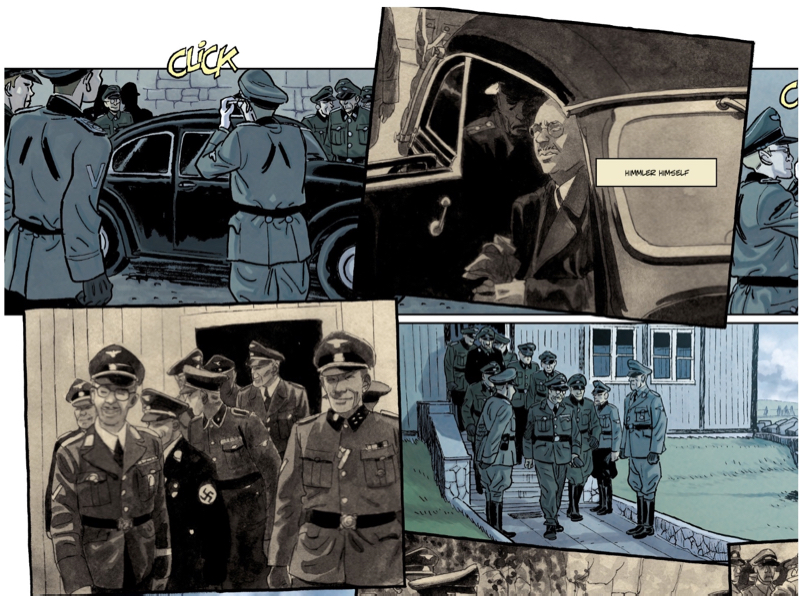
The value of The Photographer of Mauthausen is in the questions that it raises about justice and remembrance. At the time of the Nuremberg trials, the photos were used to obtain convictions but Boix expresses frustration on page in the graphic novel about why people weren't more concerned about what happened at Mauthausen and the atrocities committed.

Graphic Novel Review | The Photographer of Mauthausen | Page from graphic novel depicting the photographer capturing various Nazi officers

The Photographer of Mauthausen is an excellent graphic novel that tells, in an accessible format, an important story in the annals of Holocaust history while serving as an educational source on both Nazi atrocities and the trials following the war.

I give The Photographer of Mauthausen a superb five out of five stars. The graphic novel is extremely well illustrated and written and recommended for those interested in history, graphic novels and the Holocaust.

★★★★★

SHARE:

Thursday, 27 September 2012

Book Launch: Genocide Since 1945 by Philip Spencer

Tonight Philip Spencer talked at the Wiener Library in London about his book Genocide Since 1945. He gave an impassioned speech about what had made him become a scholar of genocide and why he wrote this book. He discussed Raphael Lemkin's struggle to comprehend why it was so difficult to bring the perpetrators of the Armenian genocide to justice, how this lead him to the naming and creation of the concept of genocide and how he lobbied the newly formed United Nations to make this act a crime under international law. Spencer noted how far we have come in such a short time from defining genocide to the International Criminal Tribunals and the establishment of the International Criminal Court.

What moved me the most about Spencer's talk was his focus on despair. I have often talked about my own despair, how the task of learning about genocide can seem so great, so unmanageable especially in the face of moral relativists, genocide deniers and others who seek to twist and rewrite history.

Spencer spoke of his own despair and the difficulty of drafting a book like this when the temptation is there to put it down as human nature and let the perpetrators get on with it.

He spoke of his obligation to the victims, those who can no longer speak for themselves or those who survived the vicious attacks. We need to speak up for them, to tell the world that it is not acceptable. We also need to speak up on behalf of the rescuers, those noble men and women who risk their lives to save others, who show that there is a choice and it is a crime to commit these acts. These are the people who show that there is hope for the future, and they are the ones who remain after the genocide to support the survivors and become their fellow citizens.

We need to continue learning about genocide causes and prevention in order to support and validate both victims and rescuers.

I spoke to Philip Spencer about Genocide Since 1945 and who his target market was with the novel. He explained that he had made the book as accessible as possible and it is certainly intended that his own university students would read it. The book contains an introduction to the concept of genocide and explains the differences between victims, perpetrators, bystanders and rescuers. Two full chapters are dedicated to case studies divided between the 'hidden' genocides of the Cold War era and those after. Each of the case studies carefully identifies victims and perpetrators with an important focus on intent. These chapters will be invaluable in understanding those genocides which have not formally been recognised or prosecuted.

Genocide Since 1945 is published by Routledge and available to purchase on www.routledge.com. For a limited time, you can use the discount code GEN45 to receive a discount of 20%.

SHARE:

Sunday, 10 June 2012

This Day In History: 10 June 1942

The Destruction of Lidice

On 10 June 1942, Nazi forces completely destroyed the Czechoslovakian town of Lidice which is located just north-west of Prague.  They surrounded the village and rounded all 173 of the men up, taking them to a local farm where they were all shot to death. The women and children were separated and unspeakable atrocities were then committed against them.  Four pregnant women had their unborn children forcibly aborted and they were then sent to concentration camps while the majority of the rest of the women were sent to work at Ravensbrück concentration camp where most of them perished. 

Lidice Children's MemorialLidice Children's Memorial. Photo credit: Moravice [Source]

Eighty-eight children were transported to the Polish city of Lodz, south-west of Warsaw.  Seven of them were selected for Germanisation but the rest were taken to nearby Chelmno on 2 July 1942 and were gassed to death. 

The village of Lidice was razed to the ground, buildings were destroyed and even graves in the cemetery were dug up and destroyed.  The absolute cleansing of Lidice was complete.

The Assassination of Reinhard Heydrich

Reinhard Heydrich was a Nazi official and one of the major architects of The Holocaust.  He spoke at the Wannsee conference in January 1942 where he called for Jews to gathered from across Europe to be worked to death in concentration camps or exterminated. 

He was assassinated on the morning of 27 May 1942 by British trained Czech and Slovak parachutists.  His death caused an intense stage of mourning amongst Nazi circles and Hitler called for the explicit destruction of any village found to be harbouring Heydrich’s killers.  He ordered that all males should be killed, women transported to a concentration camp, children Germanised or otherwise dealt with, and the village razed to the ground.

The Assassination of Reinhard HeydrichHeydrich’s car at scene of assassination. Photo credit: Bundesarchiv [Source]

Intelligence incorrectly linked the towns of the Lidice and Ležáky and Hitler’s orders were carried out to the letter in a terrible and brutal act of revenge carried out against innocent men, women and children.

Lidice Lives!

In the aftermath of Heydrich's assassination, Adolf Hitler is said to have proclaimed that “Lidice shall die forever!”  When he heard of Hitler’s plan to destroy Lidice and the terrible price that the people Lidice paid, a Labour MP in Stoke on Trent, England decided to start the Lidice Shall Live campaign.

Through his work, Lidice was rebuilt and a home created for the 153 women and 17 children who returned after the war.

You can read more about Barnett Stross’s work and the incredible generosity of the people of Stoke on Trent in helping to rebuild Lidice over at Dáithaí C’s blog: Lidice Lives.  You can also read about the anti-fascist art exhibition in Melbourne in 1942 (partly inspired by the events at Lidice) at the Art and Architecture, Mainly blog: Anti-Fascist Art Exhibition, Melbourne 1942

SHARE:

Saturday, 7 April 2012

Interview with Mark S Smith, Author of Treblinka Survivor: The Life and Death of Hershl Sperling

Treblinka Concentration Camp sign

Mark S. Smith is the author of Treblinka Survivor: The Life and Death of Hershl Sperling.  The book tells the story of Hershl Sperling, a man who survived the horrors of the Holocaust, only to take his own life 44 years later.  The paperback is due out in the US on May 1 and we spoke to Mark about his inspiration for writing this story, his journey to Poland, Islamism and rising Islamophobia, and genocide education and prevention.

Could you tell us a bit more about Treblinka Survivor: The Life and Death of Hershl Sperling? What inspired you you tell this story?

I began with the idea that I wanted to write something about anti-Semitism. Few Jews over the past two millennia have not been subjected to this vile phenomenon that is so deeply ingrained in European and more recently Middle Eastern cultures. I have been at the receiving end of it many times and so has my family, and I wanted to stick my oar in. 

I have always held the view, perhaps best expressed by Holocaust survivor and writer Primo Levi: “I can't bear how a man can be judged not for what he is but because of the group to which he happens to belong.” 

History teaches us that the consequences of hatred and discrimination are murderous and genocidal – 800,000 slain in Rwanda, two million Cambodians, 450,000 in Darfur, a million Armenians, six million Jews. An estimated four million Africans died chained in the belly of slave vessels en route to America. The list is continuous, the suffering incalculable, extending from the remotest days of human life to the present and forward into the future. Anti-Semitism, the theme of my book, is but one manifestation of evil. Yet it transfixes me – not only because I am a Jew, but also because it expresses the senseless self-loathing of Mankind. I wanted to analyze it and understand it, and, naively, cure it. 

I read volumes on the subject. I learned of the origins of anti-Semitism during the early days of Christianity, whose Gospels – violently anti-Jewish and political in nature – placed exceptional blame on the Jews for the death of Jesus. Their motive, conveniently circumventing the fact that Jesus died a Roman death on the cross, was self-interest – to demonstrate that the Christians had not shared Jewish disloyalty towards Rome during the revolt of 70AD. The words of the Gospels have had terrible consequences for Jews through the centuries. The attacks in the Koran are no less brutal for Jewish refusal to recognize Muhammad as a prophet. Muslims who cite these abuses to vindicate their own anti-Semitism disregard other Koranic passages which show respect for Jews and preach tolerance. I also saw how anti-Jewish vitriol through the ages – both Christian and Muslim – had been used by religious and political leaders to manipulate the herd. For many months, I churned my theme in my head, but I was a writer without a story. 

Then, one day in 2005, while the world was commemorating the 60th anniversary of the liberation of Auschwitz, my deliberations came to an end. I have been a journalist for more than a quarter of a century, and I recognize a good story when I see one. I was on the phone with Hershl's son, my friend, Sam, in London. 

Sam said: “You remember what my father used to say, ‘Auschwitz was nothing. Auschwitz was a walk in the park.’” 

It was a jarring remark. And I wondered how make sense of the pain of a man who felt "Auschwitz was nothing." 

I had known Hershl Sperling very well when I was a teenager. After all, he was my friend’s father. His death in 1989, a suicide from a bridge in the Scottish city of Glasgow, had shocked me. Suddenly, I saw him on that bridge and I was struck by the recollection of the blue-black number on his arm, his tattoo. He had survived almost everything the Nazis could throw at him – blitzkrieg, the ghetto, prison camps, work camps, concentration camps, death camps, death marches. He also survived Treblinka, the most murderous place on earth. Of the roughly one million souls who were transported there to die, Hershl Sperling was among 68 who survived. What had possessed him to take his own life almost fifty years later? 

Then Sam asked: “Did you know my father wrote a book after liberation?” I hadn’t known. 

“Have you read the book?” I asked. 

He hadn’t. It wasn’t until months later, after tracking down the work in an antiquarian bookshop in Jerusalem and getting it translated from the original Yiddish, that I discovered Hershl had, in fact, written just a part in this book, titled From the Last Extermination. His contribution, however, was called simply “Treblinka”. Only after reading it did I begin to understand the riddle of his suicide. In Treblinka, the most gruesome and efficient death machine ever known, the horror of Mankind’s self-loathing plunged to a terrifying nadir. 

So, I began with anti-Semitism and end up writing the story of my friend’s father.

In the book, you mentioned that Hershl's sons found it difficult to answer the questions that you needed to ask them.  Now that some time has passed, how does Hershl's family feel about the book and its success?

I know they are pleased their father's story did not disappear into history and that his testimony, his own words, was published for the first time in English as an appendix to my book. 

You researched the material for this book extensively, travelling to both Poland and America. If you look back on the process of writing your book, is there anything that you regret or that you wished had turned out differently?

This is a complicated question that needs to be answered at a number of levels. Hmm… the writing process. As I have mentioned, I began with the idea that I wanted to write something about anti-Semitism and consequences of racial hatred when it is manipulated and fanned for the purpose of controlling the herd. However, I really did not know my story until speaking with Sam, the son of the man who would eventually become the subject of my book. But the process of writing itself, the creation of the work beyond its basic structure, is mysterious to me. I had a sense of how I wanted it to be, what I wanted it to say and the effect I wanted it to have on the reader. Beyond that, it wrote itself, so I cannot truly say that regret any part of it or wish it turned out differently. I suspect it turned the way it was supposed to turn out.

In terms of information, however, there were things that came to light after the book was published, which I would have liked to include, had the timing been different.

There have been several significant developments since the book was published.

The first occurred several months after the book was published. I received a letter from the coroner who had been on duty the day Hershl's body was brought in. He had read my book and said he believed that Hershl had been in the water for perhaps several days. This contradicts the assertion of George Parsonage, the Glasgow Humane Society's lifeboat officer, who had pulled Hershl's body from the river into his rowboat. The coroner's contention raises the possibility that Hershl may not have spent as long wandering the streets of the city as we originally thought. If true, that means Hershl's suffering at the end was less, and I am glad about that. 

Hershl Sperling After Liberation

The second significant development has come from the recent work of British forensic archaeologist Caroline Sturdy Colls, who has unearthed fresh evidence to prove the existence of mass graves at the Nazi death camp Treblinka - scuppering the claims of Holocaust deniers who say it was merely a transit camp. The lack of physical evidence in the area has been exploited by Holocaust deniers, but the work of Caroline Sturdy Colls confirms Hershl's story and testimony, even to those haters who continue to deny and would rather it weren't true.

Could you tell us a bit more about your journey to Poland, to the areas that used to be Jewish but from which Jews had disappeared?

There is so much to tell and certainly not enough space here. I have been trying desperately to understand Poland without Jews. I travelled all over Poland while conducting research for the book. There have been Jews in Poland since the times of the first Crusade in the 11th century. 

Although my immediate family were not connected with Poland, the name on my maternal side, Kaminsky, has Polish roots. So Poland is in my blood.

At the same time, Poland is an integral part of Jewish history, my history.  There is no such thing as Jewish culture without Polish culture, and conversely there is no Polish culture without Jewish culture. I find it ironic that Jews first came to Poland because of its relative tolerance. Here they had their own language, religion, literature, music and even laws.

By the end of the 18th century, more than 70% of the world’s Jews lived in Poland. A visitor to to almost any small town or city in Poland for several centuries could not walk 10 feet down the street without bumping into a Jew.

Do you have any views on rising Islamophobia in Europe?

There is a striking photograph held in the archives of the United States Holocaust Memorial Museum in Washington DC, which was also used as the back cover of the paperback edition of my book, which is coming out in the U.S. on May 1. It shows a smirking German soldier lining up a group of Jews during the round up in the Polish city of Czestochowa. Almost certainly, none of the Jews in that picture survived. What fascinates me most is the look on this soldier's face. It encapsulates that vicious strand in European culture which has stigmatised, persecuted and murdered whoever could be categorised as different. This tradition in Christian Europe - and by extension in the U.S. - found perfect expression for its unquestioning superiority in its anti-Semitism and in its racism. While the Holocaust was a unique historical event, the racism and anti-Semitism that motivated it continue to flourish. Islamophobia is the latest manifestation.  Clearly, most Muslims are not terrorists. 

However, there is something else I'd like to say here, because while Islamophobia may have its roots in European prejudice, the picture since September 11, 2001 has become far more complex. Islamism, which I regard as an Islamic version of Nazism, has become a major force not just in Islam but in the non-Islamic world. In many ways I feel Islam and Islamism are opposites. 

Let me make my position clear. I have enormous respect for Muhammad, who was without doubt a unique and luminous individual. He was a warrior, a sovereign, a revolutionary and a sage. He was a great man by any standards. His achievements were huge and judging by the astonishing legacy he left behind in terms of the culture and the system of belief he set in motion, he is certainly one of the most extraordinary men to have ever lived. I have enormous respect for Mohammad and for Islam, and for the numerous benefits both have bestowed upon mankind. 

In the decade that has followed 9/11, we have heard much about a so-called civil war within Islam, between moderate, life-loving Muslims and Islamism. Well, until the Arab Spring, it seemed the civil war was over and the Islamists had won. Until recently, it seemed moderates were silent. Now they are speaking again, it places like Tunisia. This is progress not just for Tunisia, but for the world. 

So, although I have enormous respect for Muhammad and Islam, I have zero respect Islamism and the the followers of al Qaeda, which of course feeds Islamophobia in Europe. We can hardly be expected to respect Islamism, an ideology that calls only for our deaths here in the West. Islamism is as self-loathing as anti-Semitism and all racial discrimination, but it is also loaded with self-pity and self deception. Populations should always beware of political parties that have their roots its hatred and division, such as Egypt's Muslim Brotherhood. Anyone who doubts the aims of this group, should read history for themselves. Despite their place in the Arab Spring and attempts to be viewed as moderates, they are wolves in sheep's clothing and I am not afraid to say that they will promote further Islamophobia around the world and, to some extent, rightly so.

In your book, you mention the genocides in Rwanda, Srebrenica and Darfur which I especially appreciated given my interest in those situations. Do you have anything else to say about those situations?

Let me start with this… I know that my friend’s father tumbled from that bridge at least partly because the trauma of Treblinka had become a part of his very being and he could never be cured, but I suspect also that he understood the world could not be cured either.

By this I mean that there must be hundreds of thousands of Hershl Sperlings in places like Darfur, Rwanda, Cambodia, Iraq and Afghanistan, people whose families have been murdered and whose emotions have been lacerated and brutalized, and whose suffering did not end when the news stopped.

Do you think that enough is done to discuss and prevent genocide?

I don't believe we can ever stop people behaving savagely toward one another. The herd can always be manipulated. But I believe that more we understand this human phenomenon, the greater our chances of reducing it.

Anti-Semitism and racism in general are diseases passed from one generation to another. Yet the optimist in me knows that no child is born an anti-Semite or a racist. I paraphrase others when I say I do not know what a Jew is – or for that matter a Christian, a Chinese, a Muslim or even a Pygmy – I recognize only human beings. It occurs to me that every time we resist hatred and each time we teach tolerance to our children, we make the future of the world that much better. 

I put this idea to Sam, Hershl’s son. He sighed and said: ‘I think that’s too much to hope for.”


Thank you to Mark for taking the time to participate in this interview and for the incredibly detailed responses.  Read the review at: Book Review: Treblinka Survivor: The Life and Death of Hershl Sperling by Mark S. Smith.  You can purchase the paperback of Treblinka Survivor: The Life and Death of Hershl Sperling at Amazon.com or Amazon.co.uk.

SHARE:

Sunday, 17 April 2011

Book Review: Treblinka Survivor: The Life and Death of Hershl Sperling by Mark S. Smith

Treblinka Survivor coverTreblinka was a Nazi extermination camp situated near the village of Treblinka in Poland.  Extermination or death camps were different to concentration camps in that they were never designed for the incarceration of prisoners but simply to expedite the efficient extermination of thousands of people at a time.  At a conservative estimate, over 850,000 people entered Treblinka Death Camp between July 1942 and October 1943 and less than seventy came out alive.

Hershl Sperling was one of the inmates who escaped during the Treblinka Uprising on Monday 2 August 1943.  Prisoners attacked the SS headquarters, destroyed petrol tankers, and set buildings alight.  They entered into the extermination portion of the camp, killing informants and attacking watchtowers before finally escaping through the perimeter fence and across the anti-tank defences.  Many of the survivors lost their lives within the camp, while crossing the anti-tank defences, or during the relentless pursuit through the surrounding woods and in fact, most of the escapees were caught and murdered within that first 24 hours.

Treblinka Concentration Camp Sign

Of the escapees that survived the woods and reached the surrounding houses, many were betrayed and handed over to the SS by local residents.  Yet a local family helped sixteen-year-old Hershl Sperling and two others by feeding them and helping them to escape to the south-west, towards Warsaw.  He made it to Warsaw but Sperling was eventually recaptured on a train and sent to Auschwitz via Radom, then on to Birkenau, Sachsenhausen, Kaufering and Dachau where he was liberated. 

By the time he was eighteen-years-old, Hershl Sperling had survived two Nazi death camps, five concentrations camps, the escape from Treblinka, a death march, starvation, malnutrition and slave labour.  What would cause a man who had survived the greatest horrors of the twentieth century to jump off a bridge in Scotland 44 years later?

Treblinka Survivor: The Life and Death of Hershl Sperling by Mark S. Smith is an attempt to understand what Hershl went through and the events that eventually lead up to his death.  Much of the book is based on Hershl’s own testimony (Treblinka by Hershl Sperling) which appeared in a journal published shortly after the war entitled From The Last Extermination: Journal for the History of the Jewish People During the Nazi Regime.  As an eyewitness testimony, this work is extremely valuable and is translated and published in full at the end of the book. 

WW2-Holocaust-Poland

Author Mark S. Smith was a childhood friend of Hershl’s son, Sam Sperling and the book follows four main storylines: Hershl’s life before and during the Holocaust, as related by him to his sons and through his written testimony; Hershl’s life and struggles after the Holocaust, as recalled by the author, his sons and others who knew him; the struggles and experiences of his sons Alan and Sam as they grew up in the house of Holocaust survivors; and finally, the experiences of the author as he travelled to Poland and America to research the book, with visits to the sites of Treblinka and Auschwitz.  

KZ Treblinka, Lageplan

Treblinka Survivor: The Life and Death of Hershl Sperling is an extremely well-written book.  It is an authentic historical account and not dry as one might imagine, but highly readable. Having said that, there were parts that I had to force my way through as the sense of horror builds and I realised that yet another mind-blowing revelation awaited me.

The book is especially powerful as the original testimony is interspersed with a huge body of research and the author's commentary.  It is also corroborated by the testimony of other camp survivors as well as the meticulous records kept by the Nazis. 

The accounts of life and death in Treblinka were shocking and may upset sensitive readers.  This is simply the most disturbing book I've ever read.  The accounts and descriptions were vivid and well-written and I found it hard to rid my mind of the images the book evoked.

Photo of Treblinka site from 1945, mass graves were disturbed, and bones and personal effects are visible

The sheer scale of the murder at Treblinka was astounding. Ten to fifteen thousand people were systematically murdered each day between July 1942 and October 1943.  This was no concentration camp, no internment or work camp: this was a death camp.  Hershl notes in his testimony that up to 24,000 were killed on one particularly ‘efficient’ day.

It is not surprising that I experienced nightmares and sleeplessness while reading this book and felt quite unable to think of anything else.

Treblinka - Rail tracks

This is a devastating and horrific book but an important one and one that I am glad to have read.  The account of how lost Hershl felt after the Holocaust and especially after the death of his wife, of his depression and struggles with alcoholism, seemed to highlight the depths of despair to which he sank.  Anyone who has ever suffered from acute depression might understand how Hershl could ever utter, "this is worse than Treblinka".

Caught in that twilight between death and dying for so long that his reactions were forevermore a manifestation of denial, bargaining, numbness and grief, it seems that Hershl Sperling never entirely escaped Treblinka.  The author explains that he was in a perpetual state of fight or flight, in the motion of the survival instinct.  Perhaps his suicide was one last stand to live or die at his own hands and not at the hands of the Nazis or the ghosts that haunted him.

Treblinka Memorial - each stone represented a community destroyed at Treblinka

Treblinka Survivor: The Life and Death of Hershl Sperling is a devastating book and it is certainly not for the faint of heart. It is, however, an important and authentic historical account of one of the great horrors of the Holocaust and I would certainly recommend it to anyone with a desire to know and understand what happened during that time.

I appreciated the author’s mentions of the genocides in Rwanda and Srebrenica as well as the on-going situation in Darfur.  It reminds us that genocide, mass murder and hatred did not end in 1945 but carried on with a destructive force right up to the present day.  It is important to know what happened during the Holocaust and even more so now as the last of the survivors begin to pass on. 

I cannot fault Treblinka Survivor: The Life and Death of Hershl Sperling and would wholeheartedly recommend this book in spite of the gruesome subject matter and the necessarily graphic descriptions that must accompany it.

I give Treblinka Survivor: The Life and Death of Hershl Sperling five out of five stars.

Purchase Treblinka Survivor: The Life and Death of Hershl Sperling at Amazon.co.uk ¦ Amazon.com.

Photo credits:

  1. Treblinka Concentration Camp sign at Yad Vashem (David Shankbone) (GNU Free Documentation License)
  2. Map of the Holocaust in Poland during World War II, 1939-1945 (Dennis Nilsson) (Creative Commons)
  3. KZ Treblinka, Lageplan (Commons:Bundesarchiv) (Creative Commons)
  4. Treblinka 1945 (Public Domain) (Wikimedia)
  5. The symbolic "remains" of the railroad in Treblinka (Little Savage) (Wikimedia Commons)
  6. Treblinka's Memorial in Winter (Little Savage) (Wikimedia Commons)
SHARE:

Tuesday, 15 March 2011

Heinrich Himmler Issues Jewish Extermination Orders

Reichsführer-SS Heinrich Himmler gave this speech on October 4, 1943 is Poznan, Poland.  He didn’t imply or suggest but openly and explicitly called for the extermination and destruction of the Jewish people.  He ranted about theft and enrichment but stated that it was a moral good to rid the Germany people of their enemy and that ultimately, their souls would not be tarnished by this action. 

SHARE:
© A Passion to Understand

This site uses cookies from Google to deliver its services - Click here for information.

Blogger Template Created by pipdig